Attack on Iran or an Economic Own Goal? The Truth Behind the Economic D-Day
Attack on Iran or an Economic Own Goal? The Truth Behind the Economic D-Day Presented on TV as the ultimate sanctions super-bomb in history, Operation Economic Outcast hides an embarrassing detail. From Canada to China, here is the invisible network of allies

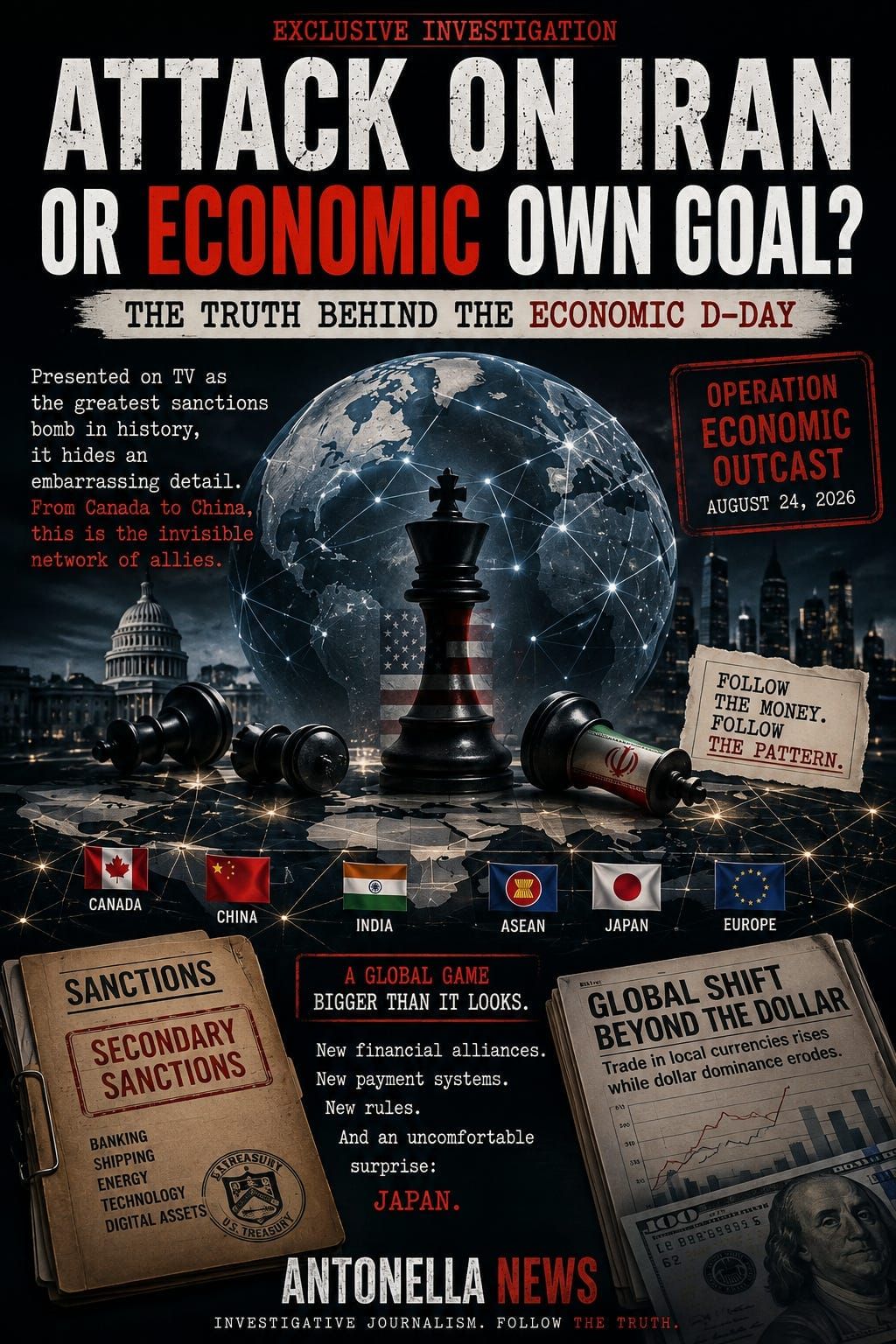
Presented on TV as the ultimate sanctions super-bomb in history, Operation Economic Outcast hides an embarrassing detail. From Canada to China, here is the invisible network of allies
Aug 26,2026
here is one word that almost always works on television: bomb. It requires no explanation and leaves no grey areas. It evokes power, destruction, superiority and, above all, a simple scene: someone possesses the weapon, someone else will suffer it. The audience only has to wait for the explosion.
And that is precisely how Alessandro Sallusti introduces America’s latest economic offensive against Iran: “America is about to announce an economic bomb of enormous power to be dropped on Iran.”
Then comes Diego Fabbri, director of Domino, explaining that Washington is preparing what is being presented as the most extraordinary sanctions machine in history: economically strangling Iran through secondary sanctions — in other words, not merely targeting Tehran, but exposing third-country actors that continue to keep certain economic circuits alive to the risk of exclusion from the US financial system.
The scene is perfect: we have the weapon, the target and even the countdown. It is almost too perfect. Because one detail is missing, the kind that changes the entire case file in a good investigation: looking at the whole scene.
As soon as we do, fingerprints appear that should not be there: allies reacting like targets, adversaries that do not appear as isolated as promised, and new financial infrastructures growing away from the spotlight. At that point, the story of the super-bomb begins to turn into another story.
Exhibit number one: Washington itself speaks as though the Normandy landings had begun
On 24 August 2026, the US Treasury did not use particularly restrained technical language. It christened the initiative “Economic D-Day” and formally launched Operation Economic Outcast, described as an unprecedented economic campaign against the Islamic Republic and its facilitators. (U.S. Treasury, 24 August 2026)
Scott Bessent explicitly compared the campaign to the D-Day landings of the Second World War, promising to sever Iran’s “economic lifelines” and make its isolation progressively more complete. The warlike framing, then, did not originate in a television studio: it came directly from Washington. (U.S. Treasury, Remarks on Operation Economic Outcast, 24 August 2026)
The US Treasury says it has mapped the nodes, facilitators and networks used by Iran to sell oil and evade restrictions; at the same time, it has expanded exposure to the risk of secondary sanctions in sectors including digital assets, technology, gold, aviation and shipping, while OFAC has designated nearly sixty individuals, companies and vessels. The message to third countries is simple: continuing certain relationships with Tehran may mean losing access to the US financial ecosystem. (U.S. Treasury, 24 August 2026; Reuters, 24 August 2026)
If you had already mapped everything, why are we still here?
Iran did not discover US sanctions in 2026.
OFAC maintains an Iranian sanctions architecture built over decades through executive orders, congressional legislation, financial, oil and trade restrictions. The new offensive, therefore, does not begin from a blank slate: it is another layer added to an already vast system. (OFAC, Iran Sanctions Program)
And yet Washington continues to identify intermediaries, shell companies, vessels, brokers, exchanges and new triangulations. On 7 August 2026, just seventeen days before Economic D-Day, the Treasury had already sanctioned two exchanges and a network of front companies accused of enabling the Iranian regime to launder and move billions of dollars in digital assets. On the same day, OFAC targeted further clandestine networks that, according to the Treasury, moved hundreds of millions of dollars through multiple countries. (U.S. Treasury, 7 August 2026)
Here we need to stop: previous sanctions have certainly damaged Iran, worsening inflation, currency shortages, investment difficulties and access to markets. But causing harm and achieving the strategic objective are not synonymous. If, after years of maximum pressure, Washington continues to discover billions moving through shadow banking, digital assets, opaque fleets and Asian intermediaries, it means the targeted system has developed at least a partial capacity to adapt.
The first red thread is therefore already visible: sanction → adaptation → new sanction → new adaptation. The medicine becomes stronger; the investigative question is why the dosage has to keep increasing.
Exhibit number two: the bomb has a problem called China
The principle of secondary sanctions seems very simple.
Trade with Iran? Washington can force you to choose: Tehran or the United States.
It works extremely well as long as the actor being intimidated has far more to lose than Washington.
Then Beijing arrives.
China has for years been the main buyer of Iranian oil.
And this is precisely where the rhetoric of “Economic D-Day” meets reality.
And this is precisely where the rhetoric of Economic D-Day meets its stress test. Reuters noted that Washington, despite its extremely aggressive language, has not yet used the option observers describe as almost “nuclear”: targeting major Chinese financial institutions involved in Iranian oil or technology transactions. On 24 August, Bessent reiterated that no one was beyond the reach of sanctions, but the initial absence of the major Chinese banks is a fact, not a theory. (Reuters, 24–25 August 2026)
The reason is not proven by a single document, but the risk is obvious: sanctioning a small intermediary is not the same as cutting off a major Chinese bank. Reuters explicitly notes that a move at that level could jeopardise the fragile trade truce with Beijing and trigger a Chinese response. This is where the secondary sanction stops being a one-way weapon and becomes a choice with blowback costs.
China had already been subjected to the Trump test
In 2025, the Trump administration exerted extremely strong tariff pressure on China. Chinese exports to the United States did in fact fall by around 20%: if we stopped the analysis at that bilateral corridor, the policy would appear to have produced the desired result.
But outside that corridor, the picture changes. In 2025, Chinese exports rose by 25.8% to Africa, 13.4% to ASEAN and 8.4% to the European Union; Beijing ended the year with a trade surplus close to $1.2 trillion, the highest ever recorded. (Reuters, 14 January 2026)
This does not mean US tariffs were irrelevant: Chinese companies faced costs, compressed margins and a difficult search for new markets. It does mean, however, that reducing access to the US market is not the same as isolating China from the rest of the world. Beijing reacted by redirecting part of its flows elsewhere: exactly what a complex system tends to do when one of its routes becomes more expensive. (Reuters, January–May 2026)
Exhibit number three: suddenly Canada is a problem too
Now let us move away from Iran and look at a name that should sound out of place on the list of targets: Canada. Not China, not Russia, not North Korea, but one of the economic, military and political partners most deeply integrated with the United States.
On 20 July 2026, Trump did in fact use Section 338 of the Tariff Act of 1930 — not the more common Section 232 or Section 301 — to impose additional 50% tariffs on nearly $20 billion of Canadian imports. Section 338 allows the president to respond to treatment deemed discriminatory against US commerce: the choice, rare and legally very specific, is confirmed directly by the USTR. (USTR, 20 July 2026)
When the new measures entered into force on 22 August, Ottawa put the value of the affected goods at C$27.6 billion. On 25 August, the Canadian government announced an equally explicit response: counter-tariffs “dollar for dollar, rate for rate”, effective from 8 September, accompanied by a new C$7.5 billion support package for workers and businesses. (Department of Finance Canada, 25 August 2026)
Technically, these are not OFAC sanctions: they are tariffs and trade countermeasures. Confusing the two instruments would be a mistake. But they belong to the same broader repertoire of economic coercion, because they use access to the US market as negotiating leverage. And this is what makes the Canadian case politically important: economic pressure is not exercised only against strategic adversaries, but can enter the ordinary management of relations with an ally.
The problem is that Canada can respond
In 2025, US-Canada trade in goods was worth about $715.5 billion; including services, the total estimated by the USTR rose to $872.3 billion. Supply chains are deeply intertwined, particularly in automotive, energy and agricultural products. (USTR, Canada Trade Summary)
Material dependence is also real: in 2025 Canada remained the leading source of crude oil imported by the United States, at around 3.9 million barrels per day; the USGS also reports that roughly 90% of US net potash imports came from Canada in 2023. These figures do not mean Ottawa can easily “win” a trade war, but they show why the damage cannot be treated as unilateral. (EIA, 29 July 2026; USGS, 2025)
A trade war between systems this integrated does not work like a long-distance bombardment: it is more like throwing a grenade into a room both sides share. The proportions of the damage may differ, but shrapnel does not ask for a passport.
And who pays the bill in the United States?
US tariffs generate public revenue, but they are paid at customs by US importers; how the cost is then distributed among suppliers, companies and consumers is an empirical question, not a slogan.
A Federal Reserve FEDS Note published on 5 March 2026 found that, by December 2025, retail prices of goods imported from China were around 8.5% higher than a year earlier and estimated consumer pass-through of at least 28–32% for those products. A second Fed analysis, dated 8 April, estimates that tariffs introduced in 2025 had cumulatively raised core-goods PCE prices by 3.1% by February 2026 and overall core PCE by 0.8%. (Federal Reserve Board, 5 March and 8 April 2026)
This is not an estimate from Beijing or from a think tank hostile to Trump: these are analyses published by the Board of Governors of the Federal Reserve, which nevertheless specifies that FEDS Notes represent the authors’ views and not an official position of the FOMC.
And the manufacturing renaissance?
It was one of the great promises: tariffs, reshoring, new factories and American jobs. Yet by December 2025 manufacturing employment had recorded eight consecutive months of decline, with more than 70,000 jobs lost since April. (Reuters, 9 January 2026)
This does not mean no factory grew or that every indicator is negative: in January 2026 the manufacturing PMI temporarily returned to expansion. Precisely for this reason, the balance must be described as mixed, not as total catastrophe and not as a demonstrated manufacturing boom.
The International Monetary Fund, in its 2026 Article IV consultation on the United States, estimates that the overall tariff package reduces the level of US GDP by around 0.6% in 2026–27 and has a relatively modest effect on the trade deficit. The IMF itself describes tariffs as a negative supply-side shock, while acknowledging that they generate fiscal revenue. (IMF Country Report No. 26/76, March 2026)
So the question becomes unavoidable: why should we assume that increasing coercion further will automatically produce better results?
But the real case is not at the border
So far we have followed Iran, China, Canada, American consumers, factories and tariffs.
But the trail leads elsewhere.
Into the pipes through which the world’s money moves.
For decades, a fundamental part of US coercive capacity has rested on the centrality of the Western financial ecosystem.
Here we need to clarify a common misunderstanding.
SWIFT is not American: it is headquartered in Belgium, is a member-owned cooperative, and neither holds funds nor manages accounts. It provides messaging and standards through which financial institutions exchange instructions. US leverage therefore derives from a broader ecosystem — the dollar, correspondent banking, clearing, US markets, access to American banks, jurisdiction and OFAC — within which SWIFT is a fundamental node but does not constitute the entire system. (SWIFT, About us)
This clarification does not weaken our investigation. It makes it much more interesting.
Because the question is no longer: “who will replace SWIFT?”
The question becomes: “how many functions can progressively be performed without always passing through the same nodes?”
And this is where the side roads appear on the scene
Let us start with China.
In July 2026 alone, CIPS processed 837,000 renminbi payments worth RMB 19.4 trillion; between January and July, 5.232 million transactions worth RMB 120.3 trillion. This is significant volume, but it must be handled correctly: CIPS data are not directly comparable with the number of SWIFT messages, because the two infrastructures measure different activities. The evidentiary point is not that CIPS has “overtaken” SWIFT, but that an autonomous cross-border RMB clearing and settlement infrastructure now exists on a growing scale. (CIPS, January–July 2026 data)
Then comes ASEAN
Here the phenomenon becomes even harder to dismiss as a “Chinese project”.
Indonesia, Malaysia and Thailand have harmonised the Local Currency Transaction Framework, while ASEAN has accelerated Regional Payment Connectivity. The operational figure is striking: in 2025 cross-border payment linkages in the region rose from 18 to 28; cross-border QR volumes increased by 190% and P2P volumes by 41% compared with the first half of 2024. A subsequent review by Malaysia’s central bank refers to 29 linkages by the end of 2025. (Bank Negara Malaysia/BIS, February–May 2026)
These are not PowerPoint slides: these are infrastructures already being used by people and businesses. And the stated motive is not simply ideological. In February 2026, the governor of Bank Negara Malaysia explicitly described a broader regional financial architecture as “risk management, not ideology”; in the same speech, he referred to the objective of reducing concentration risk through orderly diversification. The BIS itself observes that 2022 marked a turning point towards greater renminbi credit in Asia-Pacific, coinciding with monetary tightening cycles in the United States and the euro area. (BIS/Bank Negara Malaysia, February 2026)
People and businesses are already making payments through them.
Indonesia–South Korea: April 2026
From 1 April 2026, Indonesia and South Korea officially linked their QR systems to enable direct payments.
Transactions are conducted directly in the two countries’ local currencies, without the need first to convert into the traditional intermediary currency.
One transaction does not bring down American hegemony. Nor does a million.
But every new infrastructure introduces something that did not exist before: the ability to choose.
And it is this word — choice — that we need to follow.
India too is building a second track
The Reserve Bank of India has formalised a system allowing international trade to be invoiced and settled directly in rupees through Special Rupee Vostro Accounts.
In April 2026, the RBI was still describing it, very cautiously, as a complementary rather than substitutive system relative to freely convertible currencies.
And it is precisely this caution that makes it significant.
They are not saying: “bring down the dollar”.
They are saying: “add another option”.
India has also concluded local-currency settlement arrangements with the United Arab Emirates, Indonesia, the Maldives and Mauritius, and has integrated UPI/RuPay with several countries.
Once again: not revolution. Redundancy.
And what does the BIS see?
Here we have a source that is difficult to dismiss as anti-American propaganda: the Bank for International Settlements.
The BIS provides another trace that is difficult to dismiss as propaganda: from the first quarter of 2021 to the first quarter of 2025, cross-border bank credit in renminbi to emerging economies increased cumulatively by $373 billion, while dollar-denominated credit to the same group decreased cumulatively by $257 billion. The BIS attributes much of the phenomenon to Asia-Pacific and links the 2022 turning point in part to US and European monetary tightening. (BIS International Banking Statistics, July 2025)
By the end of 2025, moreover, the share of cross-border credit to EMDEs denominated in currencies other than the main reserve currencies had risen from 21% in 2019 to 29% in 2025.
At the same time, the BIS continues to record very strong growth in dollar- and euro-denominated credit.
The dollar is not disappearing. But other currencies are growing within the same system.
That is precisely the point.
The thermometer problem
SWIFT remains enormous: it connects more than 11,500 institutions in over 200 countries and territories and continues to describe itself as the leading infrastructure for secure financial messaging. For precisely this reason, it would be methodologically wrong to proclaim the “end of SWIFT” today. But it would be equally wrong to use SWIFT traffic alone as an exhaustive census of all cross-border payment and settlement methods while directly connected domestic networks, regional systems, CIPS and multi-currency solutions are expanding. (SWIFT, 2026)
But using SWIFT data alone to measure the entire universe of global transactions is becoming equally problematic.
Imagine a city that for forty years had a single major motorway. If ring roads, railways, underground systems and regional roads are gradually built, counting only the traffic on the motorway will continue to tell us how heavily that motorway is used, but it will no longer describe the city’s entire mobility on its own. The methodological problem is the same: SWIFT data measure SWIFT traffic very well; the more external or complementary infrastructures grow, the less those data can be used alone as a complete picture of the global system.
Then Tokyo appears. And this is where the ideological alibi collapses
Up to this point, the objection is predictable: of course Iran, China or other countries under US pressure seek alternative routes. It would almost be strange if they did not. Then, however, a name appears in the case file that should not be there: Japan.
Tokyo is not an adversary of the United States. It is one of Washington’s most deeply integrated strategic allies, hosts US forces, depends on the American security umbrella and, in June 2026, remained the largest foreign holder of US Treasuries, with around $1.117 trillion. In August, moreover, Japan’s Ministry of Finance carried out a coordinated foreign-exchange intervention with the US Treasury to support the yen, while also announcing its intention to use the Federal Reserve’s FIMA Repo Facility in the future.
If we were looking for proof of a break with the American system, Japan would therefore be the worst possible candidate. And that is precisely why it becomes one of the most important exhibits in the entire investigation.
In December 2025, Japan’s Ministry of Finance and Bank Indonesia renewed and expanded their framework for yen-rupiah local-currency transactions. The mechanism, launched in 2020 and initially limited to trade and direct investment, was extended to all bilateral economic transactions. Bank Indonesia then translated it into new operational rules that entered into force on 25 May 2026: special rupiah and yen accounts, transfers, financing, spot, forward, swap, cross-currency swap and other instruments can be used to settle economic relations between the two countries directly.
The official language matters. Tokyo and Jakarta do not describe the project as an attack on the dollar, but as a tool to develop financial markets, improve transaction efficiency and increase “macroeconomic resilience”. In other words: redundancy, not revolution.
And Indonesia is not an isolated case. In March 2026, the Bank of Japan and the Bank of Thailand renewed for another three years a bilateral local-currency swap of 240 billion baht or 800 billion yen, designed to allow the two central banks to provide liquidity directly in their respective currencies to financial institutions engaged in cross-border transactions. At the same time, under Japan’s 2026 ASEAN+3 co-chairmanship, Tokyo promoted a new regional discussion on cross-border digital payments and interoperability, asking AMRO to study their implications and risks.
Here the pattern changes in nature. Iran and Russia seek alternative routes because they are sanctioned; China because it wants strategic autonomy; ASEAN because it wants resilience. Japan, by contrast, shows that the same logic can coexist perfectly well with a very close American alliance.
They are not leaving the dollar system. They are doing something much subtler: remaining deeply inside the American system while increasing the possibility of carrying out
some regional operations without necessarily having to use the dollar as an intermediary currency.
This is perhaps the best definition of selective de-monopolisation: not abandoning the centre, but reducing the number of situations in which that centre is the only available route.
Then Brussels arrives. And the trail definitively stops being only Asian
If this story concerned only Iran, Russia, China and the BRICS, Washington could dismiss it as: “our adversaries are trying to circumvent our sanctions”.
Then Brussels appears — a political and economic ally of Washington and a pillar of the Western order.
And this is where the picture changes once again.
A Council of the European Union document explicitly uses the expressions “geopolitical fragmentation” and “weaponised finance”, links strengthening the international role of the euro to European strategic autonomy, and describes a gradual movement towards a more multipolar monetary system, citing among the factors concerns about US policies. It is not an anti-American manifesto: that is precisely why it is an important exhibit. Brussels is thinking in terms of resilience, freedom of choice and risk management. (Council of the EU, ST-16145-2025-ADD-1)
Even judges have entered the financial battlefield
Another episode makes the expression weaponised finance concrete.
The United States has imposed sanctions on officials and judges of the International Criminal Court — the ICC, not the International Court of Justice — through Executive Order 14203 and subsequent designations. In June 2025, a Council of the EU note proposed by Slovenia explicitly identified the European Blocking Statute as one of the instruments to consider in order to protect an EU judge and the Court; on 6 March 2026, two sanctioned ICC judges, Slovenian and French, attended the EU Justice Council and described the consequences of the measures on their daily lives. (Council of the EU, 18 June 2025; 6 March 2026)
Here abstraction ends: financial infrastructure is perceived not only as a technical means of transferring money, but also as a potential instrument of foreign policy. And when infrastructural dependence is perceived as a vulnerability, even allies begin to think about countermeasures and redundancy. A new form of “economic warfare” even among so-called “allies”.
Warning: now let us try to demolish our own thesis
Is the dollar still dominant? Yes.
Do US financial markets remain enormously attractive? Yes. In 2025 foreign investors made record net purchases of roughly $1.55 trillion in US securities, including equities and bonds.
Does international dollar credit continue to grow? Absolutely yes.
Does SWIFT remain fundamental? Yes.
Has CIPS replaced SWIFT? No.
Is there a BRICS currency ready to replace the dollar? No.
Do US sanctions continue to inflict enormous damage? Yes.
Here is the methodological point: none of these answers demolishes our thesis, because the thesis is not the death of the dollar, the disappearance of SWIFT or the imminent collapse of Wall Street. We are looking for a different variable: the gradual loss of indispensability of certain nodes and, with it, the possible reduction in the marginal coercive power that comes from being the mandatory passage.
The loss of indispensability
It is possible that ten years from now the dollar will still be the world’s number-one international currency.
It is possible that SWIFT will remain the world’s leading financial-messaging network.
It is possible that Wall Street will remain the world’s leading financial centre.
And at the same time it may be true that an Indonesia–South Korea transaction can be settled directly in local currencies; an Indian company can use INR; regional ASEAN trade can avoid an intermediary currency; an RMB payment can pass through CIPS; new fast-payment systems can connect directly; Europe can increase the international use of the euro.
No one has replaced the American system.
But something has changed.
The American system is no longer necessarily the only available route for every function.
And this is a much more sophisticated transformation than the word “de-dollarisation”.
We can call it selective de-monopolisation: not a new monopoly replacing the previous one, but a growing plurality of routes, currencies and infrastructures that leaves the American system dominant in the aggregates while reducing, transaction by transaction, the number of cases in which it is the only practicable option.
And now, finally, we arrive at the real crime scene
Let us return to 24 August.
Scott Bessent announces: Economic D-Day.
Every country will have a deadline.
Anyone who economically assists Iran risks exclusion from the American system.
The Treasury promises to close every route.
Television shows us the weapon.
But we did the one thing this story required from the beginning: we followed the cables. And then the money.
And those cables took us from Tehran to Beijing; from Beijing to Jakarta; from Jakarta to Tokyo; from Tokyo to Bangkok; from Bangkok to Mumbai; from Mumbai to Brussels; from Brussels to Ottawa.
And along the way we found a pattern that no single statistic on the dollar or SWIFT can tell on its own.
The more Washington uses access to its system as an instrument of coercion, the greater the strategic value for others of possessing at least one alternative.
This does not mean the United States is going to lose its hegemony tomorrow morning.
It means something more interesting: the cost required to exercise it may be rising.
The paradox of the super-sanction
Look at the sequence as an investigator looks at a chain of events: sanctions → adaptation → new intermediaries → secondary sanctions → new settlement methods → new coercion → greater incentive to diversify → new infrastructures. We cannot yet prove that every arrow is causally determined by the one before it; we can, however, document that these phenomena are coexisting and, in several cases, that the authorities themselves describe them in terms of resilience, concentration risk and weaponised finance.
If this circuit continues to be confirmed by the data, we will be looking at a genuine geopolitical feedback loop.
Coercion used to protect the centrality of the system can contribute to increasing the economic value of alternatives to that system.
And then the reading of the new offensive against Iran changes too.
Perhaps the “most extraordinary sanctions machine in history” demonstrates the extraordinary power of the United States.
But perhaps it simultaneously demonstrates something Washington would rather not emphasise: an ever larger machine is needed because there are ever more routes to close.
And Canada gives us the final contradiction
Within a matter of days, Washington economically threatens Iran; warns third countries that they may be targeted; enters a new trade escalation with Canada; and watches a growing worldwide network of regional financial infrastructures.
A hegemonic power can certainly afford to exert pressure on many fronts at once.
The question is: for how long, without increasing the cost to itself as well?
Because American taxpayers are not watching this game from a neutral grandstand.
Part of the impact passes through prices, industrial inputs, supply chains, retaliation, exports, interest rates and employment.
The finger, the moon and the bomb that comes back
The television story is simple: Washington has an economic bomb, Iran is the target, and we wait to see whether it will be brought to its knees. The story that emerges from the documents is more complex. The United States still possesses enormous financial power, but every coercive use of that power generates reactions: sometimes hostile, sometimes opportunistic, very often simply rational, because reducing the risk of depending on a single node is an elementary form of strategic insurance.
China, India, ASEAN and Japan do this in different ways; Europe discusses it openly; even SWIFT is investing in new interoperable and tokenised mechanisms. There is no headquarters of the “revolt against the dollar”, and perhaps that is precisely the point: each actor is building redundancy for its own reasons.
Perhaps, then, the future competitor to American coercive capacity will not necessarily be a single superpower, the yuan or some hypothetical BRICS currency. It could be the multipolar architecture itself: a structure in which the dollar remains powerful, SWIFT remains central and Washington remains indispensable for many operations — but progressively not for all of them.
And this is precisely what we will analyse in the next AntonellaNEWS research paper. We will not look for the date of the dollar’s death or announce SWIFT’s funeral: we will follow the money, mapping CIPS, ASEAN, the rupee, regional clearing, payment linkages, local currencies, European infrastructures and interoperable systems to answer a question that reserve-currency shares alone cannot resolve.
How much power does a hegemonic power retain when the world continues willingly to use its system, but progressively learns not always to need it?
Perhaps, then, the news of 24 August is not simply that Washington possesses a larger economic bomb.
Perhaps the real news is something else, far less reassuring: to produce the same effect, Washington appears to need to build ever larger economic bombs while the rest of the world, without proclamations and without a common command centre, continues to build more emergency exits.
The next case file
This dossier opens the trail. The next AntonellaNEWS research paper will enter the engine room: we will map payment routes, currencies, clearing, CIPS, ASEAN, European infrastructures and degrees of exposure to US jurisdiction in order to measure not the supposed “death of the dollar”,
but the progressive loss of indispensability of the nodes through which Washington exercises its financial coercion.
IF THIS INVESTIGATION WAS USEFUL TO YOU
If this work helped you see the moon beyond the finger, share it with those who still read geopolitics as a sequence of slogans. Leave your opinion in the comments and, if you want to make independent investigations and research papers like this possible, subscribe.
And if you want to support the work of AntonellaNEWS — independent research, OSINT, dossiers and in-depth analysis without editorial sponsors dictating the line — you can support the project with a subscription. It is the most concrete way to allow this investigation, and the next ones, to continue.
Methodological note
Data updated to 26 August 2026. Primary sources are prioritised for acts, data and statements; Reuters and other journalistic sources are used for reconstruction and context. Tariffs, primary sanctions and secondary sanctions are distinguished in the text. Volumes from different infrastructures (for example CIPS and SWIFT) are not treated as directly comparable when they measure different units. Correlations are identified as such where there is insufficient evidence to attribute causation.
Sources
U.S. Department of the Treasury/OFAC, Operation Economic Outcast and Iran releases, 7 and 24 August 2026; USTR, Section 338 tariffs on Canada, 20 July 2026; Department of Finance Canada, countermeasures, 25 August 2026; Federal Reserve Board, FEDS Notes, 5 March and 8 April 2026; IMF, United States 2026 Article IV, Country Report No. 26/76; Reuters, Iran/China/Canada and Chinese trade, January–August 2026; CIPS, Business Statistics, January–July 2026; BIS International Banking Statistics and Bank Negara Malaysia speeches, 2025–2026; SWIFT, corporate and payments infrastructure materials, 2025–2026; Council of the European Union, ST-16145-2025-ADD-1 and ST-10504-2025-INIT; U.S. EIA and USGS for US-Canada energy and potash interdependencies. Ministry of Finance Japan and Bank Indonesia, bilateral yen-rupiah framework, December 2025 and operational regulation May 2026; Bank of Japan/Bank of Thailand, bilateral local currency swap, 30 March 2026; Ministry of Finance Japan, ASEAN+3 initiatives on cross-border digital payments, July 2026; U.S. Treasury TIC, major foreign holders of Treasuries, June 2026; Ministry of Finance Japan, coordinated US-Japan foreign-exchange intervention, 3 August 2026.