THE DOLLAR IS NOT DYING. SOMETHING MORE IMPORTANT IS HAPPENING

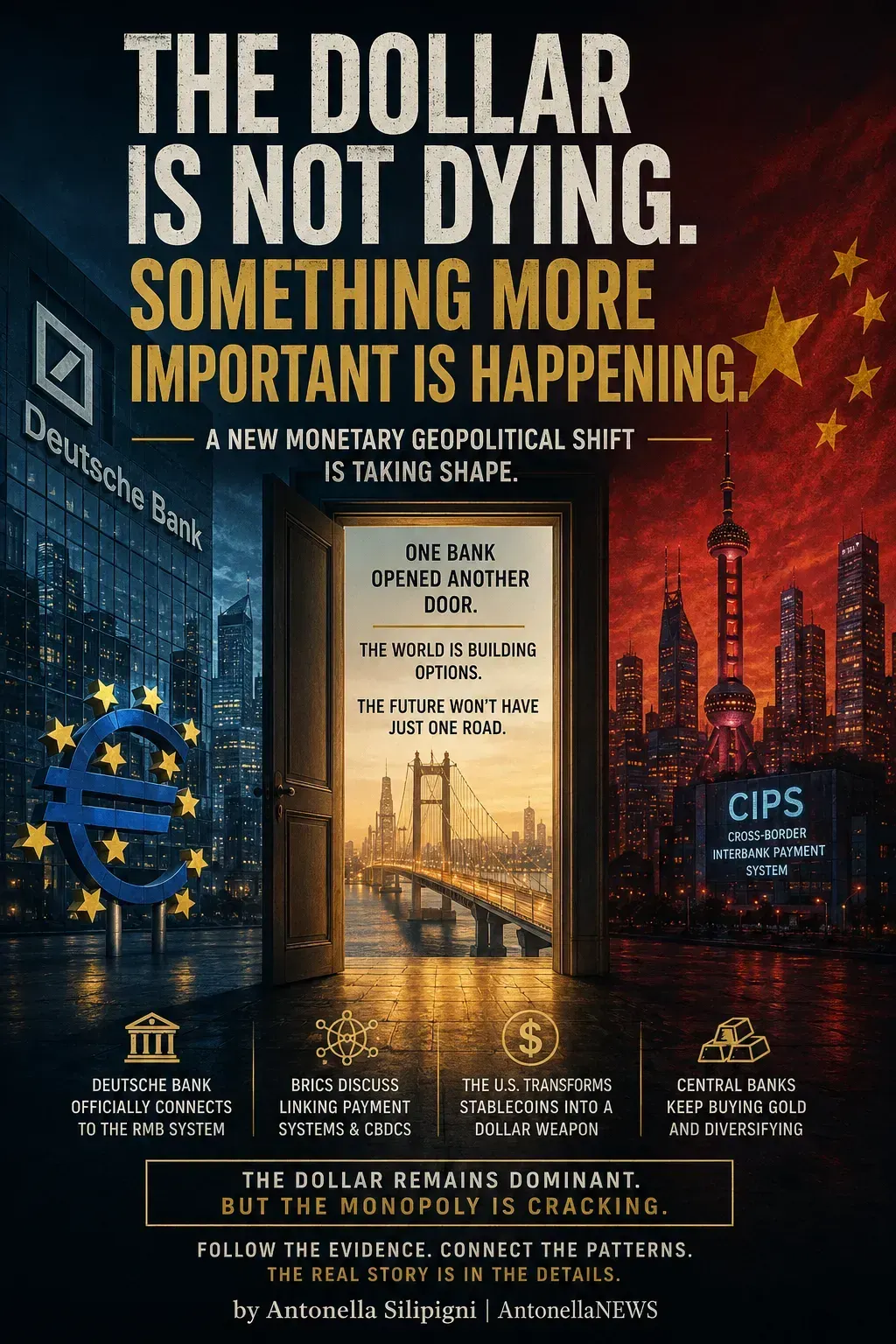
Deutsche Bank opens a new door to China’s financial system — and the timing matters.
Aug 18,2026
ugust 10, 2026. Deutsche Bank gains direct access from Beijing to renminbi clearing. The next day, the BRICS confirm they are discussing linking their payment systems. Washington, meanwhile, has already turned stablecoins into an instrument to defend the dollar. They look like three separate stories. Try looking at them together.
August 10, 2026. Deutsche Bank publishes a statement. A few lines.
No dramatic press conference. No declaration against Washington. No BRICS leader proclaiming the end of the dollar.
The People’s Bank of China, China’s central bank, has designated Deutsche Bank as a Renminbi Clearing Bank for Europe, allowing it to directly offer European financial institutions and companies processing, clearing and settlement services for cross-border RMB transactions.
Deutsche Bank uses a definition that sounds innocuous:
“a local bridge to China’s payment systems”.
- A local bridge to China’s payment systems. (db.com)
- Read it again.
- Not “a commercial partnership”.
- Not “a platform for Chinese clients”.
A bridge.
And now ask yourself a question.
Why does a systemic German bank, the world’s largest euro clearing bank according to Deutsche Bank itself, feel the need, precisely now, to become the first foreign bank in Europe to receive this designation from Beijing? (db.com)
The simplest answer is the banking one: because there is commercial demand, because it makes payments more efficient, because it reduces certain counterparty risks, because it allows European companies working with China to manage liquidity and transactions in renminbi directly.
All true.
But that is not the question that interests me.
The question is another:
why is this infrastructure becoming useful now?
To understand it, we have to go back.
Not a few weeks.
Three years.
MARCH 2023. THE FIRST FILE
On March 12, 2023, I published on AntonellaNEWS:
The title had a question mark.
Not out of editorial caution.
Because that was genuinely the question.
At the time, part of the alternative information ecosystem argued that the end of dollar dominance would come through a new BRICS currency, perhaps backed by gold or commodities; at the same time Saudi Arabia, China, Russia, India and other actors were expanding trade agreements in which the dollar was not necessarily the mandatory point of passage.
The hypothesis was fascinating.
But pieces were missing.
Three years later, we can return to the scene of the investigation and do something I consider essential when working with OSINT:
check where we were wrong too.
The famous “death of the petrodollar” announced in 2024 through the alleged expiry of a fifty-year U.S.-Saudi agreement?
The story, as it went viral, does not hold up.
The financial agreements between Washington and Riyadh in the 1970s are real. The recycling of Saudi oil revenues through the U.S. economy and Treasury securities is documented history.
But that fifty-year contract supposedly obliging Saudi Arabia to sell oil exclusively in dollars, and supposedly expiring suddenly in June 2024, does not emerge from the documentary record.
That trail was wrong.
Mark it down.
Because now something interesting happens.
Once the false trail is removed, the real one becomes more visible.
WE WERE WAITING FOR A CURRENCY. THEY WERE BUILDING THE PIPES.
For years, we searched for the BRICS currency.
A new currency.
A symbol.
A name.
A kind of Global South euro that would one day appear on the scene and challenge the dollar.
It did not happen.
As of August 2026, there is no operational common BRICS currency.
And at this point someone might close the file:
“See? De-dollarisation was propaganda.”
Wait.
Because while we were looking at the currency that never arrived, something far less spectacular was growing beneath our feet.
The infrastructure.
In 2024, the BRICS formalised work on the Cross-Border Payments Initiative.
In 2025, they returned to the use of local currencies and the interoperability of payment systems.
They did not launch a “BRICS dollar”.
They do not need one in order to begin.
And then comes August 11, 2026.
One day after Deutsche Bank.
Reserve Bank of India Governor Sanjay Malhotra publicly confirms that BRICS countries are discussing possible links between their respective fast-payment systems and CBDCs, digital currencies issued directly by central banks.
Malhotra makes one fundamental point clear: we are still at the discussion stage.
So no headlines such as “BRICS have created the new monetary system”.
That is not true.
But what he says immediately afterwards is much more interesting: the objective is to make cross-border payments cheaper, while India simultaneously continues promoting the rupee and local currencies in international trade. (reuters.com)
Now put the two dates next to each other.
August 10 — Deutsche Bank opens a direct bridge to the RMB system.
August 11 — BRICS confirm they are discussing bridges between their payment systems.
We have no evidence that the two decisions are coordinated.
We do not need any.
The clue is not coordination.
It is direction.
BUT THE DOLLAR SHOULD ALREADY BE IN CRISIS, SHOULDN’T IT?
At this point we have to do what we do in every investigation.
Look for the evidence against our own case.
If the dollar really is collapsing, the numbers should show it.
And instead something happens that appears to demolish our entire thesis.
First quarter of 2026.
According to the International Monetary Fund, the dollar still represents 57.13% of the world’s official foreign-exchange reserves.
It has not fallen compared with the previous quarter.
It has risen from 56.42%.
Euro: 20.03%.
Renminbi: 1.99%. (data.imf.org)
Read that number again.
1.99%.
The Chinese currency that, according to thousands of posts, is supposedly about to dethrone the dollar represents roughly two dollars out of every hundred equivalent units held in declared official foreign-exchange reserves.
Not enough.
There is more.
According to the BIS, in April 2025 the dollar appeared on one side of 89.2% of global foreign-exchange transactions.
In 2022 it was 88.4%.
So here too:
it increased.
Case closed?
Not yet.
Because in the same report you find another number.
The renminbi rose to 8.5% of global FX turnover, continuing a growth trajectory that began years earlier. (bis.org)
And here we are in front of the anomaly.
The dollar remains overwhelmingly dominant while, at the same time, the instruments that allow it to be bypassed in certain transactions are increasing.
How can both things be true?
Because we have confused two different questions.
“What is the dominant currency?”
and
“Are there alternatives that allow you not to use it?”
They are not the same question.
THIS IS WHERE THE INVESTIGATION CHANGES
Imagine the global financial system not as a safe.
Imagine it as a city.
For decades, the power of the dollar did not consist only in the fact that everyone wanted to hold dollars.
The real advantage was that a huge part of the financial city had been built around the dollar.
Treasury markets.
International credit.
Correspondent banks.
Liquidity.
Clearing.
Settlement.
Payment systems.
Contracts.
Commodity pricing.
To get from A to B, you often travelled on the American highway even when neither A nor B was located in the United States.
That is the detail that changes everything.
To reduce that power, you do not necessarily have to destroy the dollar.
You have to build another road.
Then another.
Then connect them.
CIPS: THE BORING ACRONYM WE SHOULD LEARN
CIPS stands for Cross-Border Interbank Payment System.
It is the Chinese infrastructure that facilitates the clearing and settlement of cross-border transactions in renminbi.
It is often described as “China’s SWIFT”.
That is a useful simplification, but technically imperfect.
SWIFT is primarily the system through which financial institutions exchange standardised messages telling each other, essentially, who has to pay whom.
CIPS can also participate in the process through which that transaction is actually cleared and settled.
To an ordinary reader, that may sound like an insignificant technical distinction.
It is not.
Because the geopolitical question no longer becomes simply:
“Who owns the currency?”
It becomes:
“Who owns the pipes?”
And this is exactly where Deutsche Bank’s August 10 announcement takes on a different meaning.
Deutsche Bank is not announcing that it intends to abandon the Western system.
It is announcing that it wants to be better connected to the other one as well. (db.com)
It is not defection.
It is optionality.
Having another possibility.
And in geopolitics, possibilities are power.
JULY 2025. WHEN WASHINGTON SHOWED IT HAD UNDERSTOOD
The second AntonellaNEWS file comes in July 2025.
I called it:
“The Dollar Disguises Itself as Crypto”
At the time, I was following a paradox.
For years, Washington had looked suspiciously at part of the crypto universe.
Then Donald Trump signs the GENIUS Act.
Why?
A stablecoin, explained without specialist jargon, is essentially a digital token designed to maintain a stable value relative to something else.
In the case that interests us:
one dollar.
My question at the time was simple.
If the world of payments is becoming digital, instead of fighting it, could Washington use that very technology to make the dollar travel even further?
Today we no longer have to infer it.
We can read what the U.S. Treasury itself says.
On July 18, 2025, Treasury Secretary Scott Bessent describes the GENIUS Act as a pivotal moment for “dollar supremacy”. (home.treasury.gov)
Five months later, he also explains the mechanism.
Stablecoins buy Treasury securities to back their reserves.
If the stablecoin market grows, demand for U.S. Treasury debt could potentially grow with it. (home.treasury.gov)
Try looking at the scene in reverse.
Washington is not preparing for the death of the dollar.
It is fighting to prevent it.
And it is doing so by building its own version of the new monetary infrastructure.
This is the passage that is often missing from the BRICS-versus-USA narrative.
We do not have an old, static system facing a new, dynamic one.
We have multiple systems adapting at the same time.
AND THEN THERE IS GOLD
Here another element appears, one we had already encountered in our previous investigations.
It is not digital.
It does not need CIPS.
It does not need SWIFT.
It does not even need a government promise.
Gold.
In 2022 central banks buy more than one thousand tonnes.
In 2023, more than one thousand again.
In 2024, more than one thousand again.
In 2025 they slow down.
But they still buy 863 tonnes, almost twice the annual average recorded between 2010 and 2021. (gold.org)
Why?
The World Gold Council asks central banks directly what their motivations are.
Diversification.
Protection in crises.
Inflation hedging.
Risk management.
In the 2025 survey, 73% of respondents expected the dollar’s share of global reserves to be moderately or significantly lower over the following five years. (gold.org)
Careful.
That does not mean 73% of central banks are “selling the dollar”.
It does not mean gold will replace the dollar.
It means something more methodologically interesting:
the people managing reserves are thinking about diversification.
That word again.
MAY 2026. THE THIRD FILE
Then we reach the third piece.
In May 2026, following the new dynamics between Washington, Beijing, Asia and the Global South, I wrote:
The question did not mean:
“The United States no longer matters.”
That would be nonsense.
It meant:
how many strategic levers are no longer controlled by a single centre?
Rare earths.
Semiconductors.
Energy.
Trade routes.
Industrial production.
Taiwan.
Hormuz.
BRICS.
ASEAN.
RCEP.
Markets.
Currencies.
Payments.
And this is the thread I continued following in the August 7 investigation:
“How Three Countries Coordinated the End of U.S. Hegemony in 30 Days”
That investigation focused above all on the gradual Asian multi-alignment: countries that can maintain military relations with Washington while at the same time deepening commercial, financial and diplomatic integration with the rest of Asia.
You do not necessarily have to change alliance.
You only have to stop depending on one.
And here we are again at Deutsche Bank.
Same pattern.
Different sector.
NOW TRY PUTTING EVERYTHING ON THE TABLE
BRICS, local currencies, debate over de-dollarisation.
Cross-Border Payments Initiative.
BRICS deepen the question of interoperability.
CIPS continues developing.
Central banks continue accumulating gold.
Washington approves the GENIUS Act and openly declares that stablecoins should support the international supremacy of the dollar.
Beijing explicitly speaks of a “multipolar international monetary system”, arguing that the global system should depend less on a single sovereign currency. (bis.org)
July 2026.
The same PBoC governor, Pan Gongsheng, says that the international monetary system is evolving more rapidly toward greater multipolarity and that use of the renminbi is expanding beyond trade into investment, financing, pricing and reserve management. It is a Chinese statement and must of course also be read as Chinese strategic communication; but it is nonetheless the official description of the direction Beijing is pursuing. (bis.org)
August 10.
Deutsche Bank becomes the first foreign European bank designated as an RMB clearing bank.
August 11.
BRICS confirm that they are discussing links between fast-payment systems and CBDCs.
Now look at the table.
The BRICS currency we were waiting for is not there.
The dollar has not collapsed.
The yuan has not conquered global reserves.
And yet something has happened.
The number of routes through which money can move without always depending on the same infrastructure has increased.
That is the part that interests me.
PERHAPS WE USED THE WRONG WORD
For three years we have spoken about de-dollarisation.
Today I am no longer convinced that this is the best term.
Because when you say “de-dollarisation”, the mind inevitably imagines a funeral.
Dollar down.
Yuan up.
A winner.
A loser.
A date to put in the history books.
But monetary orders rarely change like that.
Sterling did not disappear when the dollar became dominant.
The euro did not have to destroy the dollar in order to become the world’s second reserve currency.
And the renminbi does not necessarily need to become the new hegemonic currency for the system to become less U.S.-centred.
Perhaps what we are watching has another name.
De-monopolisation.
THE DIFFERENCE IS ENORMOUS
A monopoly does not end only when a competitor becomes larger.
It also ends when the customer can choose.
If Brazil and China can settle part of their trade in their respective currencies, the dollar continues to exist.
If India and other partners can use rupees or local currencies, the dollar continues to exist.
If a European company can manage certain operations directly in RMB through Frankfurt, the dollar continues to exist.
If a BRICS system one day genuinely allowed interoperability between national payment networks, the dollar would probably continue to exist.
But it would have lost something.
Its compulsory nature.
And that word matters more than market share.
Because real geopolitical power is not simply convincing someone to use your system.
It is making sure that they have no alternative.
AND THIS IS WHERE EUROPE ENTERS. LATE.
There is an almost grotesque paradox in this entire story.
Europe already possesses the world’s second reserve currency.
Not China.
Europe.
About 20% of global foreign-exchange reserves compared with only 1.99% for the renminbi. (data.imf.org)
In other words, if there is a currency today with sufficient scale to contribute seriously to a multipolar monetary system, it is already in our pockets.
And yet look at what is happening.
Washington designs the digital defence of the dollar.
Beijing designs the internationalisation of the renminbi.
BRICS study how to connect their systems.
Central banks diversify reserves.
And Europe too often continues talking about multipolarity as if it were a conversation taking place in another room.
Then Deutsche Bank arrives.
And does what capital often does before politics.
It prepares.
It does not choose Beijing.
It does not abandon Washington.
It opens a door.
That door gives European companies one more possibility.
In finance we would call it hedging.
In geopolitics we might call it adaptation to multipolarity.
BUT BEIJING HAS A PROBLEM
Before crowning the new order, however, we must also look at what does not work.
China wants to internationalise the renminbi.
But it maintains significant controls over capital movements.
And that is an enormous limitation.
For a Brazilian company, buying Chinese goods and paying in yuan is one thing.
For a central bank, deciding to place one hundred billion of its reserves into Chinese financial assets is another.
A true global reserve currency needs enormous, deep and liquid markets.
It needs assets regarded as safe.
It needs predictability.
And above all, whoever holds that currency must know they can enter and leave the market without suddenly running into a political wall.
The 1.99% of global reserves held in renminbi tells us that Beijing is still very far from solving this problem. (data.imf.org)
This is precisely why I do not believe the narrative:
“The yuan will replace the dollar.”
It is too simple.
The transformation we are watching is much more interesting.
LET’S GO BACK TO FRANKFURT
August 10, 2026.
The statement is still there.
- Deutsche Bank.
- Renminbi.
- Clearing.
- Frankfurt.
- “Local bridge”.
At the beginning it looked like a banking story.
Not anymore.
Because behind that phrase we found three years of clues.
We found a prediction that partly had to be corrected.
We found a BRICS currency that never arrived.
We found payment systems that are arriving instead.
We found a dollar far stronger than part of the alternative media ecosystem claims.
We found a yuan far weaker than Beijing’s narrative might suggest.
But we also found Washington feeling the need to bring the dollar into stablecoins in order to defend its dominance.
We found central banks buying gold.
We found BRICS discussing interoperability.
We found China openly declaring that it wants a multipolar monetary system.
And finally we found a major European bank deciding that it is worth having a direct bridge to that network.
One of these elements, by itself, proves nothing.
Two may be a coincidence.
Three may still be a trend.
But when the elements begin accumulating over years, the journalistic question changes.
You can no longer ask:
“Will the dollar die?”
You have to ask:
“Why is everyone building a Plan B?”
AND THAT IS THE STORY
Perhaps the dollar will not lose its dominant position in 2026.
Nor in 2030.
Perhaps stablecoins will even give it a second digital youth.
Perhaps Beijing will discover that it cannot truly internationalise the renminbi without surrendering some of the controls it considers essential to its own political stability.
Perhaps BRICS will discover that connecting systems belonging to economies, monetary regimes and geopolitical interests this different is far harder than summit communiqués make it sound.
All possible.
But there is one thing we can now document.
The world is investing in the possibility of not depending on a single circuit.
And that is exactly how the hardest power transitions to see begin.
Not with a flag being lowered.
Not with the American president announcing the end of hegemony.
Not with Xi Jinping presenting a new BRICS banknote in front of the cameras.
They happen through apparently technical decisions.
A swap agreement.
A tonne of gold.
A payment system.
A stablecoin.
A trade settlement in local currency.
A German bank opening a connection.
One bridge at a time.
Until one day you look at the map and discover that the highway you thought was indispensable is still the biggest.
But it is no longer the only one.
Deutsche Bank did not announce the death of the dollar on August 10.
It did something far less dramatic.
And perhaps, over the long term, far more important.
It opened another road.
Now the question is:
how many others are being built while we keep looking only at the dollar?
THE RED THREAD: THREE YEARS OF ANTONELLANEWS INVESTIGATION
This analysis does not begin with the Deutsche Bank announcement. It is the continuation of an investigative trail publicly documented since 2023.
2025 — The Dollar Disguises Itself as Crypto
August 2026 — How Three Countries Coordinated the End of U.S. Hegemony in 30 Days
Read together, these pieces also tell the evolution of the investigation: from the initial hypotheses about a possible BRICS currency to the discovery that the real terrain of competition may not be the birth of a new currency at all, but the gradual construction of alternative and interoperable infrastructures.
Some hypotheses formulated in previous years have held up.
Others must be corrected.
That is precisely the point.
Investigative journalism does not consist of jealously preserving a prediction until some fact appears to prove it right.
It consists of returning to the file and interrogating the evidence again.
THE FILE REMAINS OPEN
If this investigation made you notice a thread that is normally broken into dozens of apparently unrelated economic stories, share it.
If you think one of the connections does not hold up, write it in the comments and bring your sources. Documented objections do not disturb an investigation: they make it better.
And if you want to support AntonellaNEWS, you can subscribe on Substack and allow me to continue following this transition one document at a time, one transaction at a time, one bridge at a time.
Because perhaps the great monetary transformation of the twenty-first century will not arrive with a new banknote.
Perhaps it has already begun.
And it simply does not look like what we were waiting for.
SOURCES
- Deutsche Bank — Deutsche Bank appointed as RMB Clearing Bank for Europe, August 10, 2026; People’s Bank of China;
- Reuters — statements by the RBI on BRICS, fast-payment systems and CBDCs, August 11, 2026;
- IMF — COFER Q1 2026;
- Bank for International Settlements — Triennial Central Bank Survey 2025;
- BIS/PBoC — speeches by Pan Gongsheng on a multipolar monetary system,
- 2025–2026; U.S. Treasury — GENIUS Act and statements by Scott Bessent,
- 2025–2026; World Gold Council — Gold Demand Trends 2025 and Central Bank Gold Reserves Survey 2025;
- BRICS documentation on the Cross-Border Payments Initiative;
- AntonellaNEWS — investigative archive 2023–2026.