Colombia 2026: The President They Didn't Need to Kidnap

How to Execute a Regime Change in the 21st Century
Jun 25,2026
Anatomy of a geopolitical operation that uses elections as a weapon — and the UN Security Council as the prize
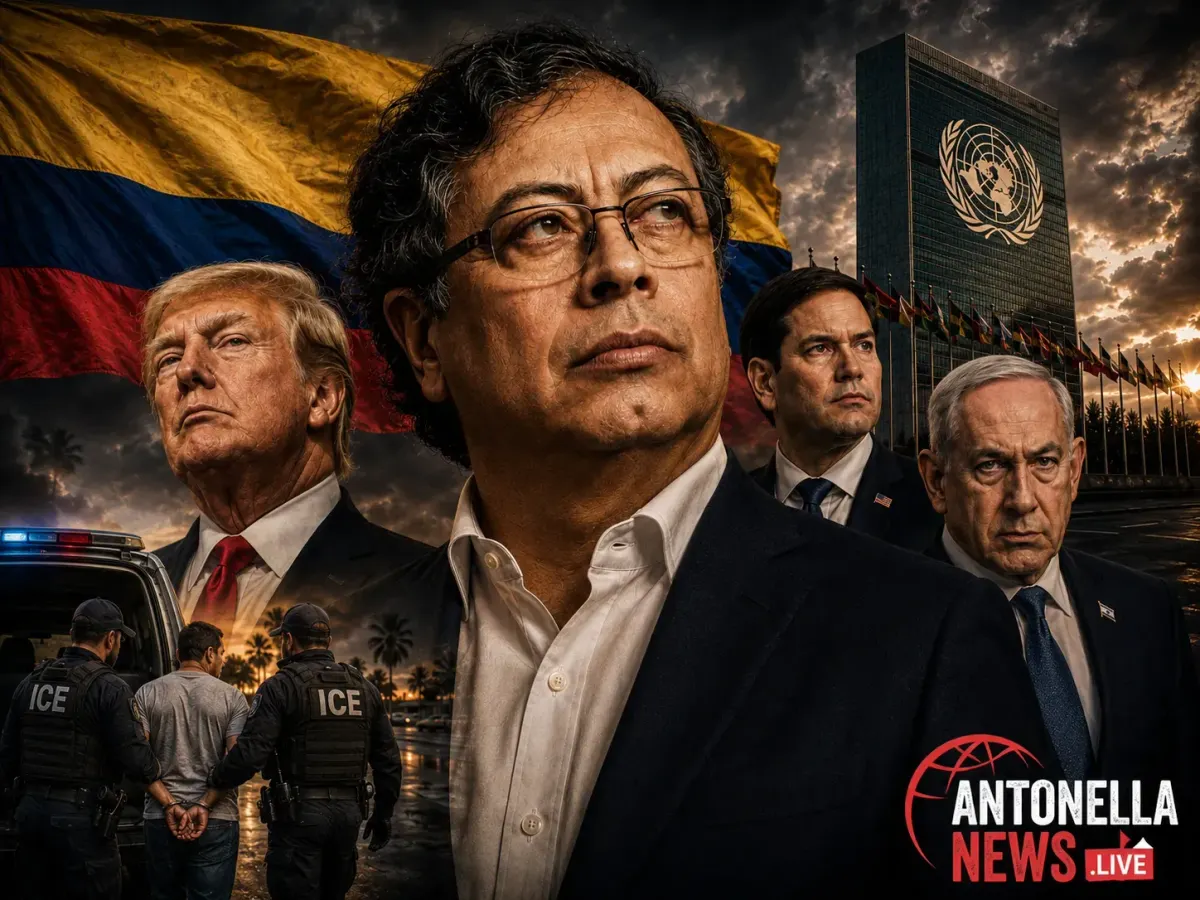
There is a photograph that circled Latin American social media on June 16, 2026. A forty-year-old man in Arizona is being loaded into a federal van while clutching the documents proving his valid work permit. Before getting in, he manages to record a video. “We must never kneel before anyone,” he says. His twelve-year-old son stands beside him on the pavement, in the dry heat of Phoenix.
The man’s name is Beto Coral. He is the son of a Colombian anti-drug police captain trained by the DEA, killed in 1994 by Pablo Escobar’s hitmen when Beto was eight years old. He has spent his life investigating that murder and denouncing those he believes ordered it. He has been in the United States since 2015, with a pending asylum application. Five days earlier he had filed a complaint in Florida against Abelardo de la Espriella — the far-right Colombian presidential candidate backed by Donald Trump — for illegal recording of telephone calls. Two hours before the arrest, de la Espriella had publicly announced on social media that Coral would be detained.
According to the account Coral later gave to journalist Daniel Coronell from a detention centre in Louisiana, a federal agent told him the order had come directly from Secretary of State Marco Rubio. Coral spent three days without being allowed to make a phone call, two days without food. He was transported in chains — wrists, waist and ankles — for over ten hours from Phoenix to El Paso. Ten Democratic congresspeople wrote to Rubio demanding answers. Bernie Moreno, Republican senator of Colombian origin and chief intermediary between Washington and de la Espriella, responded publicly: “Enjoy life back in Colombia.”
On June 21, 2026, de la Espriella won the Colombian presidential runoff by fewer than 250,000 votes — a margin of 0.94% of ballots cast. The left challenged 33,000 polling stations. Benjamin Netanyahu called almost in real time: “Israel’s friends keep winning. Long live the Isaac Accords.”
This is the story of how a regime change is carried out in the 21st century. You don’t need generals. You don’t need a coup. You don’t need to kidnap the outgoing president. You need opaque electoral software, a dual-citizen American senator, an activist to be deported at the right moment, and the ability to transform a democratic election into an open-air geopolitical operation — so open that no one feels embarrassed to claim credit for it.
TIMELINE — THE 24 MONTHS THAT CHANGED COLOMBIA
October 2023
Petro breaks the taboo: he recalls the Colombian ambassador from Tel Aviv and announces that Colombia will join Algeria’s complaint against Netanyahu at the ICC. Colombia is among the very first countries in the world to take this position.
February 2024
Colombia suspends purchases of Israeli weapons. Petro compares Israeli actions in Gaza to the Holocaust. Israel’s Defence Minister responds: “Outrageous.”
May 2024
Total diplomatic rupture. Before a May Day crowd, Petro announces live: “Tomorrow we will break diplomatic relations with the State of Israel — for having a genocidal president.” He is the first Western head of state to do so after October 7.
June 2025
Colombia elected non-permanent member of the UN Security Council for the 2026-2027 biennium. It receives 180 votes out of 188 — an extraordinary consensus reflecting the diplomatic capital Petro has built.
July 2025
Bogota hosts the Hague Group Emergency Conference: 30 countries from four continents adopt six binding measures against Israel — arms embargo, port bans, contract reviews. Washington sanctions UN Special Rapporteur Francesca Albanese for “collaborating with the ICC.”
September 2025
Petro’s final speech to the UN General Assembly: he calls for criminal proceedings against Trump over American bombings in the Caribbean. The US delegation walks out. The State Department states only: “Our delegation’s actions speak for themselves.”
Nov. 2024 – Mar. 2026
De la Espriella consolidates himself as Trump’s preferred candidate in Colombia. The US Treasury sanctions the Petro government for “alleged ties to drug trafficking.”
May 19, 2026
Alex Saab — de la Espriella’s client for six years, defended while already on the US Treasury blacklist — convicted for money laundering in Miami. Twelve days before the first round.
May 31, 2026
First round. De la Espriella 43.7%, Cepeda 40.9%. Petro denounces anomalies in 5,300 polling stations and in the counting software managed by Thomas Greg & Sons — a family convicted in the United States for a $105 million bank fraud.
June 10, 2026
Petro chairs the UN Security Council in his pro tempore capacity. He accuses Israel of “returning to the Nazi era.”
June 16, 2026
Beto Coral, Colombian activist with a pending asylum claim, arrested by ICE in Arizona. Two hours before, de la Espriella had publicly announced it would happen. The order, according to Coral, came directly from Marco Rubio.
June 21, 2026
Runoff. De la Espriella wins by 250,000 votes — 0.94%. Netanyahu posts before official results: “Israel’s friends keep winning.”
June 22, 2026
Bernie Moreno meets de la Espriella in Barranquilla. Within 24 hours they agree that all Colombian asylum seekers in the US will be repatriated.
June 26, 2026
De la Espriella assumes the presidency. The UN Security Council seat — won by Petro with 180 votes on the promise of defending international law — changes direction. Without firing a single shot.
The Patient
To understand why Gustavo Petro’s Colombia had become a problem — not for Colombians, but for Washington and Jerusalem — you need to understand what Petro had built over four years in office, and above all what he was building in his final six months.
Petro had taken office in 2022 as the first left-wing president in the history of one of the world’s most unequal countries. He had increased the real minimum wage by 39%, launched a land reform, banned fracking, broken diplomatic relations with Israel after October 7, 2023, co-founded the Hague Group — a coalition of 34 countries led jointly with South Africa to coordinate international sanctions against Israel — and proposed at the G-20 the abolition of the UN Security Council veto.
In June 2025, with 180 votes out of 188 possible, Colombia was elected non-permanent member of the UN Security Council for the 2026-2027 biennium. In September 2025, in his last speech to the General Assembly, Petro called for criminal proceedings against “the official who gave the order” — “including the highest-ranking official: President Trump.” The American delegation walked out.
And then comes the detail that explains everything. In June 2026 — the same month as both rounds of the Colombian presidential election — Colombia held the pro tempore Presidency of the United Nations Security Council. Petro personally chaired a session eleven days before the runoff. From the most powerful microphone in the multilateral world order, he accused Israel of “returning to the Nazi era.”
Let us return to the photograph of Beto Coral on the Phoenix pavement, five days before the vote. The son of an anti-drug agent who died fighting the narcos is being deported — on the order of the American Secretary of State, according to his own testimony — because he had filed a complaint against the candidate who, in a different era, had defended those very narcos as their lawyer. The story of democratic regime change has this quality: it contains everything in miniature, if you know where to look.
The Diagnosis
Three questions precede any serious geopolitical analysis: who, what, and why now.
Who: a Latin American president who had transformed his country into the diplomatic capital of the Global South in the battle for accountability of the powerful. Not a military power. Not a nuclear-armed state. A country of 52 million people with dual access to the Pacific and Atlantic Oceans, and a president who had understood how to use the very rules of the international system built by the West to challenge that West on its own terms.
What: not the land reform, not the fracking ban, not the coal exports blocked to Israel. Those are measurable economic damages — real, but manageable. Petro’s Colombia was demonstrating that a mid-sized country could use the ICC, the UN Security Council, the General Assembly — all instruments built by the powerful to govern the weak — to hold those powerful actors to account. And that this was replicable.
Why now: Colombia was sitting on the Security Council for all of 2026 and 2027. With de la Espriella, that same seat — won by Petro with 180 international votes — becomes its opposite. The same microphone. The same chair. The opposite direction.
The Scalpel
The democratic regime change of the 21st century has a five-level structure. The Colombian case exemplifies all of them with almost pedagogical precision.
The first level is narrative delegitimisation. Before any operational move, the environment must be prepared. Colombian media — concentrated in the hands of a few business families, historically harder on the left than the right according to Reporters Without Borders — had been painting the Petro government for years as an economic disaster. The result: a president who had reduced poverty was remembered primarily for chaos.
The second level is judicial and financial pressure. The Petro government ends up on the US Treasury OFAC sanctions list for “alleged ties to drug trafficking” — accusations no court has ever confirmed. A conviction is not necessary: the investigation is enough, the suspicion is enough.
The third level is electoral engineering. Twelve days before the first round, Alex Saab is convicted for money laundering in Miami. Five days before the runoff, Beto Coral is arrested on Rubio’s orders. Senator Bernie Moreno shows up in Colombia as an accredited electoral observer, having visibly backed one of the candidates for months. The counting software of Thomas Greg & Sons — a family convicted in the US for a $105 million fraud — gives de la Espriella a 250,000-vote winning margin. The margin is below 1%.
The fourth level is immediate recognition as a fait accompli. Trump posts on Truth Social before the results are official. Netanyahu follows. Rubio calls. Meloni writes. The speed is not diplomatic enthusiasm. It is the collection of debts.
The fifth level is preventive institutional dismantling. De la Espriella had already declared he would review Colombia’s membership in the UN, the OAS and the Inter-American Court of Human Rights — “a farce.” The signal is sufficient: Colombia will no longer use those platforms as instruments of resistance.
The Web
Power networks do not operate through explicit agreement. They function because actors with different — and sometimes contradictory — interests produce convergent effects by sharing the same infrastructure of power. Solitary spiders weave overlapping webs not because they coordinate, but because they respond to the same environmental stimuli.
Washington needed to neutralise the most radical and most effective voice building an international coalition against its military operations in Latin America — and doing so from inside the UN Security Council.
Israel needed to close the diplomatic front opened by Petro: co-president of the Hague Group, advocate for the ICC arrest warrant against Netanyahu, promoter of the Israeli arms embargo, the voice building among 34 countries a critical mass large enough to make the American veto politically costly on Gaza.
The extractive industry needed to cancel the fracking moratorium and reopen the oil contracts blocked by Petro. Israeli agribusiness companies — led by former intelligence officers, according to GRAIN — needed to reopen their plans to acquire Colombian land. The arms industries — American and Israeli — needed a government that would reactivate weapons supplies, purchase Israeli drones and AI systems, and open Colombian territory to American military bases with full immunity for contractors.
None of these actors needed to meet in a room. All converge on de la Espriella because de la Espriella is the solution to each of their specific problems. And he is structurally compromisable on three levels: the six years defending Alex Saab while on the US Treasury blacklist, the triple citizenship raising unresolved constitutional questions, and his documented ties to AUC paramilitary leaders. A president with skeletons in the closet is, for certain interests, a more reliable president than one without.
The Prize
On June 22, 2026, the day after the runoff, Bernie Moreno meets de la Espriella in Barranquilla. Within hours they agree that all Colombians requesting asylum in the United States will be repatriated once de la Espriella takes office on August 7. No parliamentary consultation. No formal diplomatic process. A bilateral agreement concluded 24 hours after the vote.
Netanyahu publishes his congratulations invoking the “Isaac Accords” — the Latin American franchise of the Abraham Accords. Foreign Minister Sa’ar announces he will bring bilateral relations “to their highest level ever.” Coal exports to Israel resume. Arms supply negotiations reopen. Pegasus — purchased under Duque with $11 million in cash flown on a private jet to Tel Aviv, interrupted by Petro — becomes available again.
But the most valuable prize is none of these. It is the seat. Colombia sits on the UN Security Council throughout 2026 and 2027. That seat, in de la Espriella’s hands, becomes an instrument in the hands of Washington and Jerusalem. The same microphone. The same chair. Opposite direction. Two years. From the heart of the system. Without firing a single shot.
The Question That Remains
In September 2025, Petro had said before the UN General Assembly: “They want us to go like a herd to the slaughterhouse without protesting. They want to terrorise us so we do not raise our heads.”
The democratic regime change has a second objective, beyond the neutralisation of the specific subject: it is a message to everyone else. When Netanyahu says “Israel’s friends keep winning,” he is not speaking only to Colombians. He is speaking to every government that was watching to see what would happen to Petro. The message: if you use international institutions against us, we will use elections against you.
The most disturbing aspect is not the brutality of the operation. It is its elegance. It uses democracy against itself. It leaves the institutions standing. It produces no martyrs. And it is replicable at decreasing marginal cost. Once the playbook is written, applying it a second time is easier than the first.
There is one final question no mainstream outlet has yet posed with sufficient clarity. Alex Saab — convicted in Miami twelve days before the first round — is almost certainly cooperating with American prosecutors. He almost certainly knows very precise things about de la Espriella, about the six years of legal defence, about the millions in fees, about the private conversations. Washington holds potentially explosive material about its newest best ally in Latin America.
A president with skeletons in the closet is not just a convenient ally. He is a controllable one. And a controllable ally, in the language of real power, is not an ally. He is a tool.
Colombia has not been liberated. It has been acquired.
IF YOU’VE READ THIS FAR, YOU ALREADY KNOW TOO MUCH TO STAY SILENT
This article is the result of weeks of OSINT research using public sources — official statements, court documents, UN records, international reporting. No anonymous sources. No speculation. Only the facts, placed in the order that mainstream media have not yet had the courage to arrange.
There are three open investigative threads this article could not follow to their end: what Alex Saab is telling American prosecutors about de la Espriella, who has access to the Thomas Greg & Sons electoral software, and which Israeli companies are already negotiating surveillance contracts with the new Colombian government.
The democratic regime change playbook has been written. The next chapter is being written right now — and it may not concern a distant country.
Share this article. Leave a comment. Support AntonellaNEWS on Substack · YouTube · TikTok.
All information in this article comes from publicly verifiable sources: official statements, government communications, reporting by international outlets (CNN, The New York Times, The Guardian, Al Jazeera, Haaretz, Reuters), documents from international institutions (United Nations, International Criminal Court, US Department of State), and analysis by independent organisations (GRAIN, WOLA, International Crisis Group). No anonymous sources. No undocumented speculation.