DOSSIER: Netanyahu Trial: Too Powerful to Be Judged?

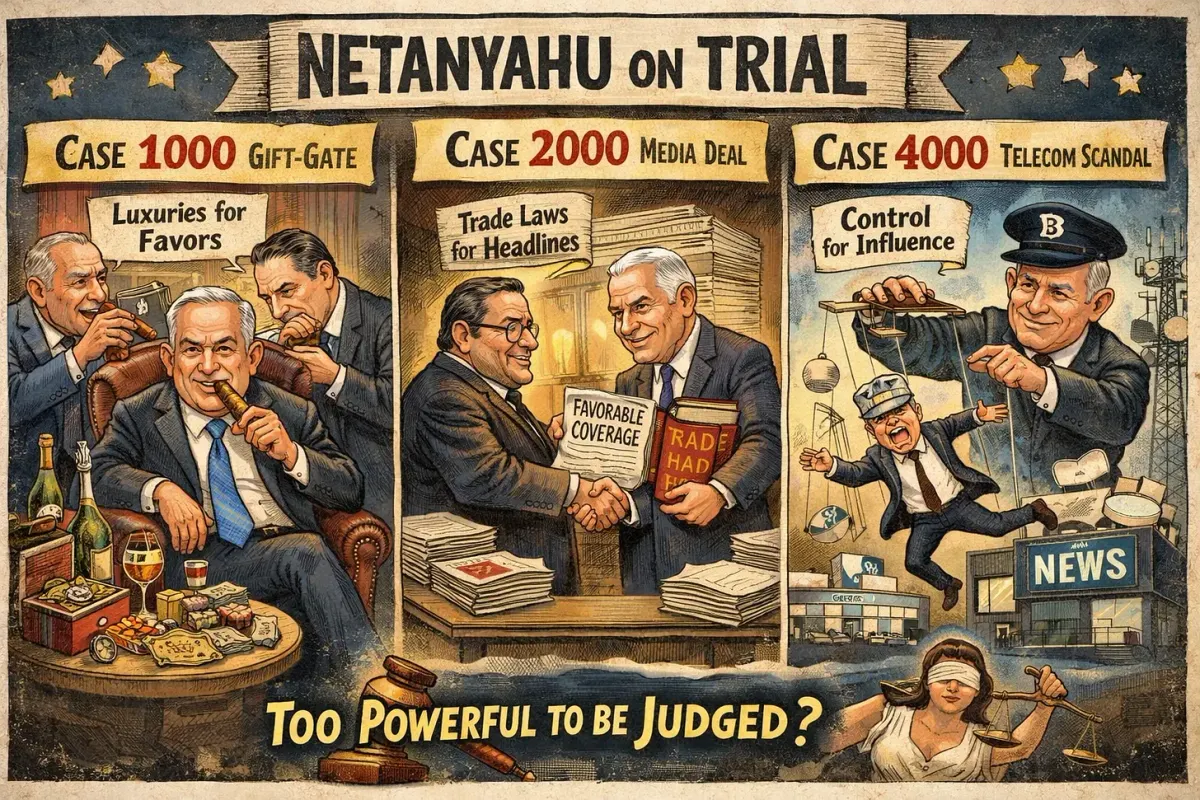
The Role of the Judiciary, Europe’s Media Silence, and the Anomaly of a Pardon Invoked Before a Verdict
Jan 02, 2026
From media capture to critical infrastructure, from ties with the narrative industry to external political pressure: a didactic investigation into why the Netanyahu trial matters to Europe—and why stopping it before a verdict would undermine the credibility of any democracy.
In European media discourse, the criminal proceedings against Benjamin Netanyahu are often reduced to a footnote, overshadowed by war, regional security concerns, or broader geopolitical dynamics.
In Israel, however, this trial represents one of the central nodes of a long-running institutional crisis. It is not only about a political leader, but about the relationship between executive power, economic interests, the media system, and judicial independence.
This dossier does not anticipate verdicts nor adopt a militant position.
It reconstructs the charges, the alleged benefits, the spheres of influence of the actors involved, and the democratic implications—posing a fundamental question: what would happen if similar dynamics had occurred in a European country?
General Context
Investigations into Netanyahu began in 2016. Formal indictments were filed in 2019. The trial started in 2020.
The mass protests of 2023—often described as contingent political reactions—actually stem from an earlier concern: the perception that power was becoming increasingly personalized and negotiable, accompanied by a progressive weakening of institutional checks and balances.
Case 1000 – The Narrative Industry, Symbolic Power, and Strategic Communication
Case 1000 is often described as the least relevant in strictly criminal terms. In reality, it is the case that allows us to understand the deepest and least visible dimension of power: narrative and symbolic power.
Actors Involved and Spheres of Influence
The case concerns ongoing personal relationships between Netanyahu and major international entrepreneurs, particularly Arnon Milchan and James Packer.
Milchan is not merely a globally renowned film producer. He is a figure positioned at the intersection of:
- the international film and television industry,
- Western media networks,
- Israeli and U.S. political-diplomatic environments.
His influence is not regulatory, but cultural and symbolic: the ability to shape the global imagination, the representation of conflicts, and the international perception of Israel.
Packer, while playing a more marginal role in the proceedings, reinforces the hypothesis of a structured relational circuit, involving major capital from the Anglo-Saxon entertainment and media sectors.
What the Prosecution Contests
The Israeli prosecution does not contest film production, nor state propaganda as such. It contests instead:
- the systemic continuity of personal benefits;
- the asymmetry between a public decision-maker and actors wielding enormous symbolic power;
- the transformation of personal relationships into privileged channels of access to power.
In European comparative law, such a configuration would likely be examined as:
- a structural conflict of interest;
- non-monetary influence-peddling;
- misuse of public office for relational advantage.
The Current Context: Strategic Communication and Hasbara
In recent years—and with accelerated intensity after October 7, 2023—Israel has significantly increased public investment in hasbara, understood as international strategic communication.
There has been growth in:
- collaboration with audiovisual productions;
- international media consulting;
- acquisitions and stakes in major television platforms and film production companies.
These practices are not illegal and fall within the soft-power strategies of many states.
The problematic node emerges when:
- state communication intersects with opaque private relationships;
- global narrative producers maintain privileged personal ties with the political leadership.
Case 1000 thus becomes the relational precedent that many Israelis now view as dangerous: the informal privatization of the construction of the state’s public narrative.
If This Had Happened in Europe
In a European context, such close and continuous relationships between a head of government and major global media producers would likely have triggered:
- parliamentary inquiries;
- investigations into conflicts of interest;
- pressure to clearly separate public office from the narrative industry.
Case 2000 – Politics and Information as an Object of Negotiation
Case 2000 is often misunderstood because it does not involve bribes, illegal wiretaps, or formal censorship.
For this very reason, it is one of the hardest cases to grasp—and one of the most revealing.
To understand it, one must start with a fundamental question:
What happens to a democracy when information becomes a subject of political bargaining?
1. The Context: Why Media Are Central in Israel
Israel is a democracy characterized by:
- strong political pluralism;
- high social polarization;
- a highly informed and politically active electorate.
In this context:
- major newspapers are not merely information outlets;
- they are indirect political actors, capable of:
- shaping the public agenda,
- influencing elections,
- legitimizing or delegitimizing leadership.
👉 Media power in Israel is not ornamental—it is structural.
2. Who Arnon Mozes Is and Why He Matters
Case 2000 revolves around Arnon Mozes, longtime publisher of Yedioth Ahronoth.
For decades, Yedioth Ahronoth was:
- the most widely read newspaper in Israel;
- a builder of political reputations;
- an actor capable of influencing governments, not merely reporting on them.
👉 Mozes is not a journalist, but a gatekeeper of information.
3. The Core Problem: The Newspaper War
During the period covered by Case 2000, the Israeli media market was marked by internal conflict:
- Yedioth Ahronoth was losing centrality;
- Israel Hayom, a free mass-circulation newspaper, was rising;
- Israel Hayom was perceived as editorially favorable to Netanyahu;
- its free distribution disrupted the economic balance of the sector.
👉 Here lies the core issue: media pluralism collides with the economic sustainability of traditional outlets.
4. What the Prosecution Contests (the Key Point)
The prosecution does not contest:
- the existence of partisan newspapers;
- editorial competition;
- political criticism or support.
It contests instead the negotiation itself, documented by recorded conversations.
According to the indictment:
- Netanyahu and Mozes discussed the possibility of:
- limiting the distribution of Israel Hayom;
- legislating interventions in the newspaper market;
- in exchange for more favorable coverage of Netanyahu in Yedioth Ahronoth.
👉 The offense lies not in the outcome of the negotiation, but in the idea that the law could be used to bargain over information.
5. Why This Is Serious Even Without Money Changing Hands
Many European readers associate corruption with money.
Case 2000 reveals another, more sophisticated and less visible form of exchange:
- the law as leverage;
- information as currency.
This type of exchange:
- distorts the media market;
- skews democratic debate;
- renders influence invisible because it appears “voluntary.”
👉 It is a form of corruption of the democratic process, not of the public budget.
6. The Sphere of Influence: Why This Concerns Everyone
Case 2000 involves:
- political power (legislation);
- media power (agenda and reputation);
- economic power (media survival).
When these three levels intersect without transparency, the risk is that:
- information no longer monitors power,
- but is negotiated with it.
7. Why Many Israelis See It as an “Existential” Case
For a growing segment of Israeli society, Case 2000 crosses a red line:
If a leader can negotiate the law in exchange for a more favorable narrative,
no election is truly free, even if formally correct.
No censorship is required:
- adjusting tone,
- shifting priorities,
- softening dissent is enough.
8. The Western Comparison
In a European country, a head of government who discussed targeted legislative action with a major publisher in exchange for favorable coverage would likely face:
- influence-peddling charges;
- parliamentary investigations;
- an immediate political crisis.
In the United States, such dynamics would be framed as:
- interference with First Amendment principles;
- attempts to manipulate information;
- grave democratic violations.
9. Why Reaching a Verdict Is Essential Here Too
Case 2000 does not concern:
- a law passed,
- a censorship enacted.
It concerns a principle.
A verdict is needed to establish:
- whether political-media bargaining is acceptable;
- where the line lies between dialogue and abuse;
- whether democracy tolerates the negotiation of public narratives.
Without a verdict, that line remains blurred—and ambiguity is fertile ground for normalized abuse.
Case 4000 – Critical Infrastructure, Regulation, and System Capture
Case 4000 is considered by Israeli prosecutors to be the most serious of the cases against Netanyahu—not for ideological reasons, but because of the systemic nature of the alleged benefits.
To understand it, one must begin with a simple question often overlooked in European debate:
What is Bezeq, and why does it matter so much?
1. What Bezeq Is: Why It Is Not “Just Another Company”
Bezeq is Israel’s former public telecommunications monopoly.
Even after privatization, Bezeq:
- manages much of the national fixed network;
- controls critical fiber-optic nodes;
- provides essential connectivity to:
- state institutions,
- emergency services,
- hospitals,
- major media outlets,
- strategic enterprises.
👉 In European terms, Bezeq is comparable to Telecom Italia, Orange, or Deutsche Telekom—with one crucial difference: it operates in a small, militarized country in constant conflict, where telecommunications constitute critical national security infrastructure.
2. Who Controlled Bezeq During the Relevant Period
At the time in question, Bezeq was controlled by businessman Shaul Elovitch.
Elovitch was not only a telecommunications operator.
He also controlled Walla!, one of Israel’s major online news portals.
👉 This is the first crucial node: a single private power center controlled both communication infrastructure and a major national media outlet.
3. Netanyahu’s Role: Exceptional Concentration of Power
During the relevant period:
- Netanyahu was Prime Minister;
- and also served as Minister of Communications ad interim.
In practical terms:
- the same individual led the government;
- and decided on rules, timing, and authorizations directly affecting Bezeq.
In many European countries, such a concentration of roles would be considered high-risk for conflicts of interest, even absent criminal charges.
4. What the Prosecution Contests (Concretely)
The prosecution does not claim that:
- Bezeq operated illegally per se;
- every regulatory decision was unlawful;
- favorable media coverage is itself a crime.
It contests instead a mechanism of exchange.
According to the indictment:
- certain regulatory decisions were neither automatic nor required;
- these decisions generated enormous economic advantages for Bezeq (estimated in hundreds of millions, if not billions, of shekels);
- in parallel, Walla! allegedly:
- softened or removed critical content;
- emphasized favorable coverage;
- adjusted headlines, images, and editorial priorities;
- responded to direct or indirect requests from the political entourage.
👉 Here, the consideration is not symbolic, but economic, structural, and measurable.
This is why Case 4000 includes charges of bribery, not merely breach of trust.
5. Why This Is Called “System Capture”
“System capture” refers to situations where:
- a private group does not merely lobby;
- but succeeds in shaping fundamental public decisions to its advantage;
- while simultaneously influencing the information that reports on those decisions.
In Case 4000, three layers of power converge:
- Economic – control of strategic infrastructure;
- Political – direct access to the regulatory decision-maker;
- Media – capacity to shape public perception.
This convergence is what makes the case so sensitive.
6. Why This Alarms a Growing Part of Israeli Society
Many Israelis view Case 4000 not as an isolated episode, but as a dangerous precedent:
- if infrastructure built as a public good becomes bargaining currency;
- if narrative control shields economic decisions;
- if regulatory power can be negotiated;
then the distinction between state and private interests dissolves.
7. Western Comparison
In a European country:
- a competent minister involved in regulatory decisions favoring a group that also controls a major media outlet;
- while receiving protective editorial coverage;
would likely have been forced to:
- resign preventively;
- face independent regulatory investigations;
- testify before parliamentary committees.
In the United States, such convergence between telecoms, media, and executive power would be treated as a national security issue, not “normal politics.”
8. Why Reaching a Verdict Is Crucial Here
For many Israeli citizens, Case 4000 lies at the heart of the institutional crisis:
- a verdict would clarify the boundary between legitimate power and abuse;
- political shelving or a pre-emptive pardon would leave open the suspicion that the system itself is negotiable.
In a democracy, systemic suspicion is more corrosive than conviction.
Why a Growing Number of Israelis Insist on Reaching a Verdict
The Pardon Question, External Pressure, and Judicial Reputation
A growing segment of Israeli society—including jurists, former security officials, reservists, academics, families of hostages, and politically unaffiliated citizens—does not demand Netanyahu’s conviction.
It demands something more fundamental: that the trial reach a full verdict.
This demand arises from a widely shared belief: the absence of judicial truth is more destabilizing than any verdict.
Equality Before the Law
Circumventing the process through political shortcuts would create an implicit class of citizens “too important to be judged.”
For a society shaped by historical experiences of arbitrary power, this is unacceptable.
What is being defended is not hostility toward a leader, but the non-negotiability of the law.
Why Trump’s Pardon Advocacy Is Seen as Unacceptable
Repeated statements by Donald Trump, calling for a pardon for Netanyahu before the trial concludes, have caused profound unease within Israel.
Not out of hostility toward the United States, but for three fundamental reasons:
- External narrative interference: a foreign leader publicly urging the termination of an internal judicial process shifts the issue from law to geopolitics.
- Implicit delegitimization of the judiciary: the message conveyed is that the trial itself is a mistake or persecution.
- Dangerous precedent: if international political pressure can halt a trial, judicial independence becomes contingent on geopolitical weight.
The Contradiction of a “Pardon for an Innocent”
Another source of concern is the logical contradiction:
- Netanyahu maintains his innocence;
- yet clemency is invoked, which by definition bypasses full fact-finding.
For many Israelis:
If a leader is innocent, he should be acquitted by a court, not rescued by a political act.
A pre-emptive pardon does not protect innocence—it renders it irrelevant.
Damage to the Judiciary’s Reputation
Israel’s judiciary is a pillar of its international credibility.
Halting or hollowing out a trial under political pressure would cause lasting damage:
- internal delegitimization of judges;
- erosion of public trust in institutional checks;
- weakening Israel’s standing when invoking rule-of-law principles elsewhere.
Defending the process, for many Israelis, means defending the country’s credibility, not attacking it.
Western Comparison
If a U.S. president or former president were on trial, a foreign leader calling for a pardon before verdict would be deemed a serious interference.
If a European prime minister faced corruption and media-capture charges, external pressure to shut down proceedings would be framed as an attack on judicial independence.
Many Israelis therefore perceive a double standard: what is unacceptable in Europe or the U.S. is normalized when Israel is concerned.
Why a Verdict Is Seen as the Only Way Out
Reaching a verdict is not about revenge or mistrust.
It is the only way to close an institutional fracture that has widened over years.
A verdict—whether acquittal or conviction—restores systemic legitimacy.
A pre-emptive pardon freezes the conflict and leaves open the suspicion that power can always bargain with the law.
This dossier does not ask readers to take sides.
It asks them to observe a simple truth:
A democracy proves its strength not by protecting its leaders,
but by allowing courts to judge them without pressure—even when geopolitics makes it uncomfortable.
In times of war, this distinction becomes even more critical.
Providing full information is not militancy.
It is democratic responsibility.