Epic Fury and the Bluff of American Omnipotence

The Pentagon briefing that was supposed to close doubts ended up confirming them
Apr 16, 2026
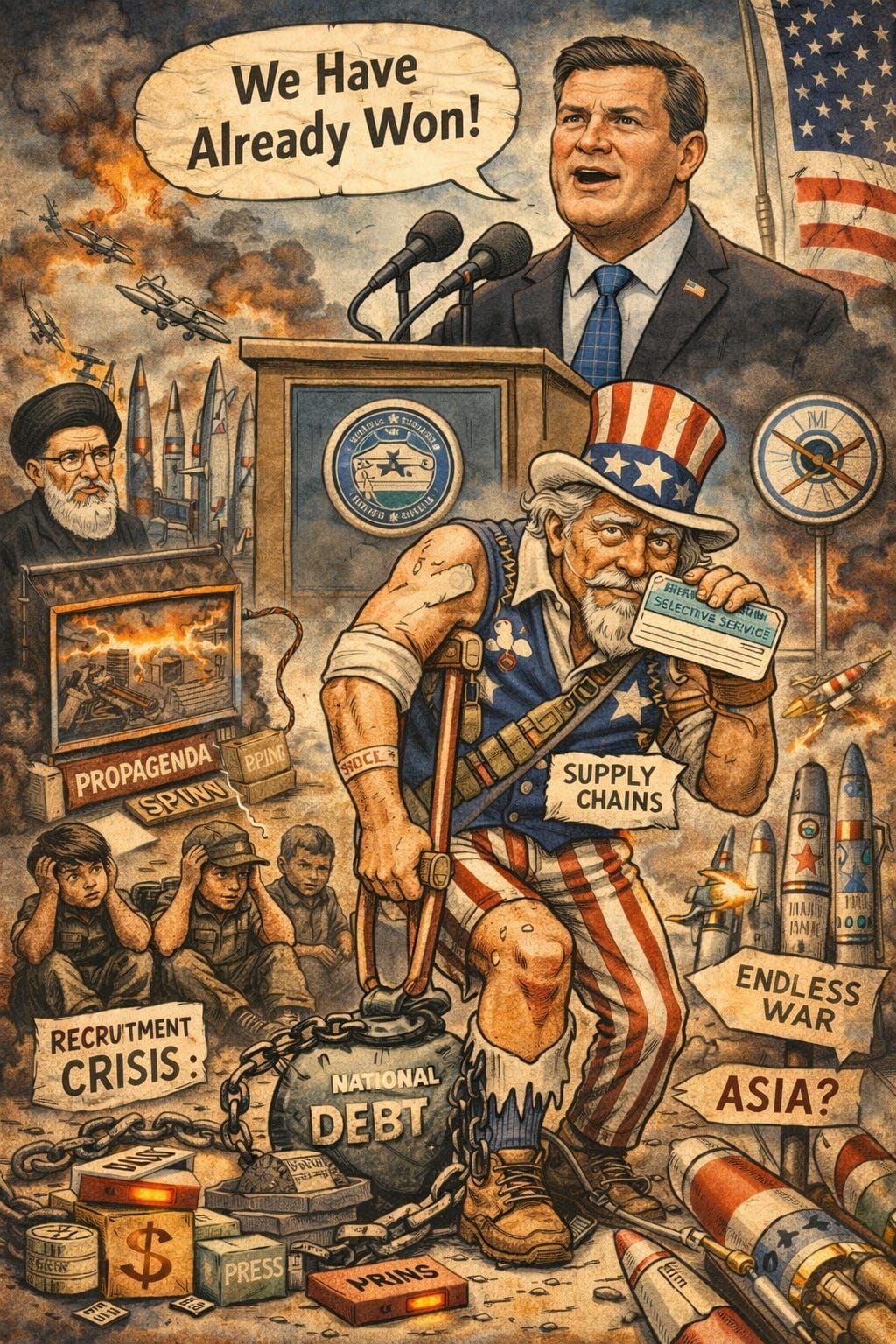
There comes a point when propaganda stops reassuring and starts revealing the exposed nerve it is trying to hide. The April 16, 2026 Pentagon press conference with Pete Hegseth, Dan Caine, and Admiral Brad Cooper belongs in that category. In the technical transcript of the live event, Hegseth speaks of an “ironclad” blockade, of an Iran that cannot “reconstitute,” of the United States being “locked and loaded,” of Iranian energy that “is not moving and will not move,” of naval superiority achieved with “less than 10% of America’s naval power,” and of recruiting numbers that are finally triumphant. Caine reiterates that the joint force is ready to resume combat “at literally a moment’s notice,” while Cooper openly says that during the ceasefire the United States is “rearming,” “retooling,” and adapting tactics, techniques, and procedures.
At first glance, it looks like a briefing of strength. In reality, it is a briefing of reputational defense. Not because everything said there is false, but because it is said in a selective, ritualized, relentless way precisely to cover the crack that has opened beneath the official narrative. If the system were truly as solid as it claims to be, it would not need to repeat with this level of intensity that it can keep fighting, keep blocking, keep recruiting, keep rearming, and keep winning.
The problem is not that Washington always lies. The problem is that it presents as final what remains unfinished, as destroyed what is in fact degraded but still operational, as control what is actually coercion with heavy downstream costs, and as proof of strength what is also a symptom of friction.
The central contradiction: if Iran had already been crushed, why is all of this still necessary?
This is the core of the dossier. On one side, Washington has already claimed, in multiple phases, to have struck or neutralized Iran’s nuclear capability, decimated its military apparatus, devastated command and control, and crippled launchers, infrastructure, and replenishment capacity. Yet Reuters had already shown in 2025 that a preliminary U.S. intelligence assessment cut against the triumphalist line: the raids had not destroyed the core components of Iran’s nuclear program and had likely delayed it only by a matter of months.
If, as publicly claimed, Iran had already emerged from the war as a strategically hollowed-out actor, then the April 16 briefing should have been a consolidation briefing. Instead, it was a threat briefing. Hegseth says the United States can still strike energy, infrastructure, and residual capabilities; Caine stresses that the joint force can restart operations immediately; Cooper stresses that the force is using the ceasefire to rearm.
That is the contradiction that can no longer be ignored. If everything had already been destroyed, why is the language still the language of a war that has to be made credible every single day? If the enemy is truly already impotent, why an open-ended blockade, why the threat of renewed bombing, why the insistence that combat can restart “at a moment’s notice”? The most plausible answer is also the most uncomfortable one: Iran has certainly suffered serious damage, but it was not reduced to zero in the way the official U.S. narrative wanted the public to believe. And the April 16 briefing, far from closing that doubt, confirms it.
The enemy that “cannot rebuild” and yet still requires blockade, threats, and constant surveillance
In the transcript, Hegseth says Iran “has no defense industry,” that it can “dig out” but not “reconstitute,” that it cannot replace what it loses, while the United States is supposedly already stronger than before.
It is a powerful formula. But it is a political formula, not a neutral finding. Independent strategic analysis does not describe Iran as an empty shell. IISS and CSIS continue to treat Tehran as an actor that invested heavily in low-cost domestic drone production, adaptive missile solutions, and an industrial base that, while heavily damaged, is not remotely the same thing as total dependence on imports. The Wall Street Journal, cited by Reuters, reported that Iran’s inventory had been significantly reduced, not erased.
That distinction matters. It is one thing to say Iran has lost capabilities. It is another to say it can no longer regenerate anything. It is one thing to degrade an adversary. It is another to proclaim the end of that adversary’s strategic relevance. The briefing deliberately chooses the second route because it is more useful in selling the idea of irreversible victory. But the evidence suggests we are not looking at an enemy that has disappeared. We are looking at an enemy that has been hit, reduced, constrained, and yet still capable of forcing Washington into a mix of blockade, deterrence, coercive diplomacy, and muscular messaging.
China, Russia, and the triangle the Pentagon prefers to treat as background noise
The briefing wanted to frame the war as almost binary: the United States on one side, an Iran no longer able to regenerate itself on the other. But reality is more complex, and more dangerous. Reuters reported on April 11 that U.S. intelligence believes China may be preparing military shipments to Iran, particularly air defense systems, even though there is no definitive public confirmation that such shipments have already occurred. On April 15 Reuters then reported that Trump had asked Xi not to arm Tehran and that Xi had offered assurances to the contrary. In the transcript itself, Hegseth confirms that Washington raised the issue directly with Beijing and that China said it would not send weapons.
On the Russian side, Reuters relayed a Wall Street Journal report in March claiming Moscow was sharing satellite imagery and UAV technology upgrades with Tehran. Reuters made clear it had not independently verified the contents of the report, and that matters. The correct formulation is not “Russia is directing Iranian attacks.” It is that credible but contested reporting points to a deeper level of Russian-Iranian cooperation, including satellite intelligence and drone-related technical support.
This matters because it dismantles another simplification in the briefing. Iran does not fight only with what it imports, but neither does it fight in total isolation. It has local capacities, seeks triangulation channels, may have access to external technological or intelligence support, and remains embedded in a network of relationships that the Pentagon reduces to background noise even though it is one of the reasons American victory cannot honestly be presented as a closed file.
The blockade as proof of superiority and as an admission of other people’s dependence
Dan Caine makes clear that the blockade applies to all ships going to or from Iranian ports, regardless of nationality, and describes an operation that has already caused 13 vessels to turn around. Hegseth insists the U.S. is controlling traffic with less than 10% of its naval power. Then, answering a question, he adds a line that deserves to be read very carefully: the United States does not rely much on the energy moving through Hormuz; Asia, Europe, and “large parts of the rest of the world” do.
That line is almost a geopolitical confession.
Because the blockade is being framed as an act of maritime order, while the structural cost of the operation falls mostly on others. Reuters reported that disrupted Iranian exports amount to roughly 2 million barrels per day, largely headed to China, and that a prolonged blockade risks tightening an already stressed energy market further. Reuters and other sources also showed that the crisis hits fertilizers, food security, and vulnerable importers in sub-Saharan Africa and South Asia especially hard. The IMF expects more than a dozen countries to seek assistance in response to the energy and logistics shock.
That is the contradiction the briefing does not want to show. American “superiority” at sea is not some abstract demonstration of international order. It is also a policy choice capable of triggering economic and humanitarian crises in third countries, especially those with neither aircraft carriers nor fiscal buffers. Blocking Iranian flows to Asia and Africa while admitting that the United States itself depends much less on that route amounts, in practice, to saying that Washington’s demonstration of control may be paid for by others.
This does not absolve Tehran. But it makes it impossible to present the blockade as a sterile exercise in maritime legality. It is a political decision with vast redistributive consequences. And the question that should now be put to the U.N., the IMF, African governments, and Asian governments is straightforward: what political legitimacy does a measure have when it is sold as containing Iran but risks translating into inflation, agricultural crisis, and new emergency borrowing across the Global South?
A “total” blockade that is not remotely a clean closure
The narrative of perfect control has visible cracks. Reuters reported that sanctioned supertankers continued to enter the Gulf despite the blockade, showing that U.S. coercive power is formidable, but not simple, frictionless, or absolute. At the same time, analysts cited by Reuters noted that Iran may be able to go weeks or even months without exports through storage, logistical adaptation, and tactical delay.
That means American superiority is not a clean binary condition of “we control it / we do not control it.” It is a more unstable equilibrium: strong enough to slow and intimidate, not simple enough to shut down without enormous collateral effects, exposed to evasion, triangulation, storage strategies, and commercial adaptation. And that is precisely what the briefing does not say. It does not present coercion as a long, costly, politically exposed process. It presents it as a static image of dominance.
Recruitment, youthful force, and automated draft infrastructure: triumphalism covering state caution
Another revealing section is the recruitment message. Hegseth boasts that the Air Force and Space Force hit their FY26 goals five months early, while the Army and Marines will soon follow. In the same conference, Caine stresses that the helmsman of a destroyer is often just 18 or 19 years old. Youth becomes a symbol of national energy, volunteer vitality, and renewed commitment to the military project.
But the omitted context is huge. The U.S. Army itself notes that in 2022 it brought in only 44,901 recruits against a target of 60,000. So the issue is not that “nobody is joining anymore.” It is that the system went through a real recruitment crisis and is now trying to convert a rebound into proof of structural renewal. Meanwhile, the Selective Service confirms that the FY2026 NDAA, signed in December 2025, mandates automatic registration, shifting responsibility from the individual to the state and integrating federal data sources. Formally, that is not an active draft. Politically, it is the modernization of the infrastructure of possible conscription.
That dual movement is too revealing to ignore. On one side, the government celebrates the return of young volunteers. On the other, it reduces the bureaucratic distance between volunteerism and a more rapidly activatable draft infrastructure in the event of emergency. If the system were genuinely confident in its human self-sufficiency, why automate registration now? The answer does not need to be shouted. It only needs to be left on the table. A state that fully trusts abundance does not spend political capital streamlining the machinery of future shortage.
Rearming and retooling: not just efficiency, but evidence of consumption and friction
Cooper’s point that the U.S. is “rearming” and “retooling” during the ceasefire is one of the most important passages in the entire briefing. Because it can be read in two ways, and the Pentagon wants the public to read it in only one. It wants it to mean: we are dynamic, we learn fast, we improve under pressure. But it also means something else: we have consumed, we have learned hard lessons, we have had to correct.
That reading fits perfectly with what we already know about the American industrial base. In 2025 the GAO wrote that the Department of Defense relies on a global network of more than 200,000 suppliers and views some foreign suppliers as national-security risks because they can interrupt access to critical materials. Dependence on China for rare earths and strategic materials remains a real issue despite the rhetoric of resilience.
At the same time, on the naval side, the briefing sells the blockade as proof of absolute command, while America’s shipbuilding and repair base continues to struggle with documented bottlenecks and delays identified by the GAO and analyzed by CSIS. This is not fleet collapse. It is something subtler and more dangerous: superiority that remains enormous, but is more expensive to sustain, hungrier for inputs, and more dependent on industrial and logistical timelines that cannot be compressed by slogans.
That is why the right word is not weakness. It is friction. Friction that official communication repackages as resilience, but which journalism has to name for what it is: the material price of permanent war.
Superiority in Hormuz and credibility in Cuba, the Pacific, and Asia
The briefing is not only about Iran. Indirectly, it is about American credibility everywhere. Because when a superpower has to demonstrate that much control in one theater, the issue is not only whether it can win there. The issue is whether it can still make threats elsewhere sound credible.
Reuters documented that Trump said “Cuba is next” on March 27, reviving the possibility of new pressure or military signaling toward the island. Reuters also reported that a Marine Expeditionary Unit from the Indo-Pacific was moved toward the Middle East and that the Iran theater required additional forces on top of the roughly 50,000 U.S. troops already in the region.
Washington is trying to offset that impression with Balikatan exercises in the Philippines and continued signaling toward Asia. AP reports that more than 17,000 U.S. and Filipino troops will take part in the drills, precisely to reinforce that U.S. commitment in Asia has not evaporated. But that too has to be read correctly. States do not stage emphatic demonstrations of presence unless they fear that others are already reading force redistribution as a sign of overstretch.
At the same time, Reuters reported that South Korea’s NIS believes North Korea is distancing itself from Iran to keep the door open to renewed talks with Washington. The point is not that the Asian theater is automatically shifting toward China or North Korea. The point is that regional actors are watching American strain and keeping more options open. They are not betting everything on Washington, not because they think it has collapsed, but because they perceive it as less free than before to manage all the fronts it threatens at once.
That leads to the question the briefing does not want on the table: is the United States still demonstrating genuine capacity to sustain multiple fronts, or is it converting every new threat into narrative capital, hoping that reputation will keep covering operational space that is getting tighter?
A war that speaks to markets as much as to enemies
There is another level the briefing does not name but still serves. It does not speak only to Tehran. It also speaks to the system that needs to keep believing the war remains financeable, sustainable, and orderly. Private contractors received roughly $2.4 trillion in Pentagon contracts between 2020 and 2024. The major firms are dominated by large institutional asset managers. Their SEC filings talk openly about record backlogs and shareholder return, while sector lobbying remains massive and structural.
There is no need to claim that Wall Street “writes the briefings.” That would be childish. It is enough to note that there is a structure of incentives in which war is not only foreign policy. It is also market logic, industrial planning, and capital positioning. That is why the language of victory does not serve only to intimidate the enemy. It also serves to reassure those who invest, produce, supply, and finance.
The attack on the media proves the real front is also domestic
Hegseth devotes a striking portion of the conference to attacking the press, accusing it of being unable to see the goodness and success of American troops and shifting the discussion from operational matters to moral-media conflict.
That is not decorative. It is revealing. When a Secretary of War spends that much time moving from the battlefield to a sermon against the press, it means the domestic front matters almost as much as the external one. It means the doubt is not only about what Iran may do. It is about the political sustainability of a long war, the level of trust in official accounts, the durability of patriotic storytelling, and the possibility that the public may begin asking not whether the United States is still powerful, but how much it actually costs to remain powerful in this way.
Journalism should not answer that offensive with reverse cheering. It should do something more useful: restore context, expose omissions, and put back together the pieces the briefing keeps carefully separated.
The synthesis the briefing cannot afford to say out loud
The United States is not the collapsed empire Iranian propaganda would like to portray. But it is not the perfectly self-sufficient, already victorious machine that Hegseth and Cooper are trying to sell either. It remains the most powerful military force on Earth. But it is also a power that has to present as destroyed an adversary that still requires blockade, deterrence, and threats of renewed combat; display record recruiting numbers while modernizing the infrastructure of potential conscription; present the blockade as proof of international order while the costs fall mainly on Asia, Africa, and the Global South; insist it can manage multiple fronts while reallocating forces from the Indo-Pacific and staging fresh reassurance efforts in Asia; and continue talking about supremacy while the GAO and other official sources warn of industrial dependencies and supply-chain vulnerability.
This is not a picture of American defeat. It is a picture of a still-enormous power that is less free than it claims, still dominant but more dependent on logistics, supply chains, reputation, and narrative discipline, still formidable but forced to explain too often why it is supposed to remain invincible.
The questions that authorities, parliaments, watchdogs, and major media should no longer avoid
If Iran has truly been rendered militarily irrelevant, why is the Pentagon still speaking like an institution that knows it must keep open the possibility of a new campaign?
If Iran’s nuclear capability has been neutralized, why does the IAEA still insist on detailed verification and inspection access to make any agreement credible?
If the blockade is a security measure, who is assuming political responsibility for its impact on fertilizers, food security, African and Asian importers, and the new wave of emergency financing requests?
If volunteer recruitment is genuinely thriving, why did the state choose this exact moment to automate Selective Service registration?
If the United States can truly dominate the Gulf, the Pacific, Cuba, and Asian deterrence simultaneously, why does it feel the need to prove it with this much symbolic and media intensity?
If China and Russia are truly marginal, why did the April 16 conference end on a question about possible Chinese weapons shipments to Iran and direct communications with Xi?
Real journalistic diplomacy does not mean replacing governments or prosecutors. It means making simplifications that pave the way to escalation harder to sustain. It means stripping war institutions of the privilege of narrating themselves unchallenged. It means forcing power to answer not only for what it shows, but for what it omits.
Because wars can also be prevented this way: by bringing contradictions to the surface early, by exposing hidden costs, real margins, denied vulnerabilities, damaged third parties, and the narratives designed to turn friction into inevitability.
The April 16 briefing was meant to close doubts. In reality, it opened new ones. And the question that should now follow the Pentagon, Congress, allied governments, and international bodies is a single one:
are we watching a superpower controlling events, or a superpower desperately trying to control the story while events are costing it more than it admits?
If this work is useful, share it. Not to cheer for one side, but to force institutions, parliaments, media, and oversight bodies to do their job: verify, request records, demand transparency, question governments, reconstruct the real costs, and prevent propaganda from becoming a shortcut to new avoidable wars. Journalistic deterrence begins here too: by making silence more costly than truth.
Essential sources
April 16, 2026 Pentagon live briefing transcript (technical auto-transcript provided by uploaded file).
Department of War / Pentagon schedule and transcript pages for April 16, 2026.
Reuters, April 16, 2026 — Hegseth says U.S. forces ready to restart combat if Iran does not agree to a deal.
Reuters, June 24, 2025 — early U.S. intelligence assessment suggested strikes did not destroy core Iranian nuclear sites.
IISS, 2026 — analysis of Iran’s UAV production and military adaptation.
CSIS, 2026 — analysis of defense supply chains, strategic materials, and industrial vulnerabilities.
GAO, 2025 — U.S. defense industrial base risks, foreign supplier dependencies, and critical material exposure.
Reuters, April 11 and April 15, 2026 — U.S. intelligence concern over possible Chinese weapons shipments to Iran; Trump-Xi communication on arms.
Reuters, March 17, 2026 — report on alleged Russian satellite imagery and drone-technology support to Iran.
Reuters, April 15–16, 2026 — Iranian oil blockade effects, sanctioned tankers entering the Gulf, and energy market strain.
Reuters, April 14–15, 2026 — fertilizer shortages, IMF emergency loan pressure, and humanitarian-economic spillover into the Global South.
U.S. Army recruiting data; Selective Service system update under FY2026 NDAA.
Reuters, March 20 and March 27, 2026 — force reallocation to the Middle East and Trump’s “Cuba is next” remarks.
AP, 2026 Balikatan exercises — U.S.-Philippines military signaling in Asia.
Reuters, April 6, 2026 — South Korean intelligence assessment on North Korea distancing itself from Iran.
Costs of War / Watson Institute, SEC filings, and watchdog reporting on Pentagon contracts, lobbying, shareholder pressure, and defense-sector incentives.