Everyone's Talking About Ceuta. Almost Nobody's Talking About Why
Everyone's Talking About Ceuta. Almost Nobody's Talking About Why The Price of the Sahara: How a Forgotten Territorial Dispute Reached Europe's Shores

The Price of the Sahara: How a Forgotten Territorial Dispute Reached Europe's Shores
Aug 01,2026
Ceuta, the Night of July 30
On Tarajal beach, someone came out of the water shouting “Bye bye Morocco, hello Spain,” and behind him, in the dark, thousands of other people were doing exactly the same thing, some swimming around the breakwater that is supposed to mark where Moroccan waters end and Spanish waters begin, others simply climbing over the double metal fence that has separated the Spanish enclave of Ceuta from Morocco for decades. Within twenty-four hours, according to the first estimates released by Spain’s own Interior Ministry, more than sixty thousand people had crossed — a figure that was later quietly removed from the National Security Department’s website, with no explanation offered as to why. The Guardia Civil, Spain’s paramilitary police force that patrols the border, recovered twenty-four bodies from the water. Melilla, the other small Spanish territory on the North African coast, was closed as a precaution, and when Prime Minister Pedro Sánchez landed in Ceuta alongside his interior minister, he used a phrase no Spanish head of government had ever used before about Morocco in the context of a migration dispute: he called what had happened an attack, and a violation of Spain’s territorial sovereignty.
The Spanish government’s official explanation is a legal one, and on paper it sounds almost technical: a ruling handed down in July by Spain’s Supreme Court found that the sea itself cannot legally be treated as part of the border wall, which means that, unlike people who climb the fence, people who swim across cannot be turned back immediately — and Madrid says organized trafficking networks seized on this loophole to organize a mass rush. But the United Nations refugee agency, UNHCR, has publicly pushed back on this explanation, saying it is not reasonable to pin a jump of this size — from a few hundred crossings a day to tens of thousands within twenty-four hours — on a single court decision. And journalists from Reuters, AFP and Al Jazeera who spoke to people on the ground describe something quite different: Moroccan police officers who, according to these accounts, made no real effort to stop the crowds as they gathered and moved toward the border near Fnideq, the Moroccan town that sits directly across from Ceuta.
A court ruling, however consequential, cannot physically open a gate. Only the people guarding that gate can do that — or simply decide, for reasons of their own, not to stop it from happening — and that is precisely what witnesses who have no stake in either government’s version of events say took place that night.
So why did thousands of people manage to cross the border on that particular night, and not some other night?
Answering that honestly, rather than guessing, means resisting the temptation to treat July 30, 2026 as the beginning of the story. It is, in fact, closer to the end of one. To make sense of what happened at Ceuta, it helps to go back roughly fifty years, to a dispute that most people outside North Africa have never heard of, and that begins not on the Spanish coast at all, but several hundred miles to the south, in a stretch of desert that was once known as Spanish Sahara.
Spanish Sahara and the Green March
Until 1975, what we now call Western Sahara was a Spanish colony, administered from Madrid since the late nineteenth century, much like Spain’s other overseas territories of that era. By the mid-1970s, though, Francisco Franco — the dictator who had ruled Spain for nearly forty years, since the end of the Spanish Civil War — was dying, and Morocco’s King Hassan II recognized in that moment of Spanish weakness an opportunity that might never come again. On November 6, 1975, he launched what became known as the Green March: some three hundred fifty thousand unarmed Moroccan civilians, carrying copies of the Quran, walked across the border into the territory to stake a symbolic claim to it, while the Moroccan army waited quietly behind them, ready to move in once the political point had been made. It was not a conventional military invasion in the usual sense of tanks and soldiers crossing a front line; it was something more subtle and, in its way, more effective — a deliberate act of demographic and symbolic occupation, designed specifically so that a dying Spanish state would be confronted with a fact already on the ground, rather than with an armed enemy it could simply repel.
Madrid gave way. Just seventeen days later, on November 14, 1975, Spain signed the so-called Madrid Accords, dividing the territory between Morocco and Mauritania without ever consulting the Sahrawi population that actually lived there — the same Sahrawi people to whom colonial Spain had promised, only months earlier, a referendum supervised by the United Nations in which they would decide their own future. Spain withdrew its administration; Franco died nineteen days after the accords were signed. And here is a detail that matters more than it might seem: Western Sahara was never formally handed over in a legal sense. Spain gave up the job of administering the territory, but the United Nations has never recognized either Morocco or Mauritania as its legitimate sovereign. That unresolved legal vacuum, still open after half a century, is the root from which everything else in this story grows.
So why was the referendum that colonial Spain itself had promised to the Sahrawi people never actually held?
The Polisario, a War, and a Referendum That Never Arrives
Even before Spain withdrew, a Sahrawi independence movement called the Polisario Front had already formed, in 1973, while the territory was still under Spanish rule. When Madrid pulled out and Morocco and Mauritania carved the territory up between them, the Polisario responded on February 27, 1976 by proclaiming its own state, the Sahrawi Arab Democratic Republic, or SADR, and declared war on both occupying powers. Mauritania, the weaker of the two militarily, gave up the fight in 1979 and formally renounced its claim to the territory altogether. Morocco did not: it simply absorbed the portion Mauritania had abandoned and kept fighting the Polisario, which by this point was receiving substantial military and political backing from Algeria — a country that, to this day, hosts tens of thousands of Sahrawi refugees in camps near the town of Tindouf, deep in Algerian territory.
That war dragged on for sixteen years before ending, in 1991, with a ceasefire brokered by the United Nations, which at the same time established a peacekeeping mission called MINURSO — an acronym that, translated from French, literally means the UN Mission for the Referendum in Western Sahara, a name that leaves little doubt about what it was actually created to do: organize a vote in which the Sahrawi population would finally choose, for themselves, between full independence and integration into Morocco.
That referendum, more than three and a half decades later, has still never taken place, and it stalled almost immediately over a question that sounds bureaucratic but turned out to be explosive: who, exactly, should be allowed to vote? Morocco pushed hard to include the tens of thousands of Moroccan settlers who had moved into the territory after 1975, a population large enough that, if counted, it would almost certainly flip the outcome of any realistic vote in Morocco’s favor. The Polisario, understandably, insisted that only Sahrawis who had been formally registered by Spain back in 1974, before the occupation began, should be eligible. Neither side has ever agreed to budge, and every serious attempt to break the deadlock since then — including the so-called Baker Plan put forward by former US Secretary of State James Baker in 2003, and the various rounds of informal talks that followed it — has run aground on that same disagreement.
So who, in practical terms, actually benefits from keeping a conflict frozen in place for more than thirty years, rather than allowing it to be resolved one way or the other?
The Wall, the Phosphate, and the Fish
There is a very concrete answer to that question, and it is written into the sand of the desert itself, in the form of a fortified structure nearly seventeen hundred miles long that Moroccans call the berm — a heavily mined wall of sand and stone that Morocco built through the 1980s specifically to split the disputed territory in two. On the western side of that wall lies what is sometimes called the “useful” part of Western Sahara — roughly eighty percent of the total territory, including all of the major towns, the entire Atlantic coastline with its rich fishing waters, and the phosphate deposits at Bou Craa, which rank among the largest reserves of that mineral anywhere on earth — and this western portion remains firmly under Moroccan administrative and economic control. On the eastern side, in a mostly empty stretch of desert, the Polisario maintains its own government-in-exile and the largely symbolic administration of the SADR.
For years, the European Union’s fishing and agricultural agreements with Morocco have quietly included products and waters that actually originate in Western Sahara, even though the European Court of Justice has ruled, more than once, that such arrangements breach international law unless the Sahrawi population genuinely consents to them. And yet those agreements keep getting renewed, typically dressed up with vague consultation clauses that fall well short of anything resembling real representation for the people whose resources are actually being used. Phosphate, fish, and, increasingly, solar and wind energy projects being developed in the territory generate a real and growing stream of revenue, which means Moroccan control over the Sahara is not simply a matter of national pride or historical symbolism — it is, quite literally, profitable, and every additional country that formally recognizes Moroccan sovereignty over the territory makes that profitability more secure and more attractive to outside investors.
So is this really only a dispute about borders and self-determination, or is it also — perhaps mostly — a dispute about who gets to control phosphate, fishing grounds and energy resources, with the unresolved territorial question serving as a convenient cover?
2020: The Precedent That Changed the Rules of the Game
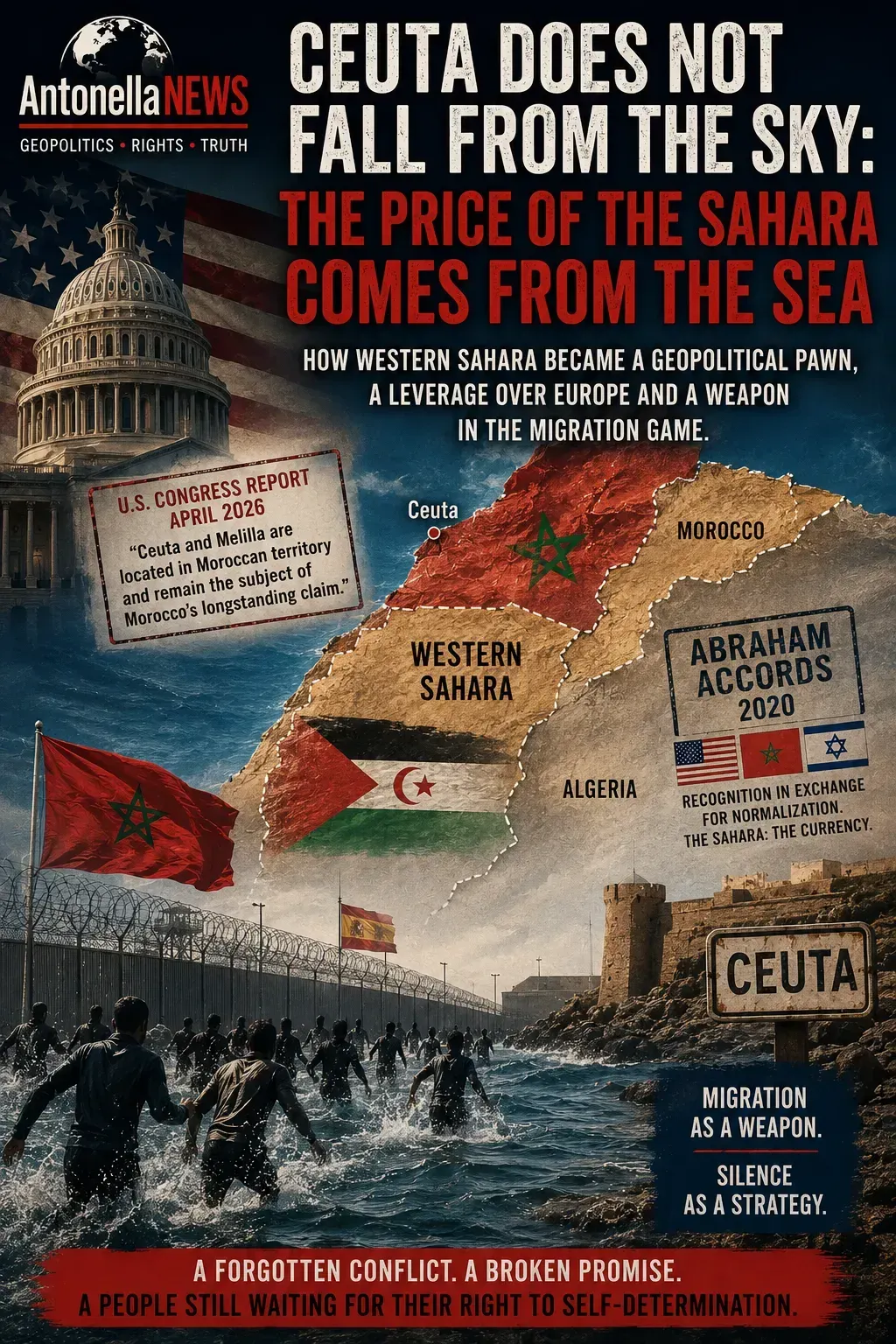
For roughly fifty years, the official position of the international community — including that of the United States, right up until 2020 — was to withhold recognition of Moroccan sovereignty over Western Sahara, keeping the territory listed by the United Nations, to this day, as “non-self-governing,” a technical term that essentially means a colonial-era territory still waiting for its people to be allowed to decide their own political future. Then, on December 10, 2020, in the final weeks of his first term in office, President Donald Trump signed a proclamation formally recognizing Moroccan sovereignty over the entire territory.
This was not simply a policy decision about North Africa made in isolation. It was, quite explicitly, the reward Morocco received in exchange for normalizing diplomatic relations with Israel, as part of the broader package of agreements known as the Abraham Accords: Morocco agreed to recognize Israel, and in return, the United States agreed to recognize Morocco’s claim over the Sahara — meaning that a territorial dispute stretching back forty-five years was effectively used as a bargaining chip in a negotiation that, on its own merits, had absolutely nothing to do with Western Sahara at all.
That single decision did more than settle one particular case; it established a method that could, in principle, be applied again elsewhere: a territory that has been frozen for decades by international law nobody actually enforces can be unlocked, in favor of one side, whenever doing so serves some larger geopolitical realignment happening somewhere else entirely. And in the years since, the relationship between Washington and Rabat has only grown closer. In October 2025, the United Nations Security Council adopted Resolution 2797, which formally named Morocco’s autonomy plan — not independence for the Sahrawis, and not a fresh referendum, but autonomy under continued Moroccan sovereignty — as the official basis for future negotiations. The European Union aligned itself with that same position in January 2026. And, crucially for the story we are telling here, Spain itself — the very country that once colonized this territory, and which arguably bears the greatest historical responsibility for the referendum that never happened — announced back in 2022 that it now considered the Moroccan proposal the “most serious, realistic and credible” solution available, effectively abandoning the neutral position it had held for decades.
So what actually happens when a disputed territory stops being simply an unresolved problem under international law and instead becomes the currency used to pay for a much larger regional strategy — and, perhaps more importantly, what happens to whoever finds themselves caught in the middle of that strategy?
Back to Ceuta: Migration Crisis, or Geopolitical Signal?
Which brings us back to July 30, 2026. Precisely because Madrid has already paid a real political price to Rabat by endorsing Morocco’s autonomy plan for the Sahara, two more recent moves by the Spanish government appear to have landed particularly badly in Moroccan eyes. The first is Sánchez’s visit to Algiers, the capital of Algeria, which happens to be the Polisario’s main international sponsor and Morocco’s chief regional rival — a visit some observers have read as an ill-timed gesture of rapprochement, arriving at precisely the wrong moment. The second is a bill currently being debated in the Spanish parliament that would grant Spanish citizenship to Sahrawis who were born, or whose parents or grandparents were born, back when the territory was still formally Spanish Sahara — a measure that would symbolically reinforce Madrid’s historic connection to the Sahrawi people, directly undercutting Morocco’s preferred narrative of full, uncontested sovereignty over the territory. The Spanish government has publicly denied any connection between these two episodes and the migration crisis, insisting that its relationship with Rabat remains “excellent” — which happens to be almost word for word the same phrase Morocco’s embassy in Madrid used on July 30 to explain the border surge as the work of “criminal trafficking networks” rather than anything resembling government policy.
On the specific events of July 30 itself, Morocco’s central government in Rabat has issued no public statement whatsoever — a silence confirmed directly by the American public radio network NPR, which reported that Morocco’s Interior Ministry simply did not respond to repeated requests for comment. This is, in fact, almost exactly the same pattern observed back in 2021, when Morocco quietly eased its border controls at Ceuta around the same time that Madrid had granted medical treatment to Brahim Ghali, the Polisario’s own leader, who was seriously ill with Covid at the time: there was no official admission of wrongdoing then either, just a sudden surge in crossings, followed — only the next day, not before — by a deployment of reinforcements using tear gas. Five years later, according to reporting from the Moroccan outlet Hespress, the same basic sequence played out again: silence first, and only afterward the deployment of water cannons to disperse the crowds gathering near Fnideq. In both cases, the Moroccan response was reactive rather than preventive, and when the same unusual pattern repeats itself twice, in almost identical circumstances, five years apart, it stops looking like coincidence and starts looking like a recognizable behavior.
So is Ceuta simply the latest flare-up along a border that has always been somewhat unstable, or is it also — through the deliberately silent language of a government’s decision not to act — a geopolitical signal being sent, quite pointedly, to Madrid?
The Paper Trail Leading Back to Washington
If that signal is indeed being read in Washington as well as in Madrid, there is a second thread running through this story — one that has received far less attention, but is, if anything, easier to document with hard evidence.
On April 1, 2026, months before a single body had been pulled from the water off Tarajal beach, a Republican member of Congress named Mario Díaz-Balart told the Spanish newspaper El Español that Ceuta and Melilla “are not in the geographic territory of Spain” but rather “in the territory of Morocco,” adding that their ultimate fate should be settled and negotiated “between friends and allies.” This was not some obscure backbench congressman making an offhand remark: Díaz-Balart is the vice-chair of the House Appropriations Committee, the body that controls federal spending, and he personally chairs the subcommittee responsible for funding American diplomacy and foreign operations around the world — in other words, he is one of the people who actually decides, in practice, how much American taxpayer money goes to which countries. He is also a member of the Congressional Morocco Caucus, an informal group of lawmakers who advocate for closer ties with Rabat.
A few weeks later, that same language found its way into an official government document. The House Appropriations Committee’s report accompanying the 2027 federal budget, filed in late April, contains wording on pages 86 and 87 that several outlets — Morocco World News, Courthouse News, Türkiye Today and Scenari Economici among them — have described as the first time in history that a congressional committee has put in writing any formal doubt about Spain’s sovereignty over its own territory. The report describes Ceuta and Melilla as cities “administered by Spain” but “located in Moroccan territory,” subject to what it calls Morocco’s “longstanding claim,” and it explicitly asks Secretary of State Marco Rubio to encourage direct diplomatic talks between Morocco and Spain over the cities’ “future status.” That same section of the report also directs at least twenty million dollars in funding through something called the National Security Investment Program, plus another twenty million dollars through the Foreign Military Financing Program, both earmarked for Morocco in the 2027 fiscal year — forty million dollars in total, sitting in the very same paragraph that opens the door to renegotiating the status of two European cities.
Taken on its own, this close proximity of language on the page — funding for Morocco right next to an invitation to discuss Ceuta’s future — does not by itself prove any direct causal connection between the two. No public document anywhere states outright that this forty million dollars is meant to “prepare” some kind of operation against Ceuta, and it would be misleading to present that as an established fact. But the shared political framing here — the same page, the same paragraph, the same committee — is not simply a neutral coincidence in how congressional budget documents happen to be organized; it reflects a deliberate choice about how that spending is being justified and understood.
Then, on July 15, 2026 — a full two weeks, not two years, before the situation at Ceuta collapsed into chaos — the full House of Representatives passed that text, a bill known as H.R. 8595, in a vote that broke down almost entirely along party lines, 217 in favor to 209 against. During that same legislative session, lawmakers voted down an amendment proposed by Republican Thomas Massie that would have cut American military aid to Israel, meaning the entire package covering Morocco, Israel and other regional allies was deliberately kept together and passed as a single unit. The bill still needs to clear the Senate before it can become law, and its path there has become complicated because it has been merged with unrelated and controversial voter-ID legislation, so technically it is not yet law. But the House of Representatives had already gone on record two full weeks before the sea at Ceuta filled with people trying to reach Spanish soil.
So why now, exactly — why would a Congress that had never before, in fifty years, put any doubt about Spanish sovereignty over Ceuta into an official written document choose to do so at precisely the moment when a migration crisis would soon make that very sovereignty look, to the outside world, like it was under siege?
The Piece That’s Still Missing: Gaza
There is one more element to this picture that deserves mention, and it is by far the most sensitive one, requiring more caution than anything discussed so far. Compared with the average position across the European Union, Sánchez’s government has taken an increasingly critical stance toward the conduct of Israel’s government over roughly the past two years, from formally recognizing the State of Palestine in 2024 to adopting notably sharper positions in EU-level discussions since then. Morocco, meanwhile, has been part of the Abraham Accords framework since 2020, and its normalization with Israel is precisely the arrangement that secured American recognition of its claim to the Sahara in the first place. Washington, for its part, treats the ongoing expansion of Arab-Israeli normalization as a long-term strategic priority in its own right, not merely as a minor detail of Moroccan bilateral relations.
None of this justifies the claim that Congress somehow punished Spain over its position on Gaza by using this particular language about Ceuta — no document, no public statement, and no primary source anywhere establishes that kind of direct connection, and that needs to be said just as plainly as every other caveat in this piece. But the timing here is not something that should simply be waved away either: the one EU country that has gone furthest in criticizing Israel over Gaza happens to be the same country whose North African border suddenly became the subject of an American congressional report, written by a committee led by lawmakers who have historically maintained close ties to both Rabat and Jerusalem.
So is the question of Ceuta’s territorial status being reopened purely to benefit Morocco, or is it also, at least in part, a way of disciplining a Spain that Washington increasingly views as drifting out of step with American strategy in the Middle East?
The Polisario in the Crosshairs, on the Very Same Day
There is one final piece of this puzzle, the most recent of all, and, chronologically, the most striking. For months, two nearly identical bills had been sitting quietly in Congress — one in the Senate, introduced by Ted Cruz, Tom Cotton and Rick Scott on March 11, 2026, and one in the House, dating back to June 2025, sponsored by Joe Wilson and Jimmy Panetta — both aimed at formally evaluating whether the Polisario Front should be designated a terrorist organization, based on allegations that it has cooperated militarily with groups linked to Iran. Both bills had been stuck in committee, going nowhere, for months.
Then, on July 31, 2026 — while Sánchez was still physically present in Ceuta describing what had happened as an attack on Spanish sovereignty, while the Guardia Civil was still in the process of counting bodies, and while Morocco’s government remained conspicuously silent — two members of the House, Josh Gottheimer, a Democrat, and Ronny Jackson, a Republican, jointly filed a new bipartisan version of that same bill, accusing the Polisario of receiving drones supplied by Iran’s Revolutionary Guard and of moving weapons across the region on Tehran’s behalf.
A single coincidence of timing, on its own, proves nothing at all: drafting and filing a piece of legislation typically takes weeks of preparation, so it cannot possibly be an instant reaction to a crisis that began that very same day. It would be a genuine error of method to claim that Congress somehow “reacted” to Ceuta on July 31. But it would be just as much a mistake to simply ignore the fact that, within that same twenty-four-hour window, while Morocco was facing its most serious migration standoff with Spain in years, another piece of the same broader strategic picture was quietly moving forward in Washington: an attempt to use the tools of American law against the one actor — the Algerian-backed Polisario — that continues to deny Morocco full, uncontested sovereignty over Western Sahara. Around this same time, Algerian state and independent media were themselves pushing the Ceuta crisis as evidence of what they described as the collapse of Morocco’s economic model, deliberately contrasting images of young people fleeing toward Fnideq with official images from Morocco’s Throne Day celebrations happening simultaneously in Rabat — yet another front, in other words, in the long-running narrative war between Algeria and Morocco, now being fought out, of all places, on the beaches of a Spanish enclave.
So why the very same day? And if this genuinely isn’t the result of direct coordination between the two events, what should we make of the fact that two entirely different instruments of pressure — one involving migration, the other involving legislation — happened to activate within the exact same narrow window, aimed at the exact same two targets: Spanish sovereignty over Ceuta, and the Algerian-backed cause of Sahrawi independence?
Who Actually Benefits From All of This
Setting all of these facts out in sequence — the Green March of 1975, the referendum that was promised and never held, the wall separating a profitable part of the desert from an unprofitable one, Trump’s recognition of Moroccan sovereignty in 2020, Morocco’s total silence on July 30, the congressional committee report, the House vote on July 15, and the fresh push against the Polisario on July 31 — is not the same thing as proving that a single hidden hand orchestrated all of it. We do not have, and it is worth repeating this with exactly the same clarity applied to every other claim in this piece, any document that actually says these forty million dollars were meant “to buy Ceuta,” nor any proof that Morocco received an explicit order to loosen its border controls, nor any statement that directly ties the fresh push against the Polisario to the migration crisis itself. Presenting any of that as an established fact would repeat precisely the kind of methodological mistake that thirty-five years of a frozen, never-held referendum ought to teach anyone to avoid — because in this particular corner of the world, international law tends to get rewritten not through explicit public announcements, but through facts quietly established on the ground, through calculated silences, and through timing that only really makes sense once you see the individual pieces laid out in their proper sequence.
What we do have, verified point by point rather than assumed, is a sequence of events spanning half a century: a territory handed over without ever consulting the people who actually lived there, back in 1975; a war followed by a referendum that was promised and never delivered; a wall separating a profitable stretch of desert from one that isn’t; a claim to sovereignty effectively purchased in 2020 through normalization with Israel; a steady international realignment — the UN Security Council, the European Union, and finally Spain itself — that has, over the past four years, eroded almost every remaining shred of ambiguity in Morocco’s favor; a key member of Congress publicly denying, on the record, Spain’s sovereignty over Ceuta and Melilla; a House committee putting that exact same position into an official written report, backed by forty million dollars earmarked for Morocco; that same text passing the full House two weeks before Ceuta’s border effectively collapsed; total, unexplained silence from Morocco’s central government in the face of the worst migration crisis it has faced with Spain in years; and, on the very same day that crisis was unfolding, a fresh legislative effort aimed squarely at the one movement still standing in the way of Morocco’s full annexation of Western Sahara.
Taken one at a time, each of these individual facts could reasonably be dismissed as coincidence, as ordinary legislative routine, or as the pet project of one ambitious lawmaker. But taken together, and understood as the latest chapter in a story that actually begins in 1975 rather than in 2026, they point toward something considerably more unsettling: the gradual, largely unspoken transformation of a decades-old Moroccan territorial claim into a diplomatic lever that Washington appears to be quietly normalizing, with Spain caught squarely in the middle — a NATO ally that has already been asked to give ground on the question of the Sahara, and that may now, for the first time, be facing similar pressure much closer to home.
One Last Question
None of this amounts, yet, to proof of an actual plan to annex Ceuta. What it may represent, instead, is the early stage of that idea becoming politically normalized, one small step at a time. And the question worth keeping in mind over the coming weeks is probably not whether Morocco deliberately opened the border at Ceuta on the night of July 30 — because, in all likelihood, no definitive documentary proof of that will ever surface, in much the same way that no such proof has ever settled the question of the referendum itself, after all these decades.
The harder, more uncomfortable question is a different one, and it reaches well beyond Spain and Morocco alone: if a referendum promised by the United Nations — one important enough that an entire peacekeeping mission was named after it — can remain frozen and unresolved for more than three decades without any real consequence for whichever side is responsible for blocking it, then which other principles of international law, ones that most of us take entirely for granted today, might turn out to be just as negotiable, whenever geopolitical interests happen to require it?
If this piece helped you notice a connection that most mainstream coverage has been reporting only in scattered, disconnected fragments, consider subscribing to AntonellaNEWS — this is where these threads get followed all the way through, one document at a time, from 1975 right up to the present day. And if you happen to have Moroccan, Algerian, Sahrawi or American sources who could help confirm or challenge any part of this reconstruction, leave a comment — every additional piece of evidence helps complete the picture.
Main sources: Reuters; AFP; Al Jazeera; NPR; Europa Press; Courthouse News Service; Morocco World News; Türkiye Today; Scenari Economici; Hespress; El Español; UN resolutions and historical documentation on Western Sahara and MINURSO; UN Security Council Resolution 2797 (October 2025); Madrid Accords (November 14, 1975); US presidential proclamation on Western Sahara (December 10, 2020); House Committee on Appropriations, H.R. 8595 and Filed Report 119-631 (Congress.gov); Clerk of the House, Roll Call 247 (July 15, 2026); S.4063 and H.R.4119, Congress.gov; Office of Rep. Josh Gottheimer, press release of July 31, 2026; Office of Sen. Ted Cruz; UNHCR; CRS – Congressional Research Service, R48956.