From Salento to Sazan Island: The New Map of Israeli Power in the Mediterranean

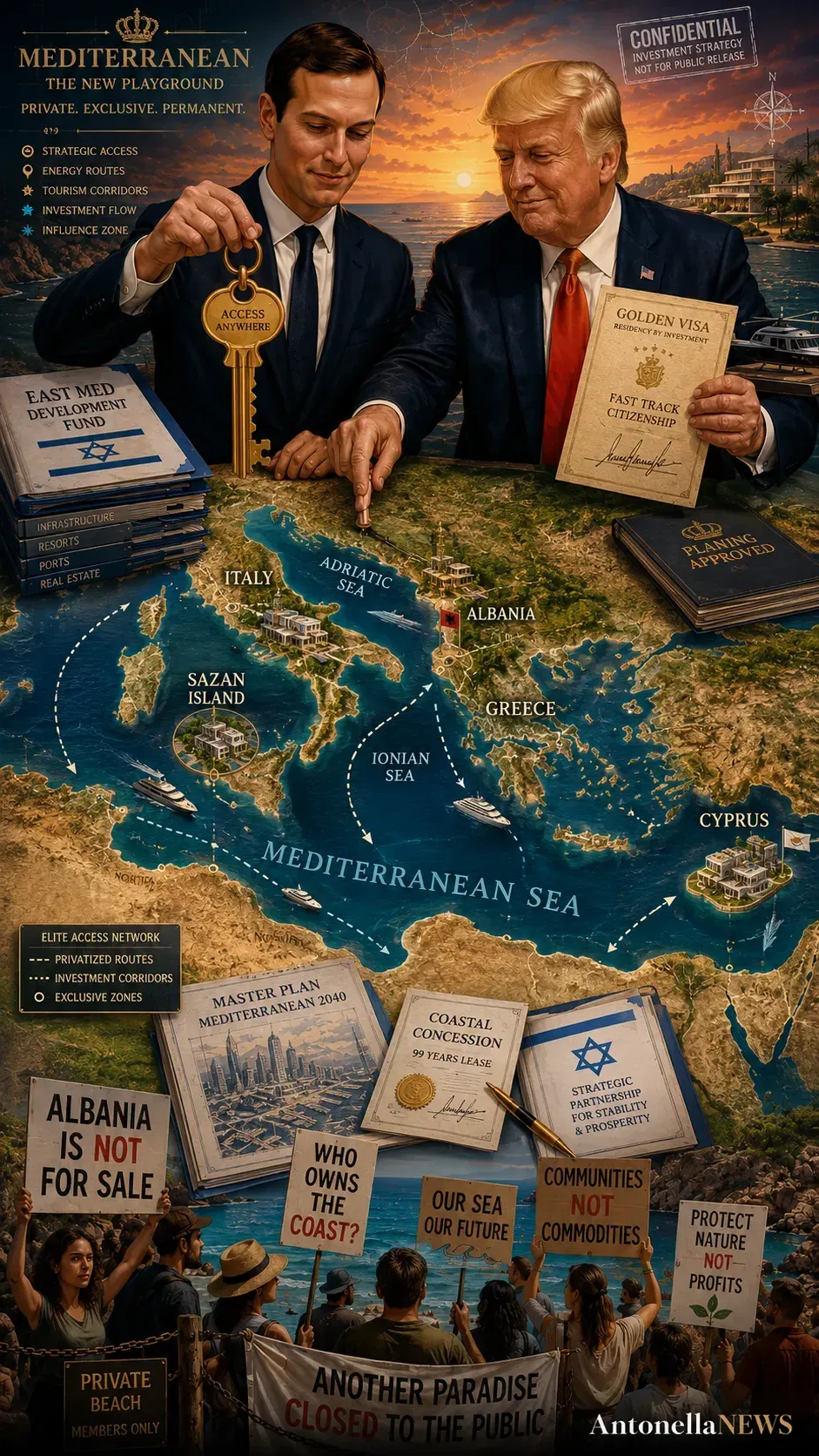
When the luxury resort stops being merely tourism and becomes an instrument of geopolitical repositioning in the Mediterranean.
Jun 04,2026
Anarrative journey through Israeli communities in the Italian Alps, golden visas in Cyprus, projects in Greece and Serbia, the Kushner-Trump mega-resort in Albania, and the questions now emerging in the U.S. Senate.
Are we witnessing simple investments — or the birth of a new form of territoriality?
The first warning signs in the Italian hills
A few years ago, in the mountains of Valsesia in Piedmont, a small but stable community of Israeli families began to take shape. These are not tourists passing through, nor second homes for holidays. These are properties purchased systematically, with schools, services, and daily relations with the surrounding territory.
Further south, in Salento, projects such as Coral 37 are presented as self-sufficient communities intended for Israeli families: agriculture, energy production, internal services. Models of enclaves partially separated from the ordinary fabric of the country.
Seen only within Italy’s borders, these phenomena can still be interpreted as isolated cases of wealth migration or a search for safety. But if one follows the thread crossing the Mediterranean, a broader and more coherent pattern begins to emerge: the multiplication of civilian, financial and logistical footholds inside formally sovereign countries, built through legal instruments, accelerated regulatory exemptions, and capital very close to American and Israeli political and financial circles.
The Mediterranean as a new laboratory of influence
The Mediterranean is no longer only the sea separating Europe from North Africa and the Middle East. It is becoming a transition zone in which the boundary between private investment, strategic presence and the silent redefinition of sovereignty is growing increasingly thin.
Large luxury real-estate projects, infrastructure schemes and exclusive communities no longer serve only tourism or rent extraction. They also function as instruments of influence, privileged fiscal platforms and, in some cases, forms of hybrid territoriality.
In this scenario, elite tourism and mega real-estate projects become vehicles for creating semi-autonomous economic enclaves: zones with their own rules of access, security and taxation, linked to one another by flows of capital and influence, but increasingly distant from the priorities of local populations.
Cyprus: the most advanced laboratory
In Cyprus, the debate has been going on for years and has reached a high level of public awareness. Golden visa and citizenship programmes have attracted massive flows of capital. Entire stretches of coastline have passed into foreign hands. Residential districts and complexes have emerged with urban-planning and fiscal rules different from the rest of the island.
Many Cypriots no longer perceive these spaces simply as tourist development. They experience them as territories that, while formally remaining under Cypriot sovereignty, operate according to partially autonomous economic and social logics. Zones in which foreign concentration has altered prices, services and, potentially, political balances of power.
Cyprus represents the most mature case of this transformation. Here, the perception of “separate territories” inside the same state has become a recurring subject of public debate.
Greece and the Balkans: the model expands
The same dynamic, with different levels of intensity, can be observed in parts of Greece. Acquisitions of high-value real estate, large-scale tourism projects, investments in minor port and airport infrastructure.
Here too, the official justification is always “modernisation” and “job creation”. But when urban-planning and environmental exemptions are granted with unusual speed to certain investors, and when entire portions of coastal territory end up being managed according to their own standards, the line between development and partial surrender of control becomes the object of increasingly heated debate.
In the Western Balkans, Serbia included, the picture intersects with broader geopolitical calculations. Investments in infrastructure, energy and luxury real estate are never purely economic. They form part of a competition for influence between extra-European powers and Atlantic actors.
The result is a web of projects which, when observed together, reveal the same logic: the creation of economic and logistical nodes with a degree of autonomy from ordinary state control.
Albania and the Kushner project
It is within this regional context that the Albanian case must be placed. Not as an isolated episode, but as the latest visible piece of a wider mosaic.
In late 2024, only a few weeks before Donald Trump’s inauguration, Edi Rama’s government granted “strategic investor” status to Atlantic Incubation Partners LLC, Jared Kushner’s company.
The Zvërnec South Adriatic Development project includes around one thousand luxury villas, five-star hotels and a new international airport between Sazan Island and the Zvërnec peninsula, inside the protected Pishë Poro-Narta wetland.
The declared value exceeds $1.4 billion. The final permit was issued on 29 April 2026. A few months earlier, the Albanian Parliament had amended the legislation on protected areas, introducing the possibility of building high-end hotel structures in zones previously off limits.
The timing of the amendment has fuelled suspicions that the law was written to fit the project.
Sazan Island is not just any beach
Forty-one environmental organisations from twenty-eight countries have called for the immediate suspension of the project. Local residents, associations and the Greek minority in the area have taken to the streets with a clear message:
“Albania is not for sale.”
What makes the case particularly significant is not only the environmental impact. It is the fact that a sovereign state accelerated regulatory exemptions and granted privileged status to an investor linked to a political family that was about to return to power in the United States.
The question many Albanians are asking is whether this is a purely economic investment — or whether it also contains a diplomatic and strategic dimension.
Sazan Island is not just any beach. Historically a military base for the control of the Adriatic, the island has strategic value that goes far beyond tourism.
Any advanced infrastructure — especially an international airport — in a sensitive coastal area creates physical presence, flows and long-term relationships that cannot be interpreted only through the lens of recreation.
Luxury tourism, in certain contexts, also functions as a vehicle for geopolitical positioning.
The Albanian protest and the suspicion of a tailor-made law
The protest rising in Albania brings together environmentalists, residents, local opposition forces and part of the Greek minority. This cross-cutting alignment suggests that the perceived problem is not only ecological.
It is the feeling that a portion of national territory is about to be transformed into something separate from the interests of the local population — economically, legally and, in perspective, politically.
When a state modifies its environmental and urban-planning framework to accommodate geopolitically powerful capital, the issue stops being merely “tourism development”.
It becomes a question of administrative sovereignty.
The voice coming from Washington
While protests were growing in Albania, in Washington Democratic Senator Chris Murphy — long attentive to the dynamics of foreign influence and the relationship between American politics and overseas investments — raised broader questions about the nature of certain real-estate and infrastructure deals in the Balkans and the Mediterranean.
This was not a direct attack on the Albanian project. It was a wider concern: when large operations are accelerated through regulatory exemptions and privileged statuses, and when the actors involved have direct ties to influential political circles, it becomes legitimate to ask whether this is still simple economic activity — or a more sophisticated form of influence projection.
Hybrid territoriality: the method changes depending on the context
The thread connecting Valsesia, Salento, Cyprus, Greece, Serbia and Albania is not a conspiracy.
It is a method that adapts to context.
In the Middle East, where Israel maintains military superiority or direct control, expansion takes place through force, settlements and de facto annexation — a presence that the International Court of Justice has defined as illegal in the Occupied Palestinian Territories.
In the European Mediterranean and its immediate Balkan extensions, the instrument cannot be military. It becomes civilian, real-estate-based, financial, touristic, energetic, educational.
Communities, properties, infrastructure and enclaves with partially autonomous rules multiply. They are not colonies in the classical sense.
They are forms of hybrid territoriality: formally legal, yet capable of creating economic and social spaces that respond to logics different from those of the host state.
This external presence serves several objectives at the same time: wealth protection, the construction of strategic depth, and the gradual normalisation of political and economic relations.
The question that remains open
Albania, with its position on the Adriatic and its Euro-Atlantic alignment, represents a logical piece in this emerging geography.
The Kushner and Ivanka Trump project is not the only one. It is the most visible at this moment, and the most explicit in showing how a small state can be induced — or can choose — to modify its regulatory framework in order to welcome geopolitically powerful capital.
The question emerging from this journey along the coasts of the Mediterranean is no longer whether individual projects are legitimate or not.
It is broader.
And more uncomfortable.
Are we observing simple international investments — or the birth of a new form of territoriality in the twenty-first-century Mediterranean?
A territoriality in which portions of sovereignty are ceded not through formal treaties, but through accelerated regulatory exceptions, privileged statuses, semi-autonomous economic enclaves and the creation of stable physical presences by transnational elites.
A map that does not yet appear in official atlases, but which is redefining, piece by piece, the real balance of power along coasts that once separated continents and empires.
If this trend continues without explicit public debate and without stronger democratic oversight mechanisms, the Mediterranean of the future may no longer be only a sea contested by powers.
It may become an archipelago of enclaves with varying degrees of autonomy, connected to one another by flows of capital and influence, but increasingly distant from the priorities and control of the populations who inhabit them.
The question remains open.
And the answer we give in the coming years will decide what kind of Mediterranean — and what kind of Europe — we leave to future generations.
The investigation continues
This is not a story that ends in Albania.
Nor in Italy.
Nor in Cyprus.
The questions emerging from this journey concern the very future of the Mediterranean and the relationship between global capital, national sovereignty and democratic control of territory.
If this research was useful to you, share it.
Not to spread a conclusion already written.
But to widen the debate and stimulate further verification, questions and public scrutiny.
Because geopolitics does not manifest itself only in wars.
Sometimes it manifests itself in contracts nobody reads, in laws nobody watches, and in territories changing ownership while almost no one notices.
Subscribe to AntonellaNEWS to receive the next investigative dossiers, geopolitical analyses and in-depth reports dedicated to the great transformations reshaping the Mediterranean and twenty-first-century Europe.
Sources
Reuters – Albania approves luxury resort project linked to Jared Kushner’s company (2025)
Reuters – Albanian protests against Kushner-linked resort project (2026)
Associated Press (AP) – Reporting on Albania resort controversy and regional reactions
U.S. Senate hearings – Statements by Senator Chris Murphy regarding Balkan investments and anti-corruption concerns
International Court of Justice (ICJ) Advisory Opinion (2024) on the Occupied Palestinian Territories
Haaretz – Reporting on Israeli communities and migration trends in Northern Italy / Valsesia
The Times of Israel – Real-estate investment trends involving Greece and Cyprus
Kathimerini – Foreign property acquisitions and Golden Visa developments in Greece
Cyprus-based reporting and parliamentary debates concerning foreign property ownership and Golden Visa programmes
Public documentation relating to Albania’s Strategic Investor framework
Environmental organisation.