HOW ITALY JUST MORTGAGED 45 YEARS
If your government is a shareholder in a defense company, and that government asks the EU for money to finance that company, knowing it will make the stock rise—and the company is 60% owned by American investors who profit from the rise—is that a conflict of interest?

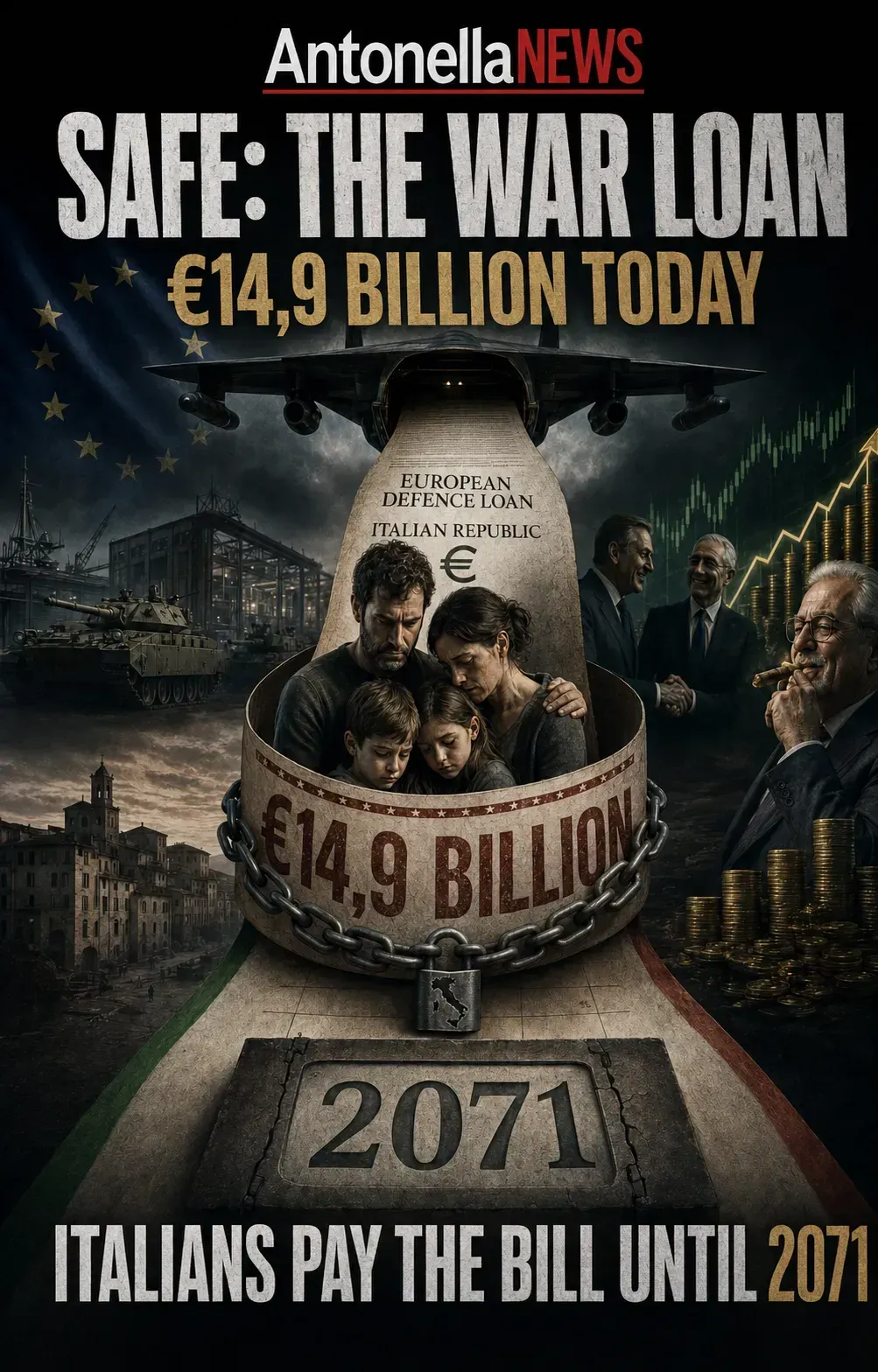
€14.9 Billion in Public Debt That Profits Wall Street and the Gulf—While Italians Pay Until 2071
Aug 02,2026
n 28 July 2026, the Italian government announces something that sounds like good news: €14.9 billion from Europe’s SAFE fund. Favorable rates. “Financing for Italian defense.”
What they don’t tell you: it’s a 45-year loan.
The Leonardo defense company’s stock rises 17% in three weeks. American shareholders gain billions. Saudi Arabia quietly closes a deal to acquire Italian aerospace capabilities. Italian taxpayers will service this debt until 2071.
This is how Europe’s biggest military financing scheme works: quietly, technically, without democratic scrutiny. And why nobody talks about it.
THE ANNOUNCEMENT THAT CHANGED EVERYTHING (AND NO ONE NOTICED)
On 28 July 2026, Italy’s Minister of Economy Giancarlo Giorgetti makes an announcement he frames as a win.
€14.9 billion from Europe’s SAFE fund (Security Action for Europe). Favorable interest rates. Money for “Italian defense.”
The markets cheer. The defense sector stocks spike. Leonardo—Italy’s flagship defense contractor—rises 17% in three weeks.
But stop for a second. Read this carefully.
It’s not a grant. It’s not a gift. It’s a loan. For 45 years. With interest that will grow over time.
That means one in ten Italians alive today will be dead before this debt is repaid.
And here’s what no politician mentioned on the evening news:
Who actually gets rich from this?
FIVE DAYS THAT TELL THE WHOLE STORY
In November 2024, Leonardo’s CEO Roberto Cingolani drops a bombshell during earnings.
He announces the company is considering spinning off its Aerostrutture division (aircraft parts manufacturing). It’s the kind of announcement that makes labor unions panic. Within hours, workers at the Grottaglie plant in Puglia are striking.
“Our jobs are not for sale!” the signs read.
Then, five days later, Cingolani reverses course completely.
No spinoff. No sale. Never happening. Everything is fine.
But why announce it in the first place?
A few months later, in January 2025, Cingolani adds something that reframes the entire situation.
He says the company needs an “international alliance“ to transform the Aerostrutture division.
Not a sale. An “alliance.”
Key word.
ENTER SAUDI ARABIA (NO HEADLINES)
In February 2025, Bloomberg breaks a story that barely makes Italian news.
Saudi Arabia’s sovereign wealth fund—the Public Investment Fund (PIF)—is in advanced negotiations to acquire a major stake in Leonardo’s Aerostrutture division.
You didn’t read this in the Italian mainstream media. Not on RAI. Not in Corriere della Sera. If you’re an average Italian, you have no idea that Saudi Arabia is about to own part of your country’s defense infrastructure.
Three weeks later, Premier Giorgia Meloni flies to Riyadh. She meets Crown Prince Mohammed bin Salman. They sign agreements worth $10 billion.
Leonardo updates its memorandum with the Saudis: “new joint technological development projects.”
Translation: technology transfer.
In February 2026, PIF representatives visit Leonardo’s factories in person. Nola. Pomigliano. Foggia. Grottaglie.
This is due diligence. This is a pre-acquisition inspection.
Still, zero coverage in Italy.
By July 2026, Leonardo announces it received an order for 11 helicopters from “The Helicopter Company.” Deliveries in 2027-2028.
Who is The Helicopter Company? A company owned by the PIF.
First concrete order from your new “international ally.”
ONE WEEK BEFORE THE BIG ANNOUNCEMENT
Now, here’s where it gets interesting.
On 19 May 2026, Leonardo’s board approves a share buyback program. Standard corporate procedure. Supports employees, stabilizes the stock, routine financial maneuver.
It kicks off on 29 June 2026.
Between 29 June and 3 July, Leonardo repurchases 880,000 shares at €46.87 each. €41 million total.
Mark the dates:
- 29 June - 3 July: Leonardo buyback program
- 28 July: Government announces SAFE (€14.9 billion)
- 31 July: Leonardo stock at €54.78
That’s +17% in one month.
If you held Vanguard stock (which owns 3% of Leonardo), you just made billions.
If you held BlackRock (2.77%), you made hundreds of millions.
If you were positioned in an activist hedge fund like Sachem Head (1.68%), you profited massively.
The buyback, arriving just one week before the SAFE announcement, looks consistent with a price-support strategy.
Is there proof of coordination? No.
But two timelines run in parallel, and they produce the same result: the stock rises. Shareholders profit.
WHO REALLY OWNS LEONARDO
Here’s the part they don’t teach you in civics class.
Leonardo is described as “Italian state-controlled.” True—the Italian government owns 30%.
But 70% is public. Anyone can buy shares.
And here’s what happened: 90% of that free float is controlled by foreign investors.
Mostly American.
Here’s the breakdown:
Vanguard Group: 3.04% BlackRock: 2.77% Capital Research & Management: 5.05%
These three American mega-funds control approximately 11% of Leonardo combined.
But these aren’t ordinary investors.
- Vanguard manages $8 trillion globally
- BlackRock manages $10 trillion
- Capital Research manages $600 billion
Add in Sachem Head Capital Management, an activist hedge fund that doesn’t just invest—it intervenes in companies to “unlock value.” They own 1.68% of Leonardo.
So roughly 20-25% of Leonardo is controlled by American mega-investors who all have the same incentive: Leonardo should make money. The stock should rise. Defense orders should flow.
Italian government owns 30%. But 20-25% of coordinated American investors outweighs fragmented state ownership.
Who actually decides what gets voted on in a Leonardo shareholder meeting?
Italian government (30%) + American mega-investors (20-25%) = about 50-55% combined.
When Italy’s government requests €14.9 billion in SAFE funds to buy Leonardo products, they’re automatically enriching American shareholders.
This isn’t corruption. It’s not illegal. It’s just how modern capitalism works.
Nobody calls a meeting. Nobody needs to coordinate. The financial incentives align automatically.
WHO WINS, WHO LOSES
The Winners:
✓ Vanguard, BlackRock, Capital Research: +17% on their Leonardo stake = billions of dollars
✓ Sachem Head Capital: Activist profits on their 1.68%
✓ Saudi PIF: Acquiring aerospace division at favorable terms
✓ EDGE (UAE fund): Already partner in Leonardo defense systems (announced earlier in 2025)
✓ Leonardo management: Stock incentives + buyback bonuses
✓ US defense contractors: Increased European spending means increased orders
The Losers:
✗ Average Italian: Carries €52,000 in per capita public debt right now
✗ Plus 45 years of repayment: About €571 per citizen distributed across decades
✗ Plus higher taxes: To service growing interest on debt
✗ Plus fewer services: Healthcare, education, infrastructure—all competing with debt repayment
✗ Plus future generations: Who’ll inherit debt for decisions they didn’t make
DO THE MATH
Here’s what the government doesn’t say on prime-time news.
Italy spends €65-70 billion annually on interest alone. That’s more than the entire education budget.
For an average worker, roughly two months of salary every year goes just to servicing the national debt. Before paying for anything else.
Adding €14.9 billion in SAFE? That’s 45 years of additional fiscal burden.
Conservative estimate: each Italian carries about €571 in additional repayment costs over 45 years. A family of four: €2,284.
But the real damage is structural. Less space for healthcare. Less space for education. Less space for investments that create jobs.
SAFE exists because Europe wanted €800 billion in military spending by 2030. The US pushed NATO members to spend 5% GDP on defense by 2025. Italy couldn’t do this with a normal budget without catastrophic cuts.
So Italy borrowed for 45 years.
And who benefits from European rearmament?
Vanguard. BlackRock. American defense contractors. And the Saudi government.
WHAT REMAINS UNANSWERED
Question 1: What percentage of Leonardo will Saudi Arabia actually acquire?
Bloomberg reported “51%” in February 2025. The government has never officially confirmed this. It’s possible the PIF will own a majority of Aerostrutture, and Italians won’t find out until the deal closes.
Question 2: When will this be announced publicly?
Before SAFE is activated? After? Never? At what point does transparency become mandatory?
Question 3: Did the Italian government know SAFE would spike Leonardo’s stock?
Of course they knew. Announcing a €14.9 billion defense spending program obviously helps defense stocks. But you’re a shareholder in Leonardo (30%) requesting public European money to finance it—knowing your asset will appreciate. That’s not illegal. But it’s a conflict of interest worth discussing.
Question 4: How do you justify adding €14.9 billion in debt when Italy already sits at 138.6% debt-to-GDP?
The IMF warned this could hit 150% by 2030. Where’s the plan to reduce debt? Where are the guarantees this doesn’t make things worse?
Question 5: Why didn’t parliament vote on SAFE?
The PNRR (post-pandemic recovery plan) required a parliament vote. SURE (unemployment insurance fund) required a vote. But SAFE—which binds Italy for 45 years—did not. Major fiscal decisions now bypass legislative scrutiny. Why?
The Italian government offers no public answers.
WHAT THIS REVEALS ABOUT EUROPE
Beyond Italy, this case exposes how European defense financing actually works:
American investors control European defense decisions. When Vanguard, BlackRock, and Capital Research own significant stakes in defense contractors, European strategic autonomy becomes theoretical. Washington doesn’t need diplomats. It has shareholders.
Defense spending has been privatized. What used to be a sovereign fiscal decision is now managed through European financial instruments controlled by foreign investors. SAFE lets governments spend on weapons while technically circumventing deficit rules—fiscal sleight of hand that displaces accountability.
Technology flows to the highest bidder. Saudi PIF acquiring European aerospace capabilities represents a significant technology transfer from NATO allies to Gulf monarchies. This happens within SAFE, with minimal oversight.
Democracy doesn’t scale. Major economic decisions affecting 59 million citizens are now framed as “technical European procedures” requiring minimal public input. Parliament is bypassed. The public is uninformed. The results are locked in.
WHAT YOU SHOULD KNOW
If you connect the official statements, stock price data, timelines, and financial records, a pattern emerges:
Italy borrows €14.9 billion.
Who gets rich? Not Italy. Foreign investors.
Who pays? Italians. For 45 years.
It’s not a conspiracy. It’s how the system is designed. It’s what happens when defense becomes a financial asset class.
Defense is necessary. NATO exists. But there were alternatives. Investing in healthcare creates jobs and saves lives. Investing in education builds human capital. Investing in renewable energy creates industry.
Italy chose SAFE.
Starting in 2027, the interest payments begin. For the next 45 years, money flows out. Vanguard, BlackRock, the PIF, American defense contractors—they count their profits.
Meanwhile Italian schoolkids in 2071 will still be paying for a decision nobody asked them about.
That’s the system. That’s how it works. That’s is Italian Political establishment run the country since the seventy years.
The question is: does it deserve to work this way?
HOW TO FOLLOW THIS STORY
This is Part 1. There’s more coming:
- Part 2: “Why the Italian Government Silent on Saudi Arabia”
- Part 3: “How SAFE Finances American Defense Contractors”
- Part 4: “What Italy Could Have Done Instead”
Want to stay informed? Subscribe below. You’ll get each investigation as it drops—plus access to the full source documentation and follow-up analysis.
Want to share this? Use the button at the bottom. Forward it to friends, colleagues, people in policy. This story affects everyone.
Have information to add? Comment below. Readers often add crucial details the mainstream press misses.
A FINAL QUESTION
If your government is a shareholder in a defense company, and that government asks the EU for money to finance that company, knowing it will make the stock rise—and the company is 60% owned by American investors who profit from the rise—is that a conflict of interest?
Nobody in Italian politics wants to answer that question. Maybe that’s the story worth following isn't it?
SOURCES
Official Communications
- Italian Government, Ministry of Economy, 28 July 2026
- Leonardo SpA, Borsa Italiana filings (May-July 2026)
- EU Regulation 2025/1106 (SAFE)
- European Commission, Excessive Deficit Procedure (Italy)
Verified Press Coverage
- Bloomberg, “Saudi PIF Negotiates Leonardo Investment,” 26 February 2025
- Il Sole 24 Ore, “Cingolani Reverses on Aerostrutture Spinoff,” 26 February 2025
- Il Fatto Quotidiano, “Cingolani Announces Spinoff,” November 2024
- Il Post, “Meloni in Riyadh Signs Defense Agreements,” January 2026
Financial & Economic Data
- ISTAT (Italian Statistical Institute), Debt figures, February 2026
- Bank of Italy, Interest Expense on Public Debt, 2025-2026
- European Central Bank, SAFE Interest Rates
- Borsa Italiana, Historical Leonardo stock data
Equity Ownership
- Bloomberg Terminal, Leonardo top shareholders
- SEC Filings (USA), Investment disclosures
- Leonardo SpA, Management report 2025
Labor & Political Records
- Italian labor unions (Fim-Cisl, Fiom-Cgil, Uilm-Uil), meeting minutes, November 2024
- Quotidiano di Puglia, Labor union coverage
AntonellaNEWS — Investigating where Italian public money goes, who profits, and why nobody talks about it.
YOU ALREADY KNOW THE MAINSTREAM WON’T COVER THIS
So you know what I’m talking about. Every article here tells a story traditional media ignore, with verified sources, unanswered questions, and the connections nobody makes.
f you want to read them first—before they get diluted elsewhere—subscribe now.
And if you think someone else should read this, share the link. I need readers who think critically.
You’re one of them.