ICE: From Administrative Agency to Internal Coercive Force

Minneapolis, Project 2025, and the Paradox of Imported Security Antonella Silipigni
Jan 10,2026
When Enforcement Becomes Politics
For years, U.S. Immigration and Customs Enforcement (ICE) has been portrayed as an administrative agency: immigration, removals, borders.
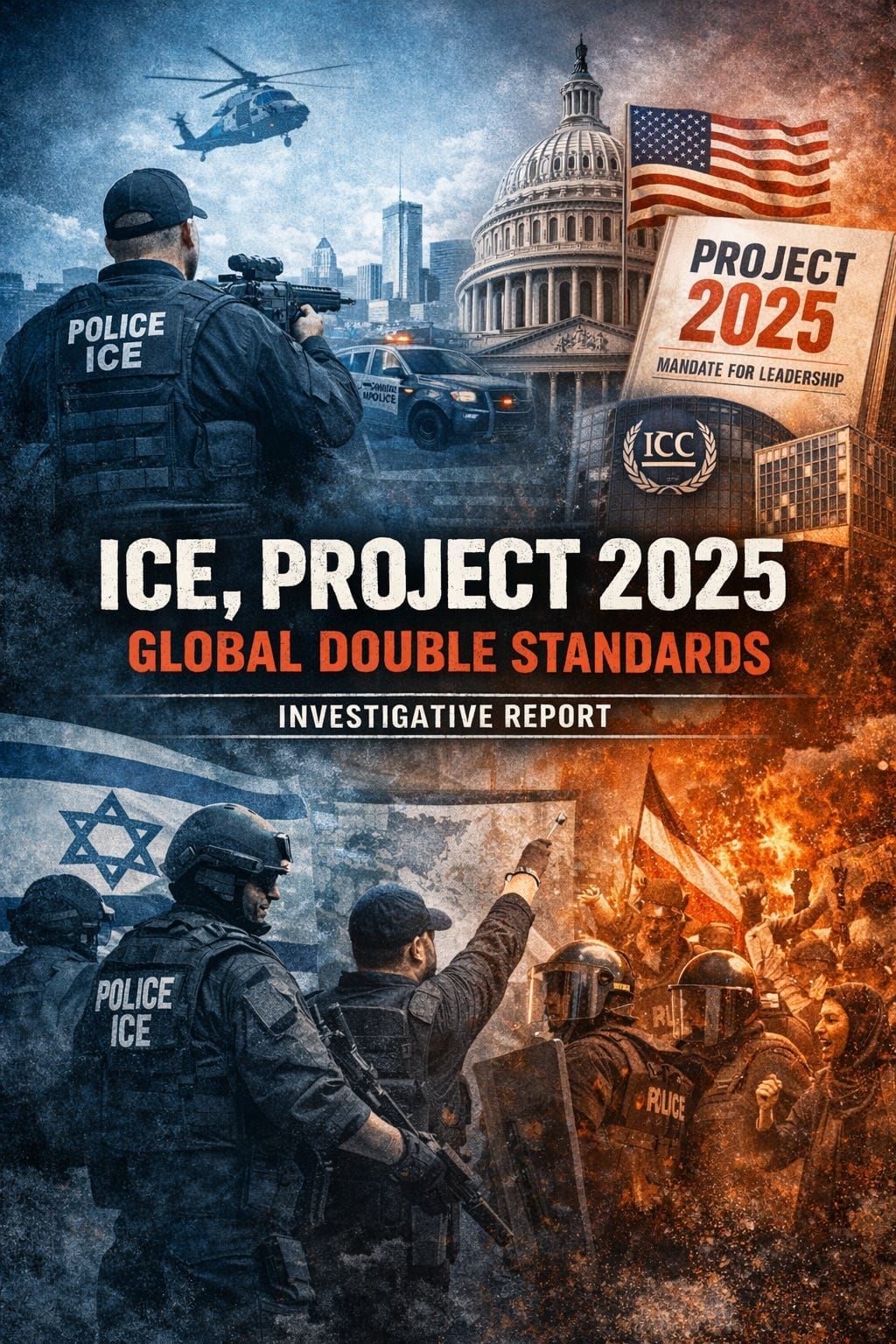
What emerges in the 2025–2026 period — and what the Minneapolis case makes impossible to ignore — is a structural transformation: ICE as an internal policing force, capable of overriding local police, imposing securitized narratives, and removing its actions from effective oversight.
This is not an accident.
It is a change of function.
1️⃣ Minneapolis: a local case revealing a federal pattern
On January 7, 2026, during a federal operation in Minneapolis, U.S. citizen Renee Nicole Good was killed by an ICE agent belonging to a tactical unit (ERO Special Response Team).
Verifiable facts
- Video footage of the event exists (bystander recordings and partial material released through government channels).
- The official narrative speaks of an “attempted vehicular assault” and rapidly adopts the frame of “domestic terrorism.”
- Eyewitnesses, independent analyses, and local authorities dispute this account: the woman appears to have been attempting to leave the scene, not posing an imminent threat.
The institutional node (more serious than the shooting itself)
The investigation was federalized: the Federal Bureau of Investigation took control, limiting access to evidence for Minnesota state authorities.
👉 This step is crucial:
we are no longer dealing only with use of force, but with who controls the evidence, who shapes public truth, and who answers to whom.
Minneapolis thus becomes a litmus test for the new federal posture.
2️⃣ ICE today: when an administrative agency becomes a coercive force
In recent years ICE has progressively expanded:
- the use of armed and tactical units;
- participation in large-scale domestic operations (thousands of agents, multi-agency coordination);
- a militarized operational culture, increasingly indistinguishable from internal security forces.
This evolution is not only practical, but narrative:
- official communication precedes judgment (“terrorism”);
- independent review comes later — if at all;
- local accountability is compressed.
ICE no longer merely “enforces the law”: it produces political order.
3️⃣ Project 2025: enforcement as a governing architecture
This shift fits into a broader framework: Project 2025, the executive reorganization plan promoted by the orbit of the Heritage Foundation.
Programmatic documents outline clear directions:
- centralization of executive power;
- expanded use of ICE detention capacity;
- reduction of alternatives to detention;
- framing immigration and internal order as a structural security issue, not an emergency.
In this sense, Minneapolis is not an anomaly: it is an operational preview of a doctrine that turns federal enforcement into a permanent political instrument.
4️⃣ International cooperation: the systemic level (not the individual agent)
A sensitive point — often distorted by propaganda — concerns security cooperation between the United States and Israel.
What is documented
- ICE/HSI operate within a global network of offices and international liaison posts.
- There are official channels for cooperation and exchange on immigration, counter-terrorism, and border control.
- Training programs and seminars for U.S. law-enforcement personnel in Israel are documented, promoted by security organizations and networks.
👉 Key point:
this does not prove that the individual agent involved in Minneapolis was trained by the IDF.
It does prove the existence of a transnational security ecosystem, where doctrines, practices, and language are shared and normalized.
Here, analysis must remain systemic, not personalized.
5️⃣ The legal paradox: security imported from a state under accusation
This is where the most uncomfortable question emerges.
Israel:
- is described by major international NGOs as operating a system of apartheid;
- has political leaders targeted by International Criminal Court arrest warrants (2024);
- is subject to proceedings and legal opinions before the International Criminal Court and the International Court of Justice.
And yet, it continues to be treated as a partner of securitarian “best practices.”
This is not an oversight.
It is a choice.
👉 International legality is not the guiding parameter of security policy.
What matters is control effectiveness, not compliance with law.
Israel is not adopted as an ethical model,
but as an operational laboratory for advanced coercive governance.
6️⃣ Minneapolis and the American double standard: when force is “repression” only if used by others
The Minneapolis case becomes even more revealing when placed within the systemic double standard of the United States regarding the use of force against civilians.
For years, Washington:
- publicly condemns European countries when police use force against protesters (France, Germany, Italy, Greece), speaking of erosion of the rule of law;
- regularly accuses Middle Eastern governments — particularly Iran — of violent repression of dissent, calling for sanctions, UN resolutions, and diplomatic isolation;
- uses human rights language as a geopolitical tool of pressure and delegitimization.
Yet, when lethal force is used on U.S. soil, during a federal operation against unarmed civilians or protest observers, the grammar changes completely.
In Minneapolis:
- the use of weapons is immediately justified, before any independent forensic review;
- the victim is semantically criminalized (“domestic terrorism”) without judicial determination;
- the investigation is removed from the local level and centralized federally, reducing transparency and accountability.
👉 This is not a communication accident.
It is a structural asymmetry.
The United States does not reject the use of force per se:
it rejects it only when used by others and outside its control.
When force is exercised:
- by non-aligned governments → it is repression;
- by allied governments → it is public order;
- by the U.S. federal state → it is self-defense or operational necessity.
Minneapolis shows that the same standards invoked against Iran, or against European states during social protests, are not applied domestically.
The difference is not legal.
It is political and hierarchical.
Those who hold hegemony define:
- what counts as legitimate protest;
- what constitutes a threat;
- when force is abuse and when it is “necessary.”
Here, Minneapolis ceases to be national news and becomes a mirror of the international order:
a system in which human rights are not universal principles, but selective instruments of power.
The question that remains
The question is not:
“Why Israel?”
The real question is:
why are Western democracies seeking authoritarian models without admitting it?
ICE today is one of the instruments through which this transformation takes shape.
Minneapolis is merely the moment when the veil was torn.