Nigeria, Somaliland and December 2025
Nigeria, Somaliland and December 2025 The war they don’t tell you about: religion as narrative, Africa as a geopolitical battlefield
The war they don’t tell you about: religion as narrative, Africa as a geopolitical battlefield
dic 28, 2025
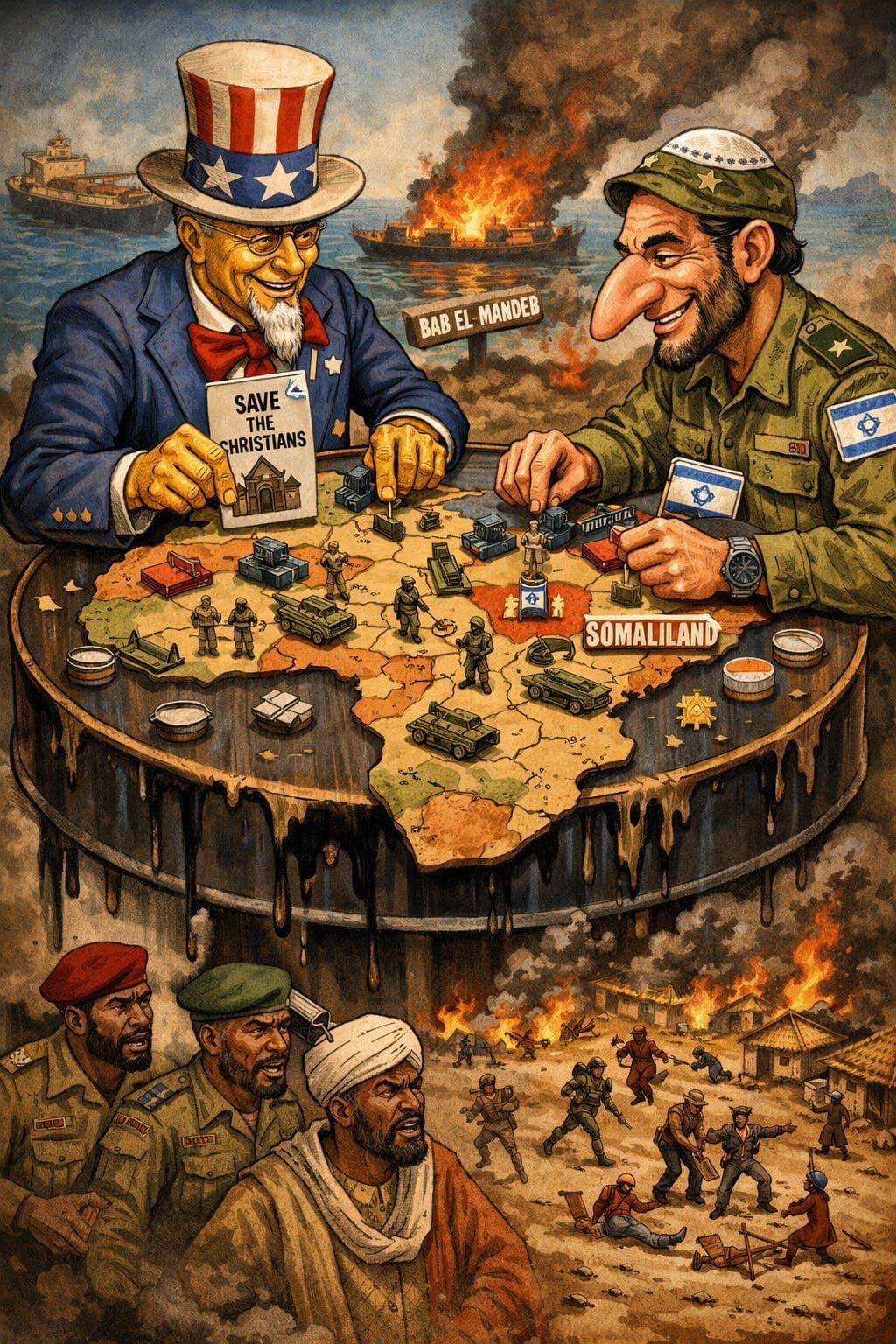
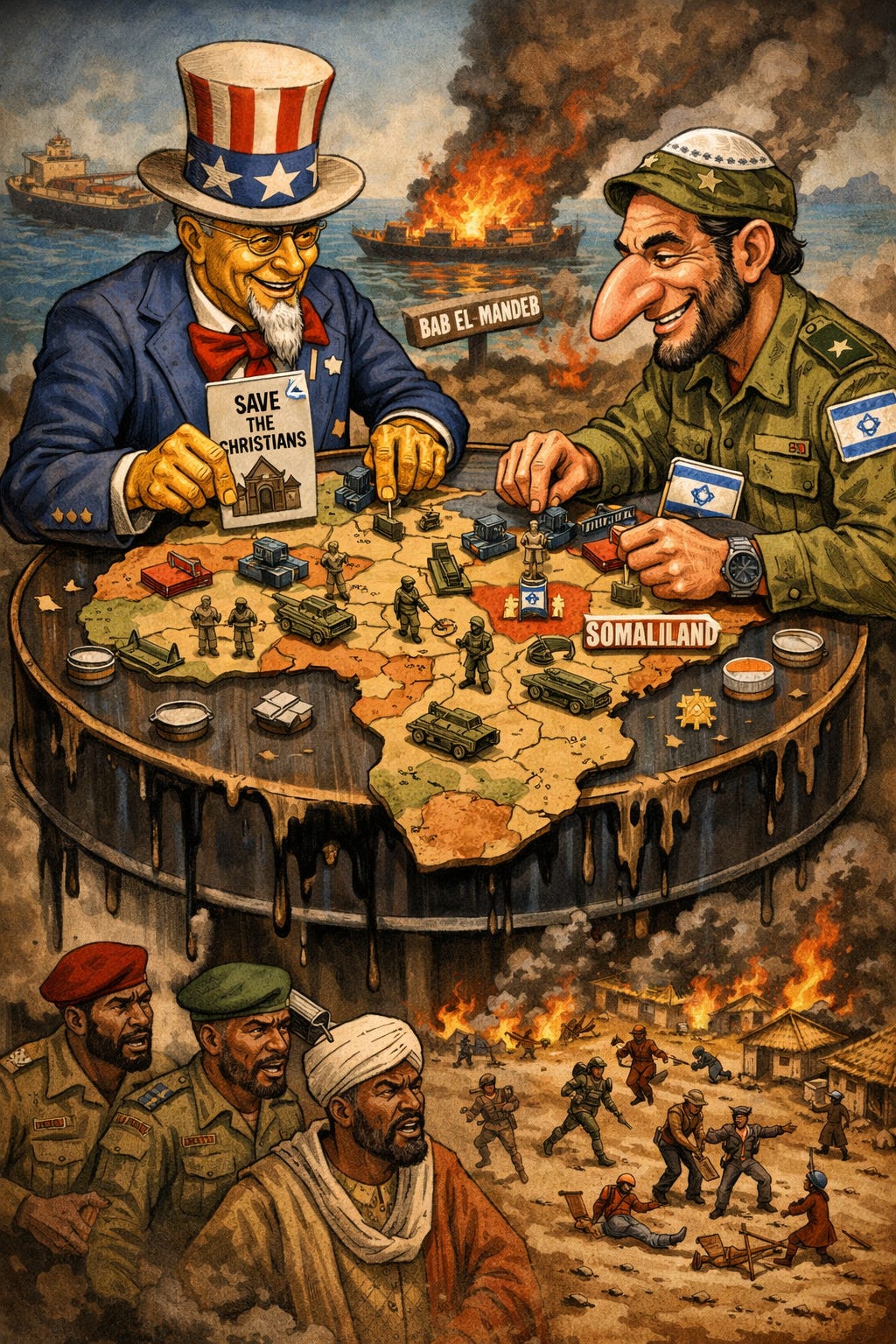
S airstrikes in Nigeria and Israel’s move on Somaliland were not isolated events.
Read together, they reveal how religion is used to mask power struggles over Africa, trade routes, and the emerging multipolar order.
When “coincidences” become a method
December 2025 has been presented to Western audiences as a sequence of necessary security decisions.
The United States bomb Nigeria to “save Christians” and fight ISIS.
Almost simultaneously, Israel publicly advances a historic political shift: the recognition and strategic consolidation of Somaliland, a breakaway territory not recognised by the United Nations but crucial to Red Sea geopolitics.
Taken separately, these events appear unrelated.
Read together — in their timing, language, and beneficiaries — they reveal a coherent geopolitical pattern.
This article reconstructs that pattern.
Nigeria – The official narrative versus the data
Western rhetoric framed the US strikes as a response to “Christian persecution” and jihadist terror.
The data, however, tell a very different story.
According to ACLED, UNDP, and the International Crisis Group:
- the majority of civilian victims in Nigeria are Muslim, not Christian;
- violence is concentrated in rural northern regions and the Middle Belt;
- its main drivers are:
- competition over land and water,
- climate change and Sahel desertification,
- organised crime and banditry,
- structural corruption and state absence.
Religion is not the primary cause.
It is a post-hoc narrative layer, applied to material conflicts rooted in resources, governance, and environmental stress.
When Washington speaks of “saving Christians”, it is not describing Nigeria’s reality — it is reframing it for political use.
The military paradox: “helpless states” by design
Nigeria is not militarily abandoned.
For decades it has:
- cooperated with AFRICOM,
- hosted Western training and intelligence programs,
- received equipment, surveillance, and operational support.
Yet it is consistently portrayed as incapable of securing its territory, requiring external intervention.
This is the core paradox:
How can one of Africa’s most externally trained and monitored states be presented as powerless?
The answer is not technical.
It is political.
Weapons everywhere, factories nowhere
Africa:
- has no large-scale indigenous arms industry,
- hosts multiple states under embargo or arms restrictions,
- lacks autonomous weapons supply chains.
Yet Nigeria, the Sahel, and the Horn of Africa are saturated with:
- automatic rifles,
- ammunition,
- explosives,
- increasingly, drones.
According to UN Panels of Experts, Small Arms Survey, and SIPRI, these weapons originate from:
- post-conflict stockpiles (notably Libya after 2011),
- legal-to-illegal diversion through third countries,
- private military contractors,
- tolerated or protected trafficking networks.
This reality is systematically absent from “religious conflict” narratives — because acknowledging it would expose external responsibility for African instability.
Energy, extraction and colonial soft power
Nigeria is:
- Africa’s largest oil producer,
- a major gas exporter,
- strategically vital for Europe after the rupture with Russian energy supplies.
In the Niger Delta, decades of extraction by Western energy corporations have produced:
- environmental devastation,
- economic dispossession,
- entrenched political corruption.
This structural economic violence forms the material base of insecurity — yet it is never mentioned in narratives focused on faith or identity.
Religion functions as a convenient frame:
- it shifts blame,
- erases corporate accountability,
- legitimises military force.
The turning point: African sovereign realignment
From 2023 onwards, a major shift occurs.
Mali, Burkina Faso and Niger break with ECOWAS, expel French forces, reduce Western cooperation, and form a new regional alliance.
At the same time:
- China accelerates infrastructure and logistics investment,
- Russia offers alternative security partnerships,
- non-Western development models gain traction.
This is the real strategic shock:
An Africa that is no longer politically passive.
Somaliland – The quiet move on the Red Sea
Within this context comes Israel’s Somaliland decision.
Somaliland:
- lacks UN recognition,
- controls a critical coastline on the Gulf of Aden,
- sits next to the Bab el-Mandeb, one of the world’s most strategic maritime chokepoints.
After Gaza and the Red Sea crisis, control over maritime surveillance, ports, and intelligence becomes central.
Recognising Somaliland allows:
- bypassing international legal frameworks,
- creating selective recognition precedents,
- weakening the African Union,
- enabling bases, radar and intelligence infrastructure.
This is not diplomacy.
It is geopolitical positioning.
Nigeria and Somaliland: one integrated strategy
Read together, December 2025 reveals a coherent logic:
- in Nigeria, military intervention justified through moral rhetoric;
- in the Horn of Africa, strategic consolidation under the banner of stability.
Two different theatres, one objective:
- securing trade routes,
- containing multipolar expansion,
- managing African instability,
- indirectly shielding Israeli and Western strategic interests.
Religion is the language.
Security is the pretext.
Geoeconomics is the engine.
What December 2025 actually tells us
December 2025 does not describe a religious war.
It describes:
- Western anxiety over losing influence in Africa,
- attempts to slow a shifting global order,
- the instrumentalisation of morality,
- Africa’s transformation into a central arena of global power competition.
Africa is not the problem.
It is where the future balance of power is being negotiated.
This analysis is part of AntonellaNEWS – Uncomfortable Truths,
an independent project on geopolitics, power and global narratives.
Subscribe to support long-form investigative journalism.