The NHS UK scandal : Gaza, and the Architecture of Institutional Complicity

When truth is acknowledged privately and neutralised publicly
Feb 10,2026
or years, public debate in the United Kingdom around Gaza, Israel, and international law has appeared polarised, emotional, and inconclusive. Governments change, language shifts, but policy remains largely intact. What is often missing from this debate is not information, but context — and more importantly, process.
This investigation does not argue that British institutions were unaware of what was happening in Gaza. On the contrary, it shows that they knew. They received testimonies, reviewed reports, and internally acknowledged serious violations of international law. What follows is not a story of ignorance or confusion, but of deliberate containment of knowledge.
This dossier reconstructs how awareness of war crimes coexisted with political inaction, how internal recognition diverged from public posture, and how institutional mechanisms were used to manage the consequences — not the causes — of that contradiction.
The evidence existed
Long before the most recent escalation, British medical professionals returning from Gaza described a consistent pattern: injuries incompatible with conventional combat, attacks on hospitals and ambulances, children and women bearing the brunt of violence, and repeated violations of medical neutrality.
These testimonies were not isolated. They were shared with parliamentarians, ministries, professional bodies, and international organisations. They aligned with findings published by Amnesty International, Human Rights Watch, and Médecins Sans Frontières, all of which documented patterns consistent with war crimes, collective punishment, and apartheid-like practices.
At the multilateral level, United Nations rapporteurs and investigative mechanisms repeatedly raised alarms. This culminated in 2024, when the International Court of Justice recognised the plausibility of a genocidal risk in Gaza and clarified the obligations of third states.
From that moment onward, non-action ceased to be politically ambiguous. It became legally consequential.
What changed behind closed doors
Publicly, British officials maintained cautious language. Privately, something very different was occurring.
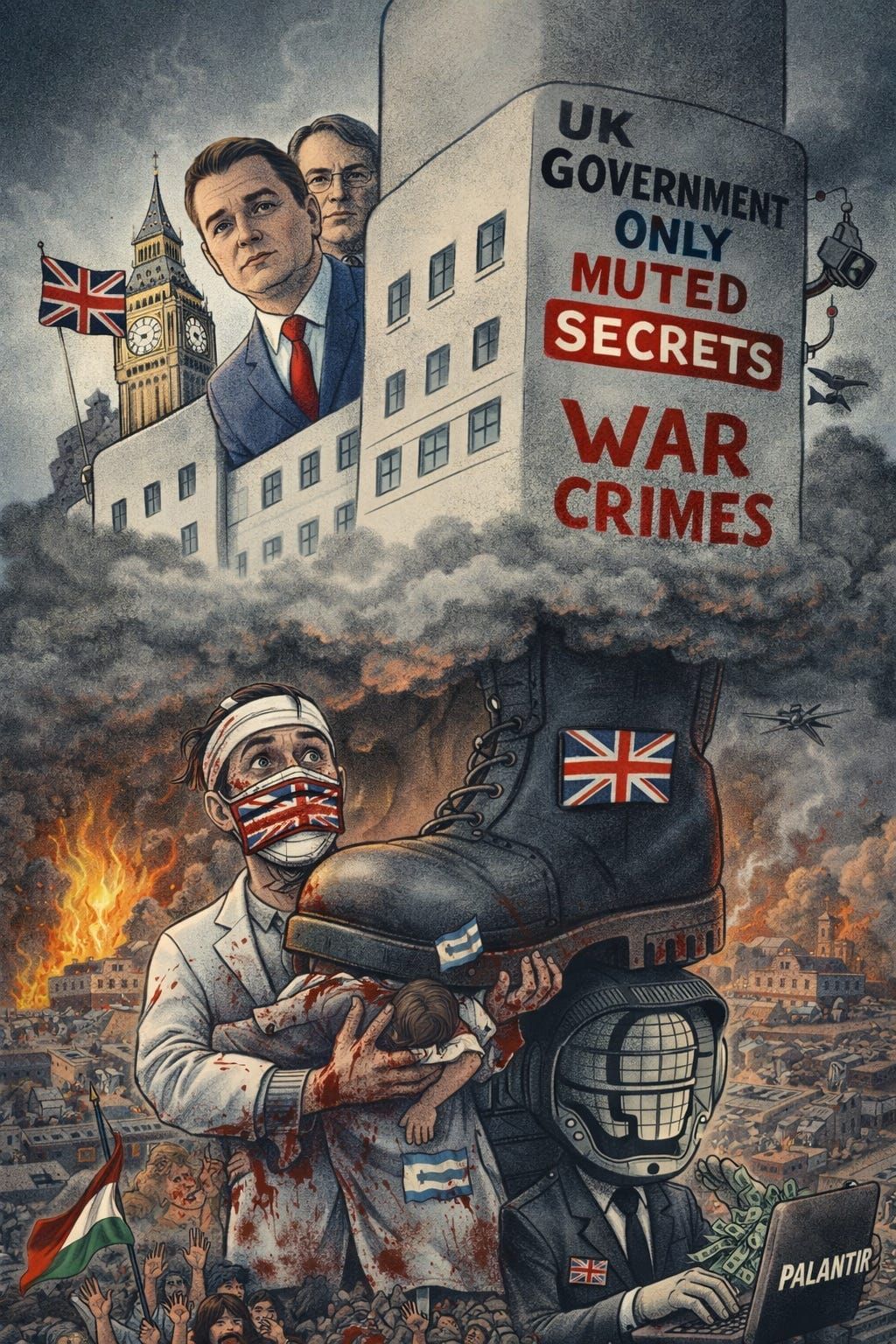
Messages exchanged in 2025 between Wes Streeting and Peter Mandelson reveal a level of clarity absent from official statements. In these exchanges, Streeting explicitly referred to Israel committing “war crimes,” using the language of “ethnic cleansing,” describing state behaviour as “rogue,” and calling for sanctions at the state level.
These were not radical claims. They mirrored the conclusions of international legal bodies and humanitarian organisations. What makes them significant is not their content, but their containment. They remained private, informal, and disconnected from policy.
This divergence between private acknowledgment and public restraint is the core tension of this case.
Knowledge at the top, repression at the bottom
While senior officials privately recognised grave violations, institutions under their authority moved in the opposite direction. Medical professionals who spoke publicly about their experiences faced disciplinary pressure. Academics and public-sector workers encountered intimidation or reputational threats. In several cases, criticism of Israeli actions was reframed as an institutional risk rather than a factual or ethical concern.
This pattern is not accidental. It reflects a structural logic: truth is not refuted, it is neutralised.
The issue was not whether testimonies were credible. They were. The issue was whether their visibility could be politically absorbed.
A timeline of continuity
Across successive governments, the same behavioural pattern emerges.
In the early 2000s, allegations of violations were already known but treated as tolerable geopolitical friction. During the following decade, criticism was increasingly moralised and individualised, detached from legal accountability. By the mid-2010s, institutional mechanisms were in place to discourage public scrutiny without overt censorship.
From 2021 onward, a dual-track system became visible: internal recognition of abuses coexisted with external silence. After the 2024 ICJ ruling, this dissonance intensified. Gaza became less a matter of law and more a matter of electoral calculus.
The result was not policy correction, but narrative management.
The technological dimension
Since 2023, the UK has awarded more than £500 million in public contracts to Palantir Technologies, a US-based data analytics firm founded by Peter Thiel. These contracts span the National Health Service and the Ministry of Defence, including a £241 million defence deal awarded in December 2025 without a competitive tender.
Palantir is not a conventional health-tech provider. It was developed for intelligence, counterinsurgency, and behavioural prediction. NHS data is not valuable merely for healthcare optimisation. It provides longitudinal insight into population stress, vulnerability, compliance, and social fracture.
When the same company operates across civilian health infrastructure and military decision-making, data becomes an instrument of anticipation and control, not simply efficiency.
The political facilitation of this relationship, including the organisation of Prime Minister Keir Starmer’s visit to Palantir’s headquarters by networks linked to Mandelson, highlights the non-transparent nature of this integration.
Managing consequences, not causes
Taken together, these elements form a coherent system.
International crimes are acknowledged privately.
Public accountability is deferred.
Institutional dissent is contained.
Technological capacity for prediction and control is expanded.
This is not the failure of a single government or party. It is a continuity of governance logic across administrations.
Rather than addressing the root cause — a foreign policy misaligned with international law — the system invests in managing domestic fallout.
This investigation does not claim the existence of a conspiracy. It documents something more mundane and more dangerous: a rational system making choices.
A system that knows.
A system that calculates.
A system that decides silence is safer than law.
Under international legal standards, awareness combined with inaction and interference carries a name: complicity.
The final question is not whether the UK knew what was happening in Gaza. The record shows that it did.
The question is how long a democratic system can endure when truth itself becomes a liability to be managed, rather than a responsibility to be acted upon.