The “Orwellian” China Defending Workers from the Algorithm

May 02,2026 China’s AI Paradox and the Western Illusion of Freedom
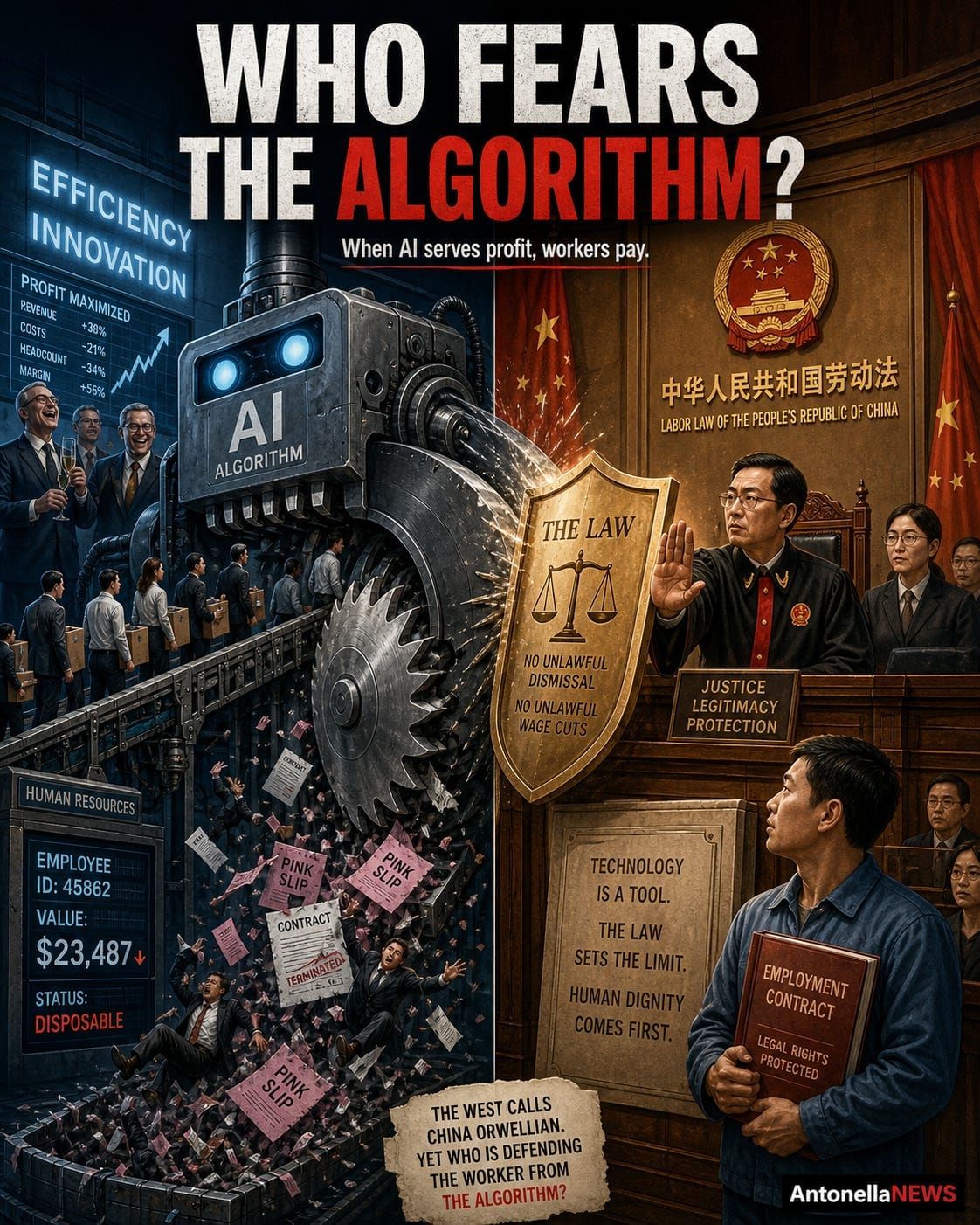
The Hangzhou case does not ban AI. It bans something far more dangerous for corporations: using automation as a licence to cut wages, demote workers, dismiss employees, and offload the cost of technological transformation onto human beings.
There is a story that, if read carelessly, looks like a minor Chinese labour-law curiosity. Read properly, however, it opens a crack in the dominant Western narrative about artificial intelligence.
For years, we have been told that China is the perfect laboratory of the Orwellian society: surveillance, digital control, social scoring, censorship, algorithms serving the state. Part of that criticism is not baseless. Beijing does use digital regulation as an instrument of political control, national security and discipline over the information space.
But then a Chinese court, in the heart of one of the country’s major technology hubs, tells a private company something that many Western liberal democracies have still not said with the same clarity:
you cannot use AI as an excuse to cut a worker’s salary and then dismiss him when he refuses.
The case was published on 28 April 2026 by the Hangzhou Intermediate People’s Court as part of a series of typical cases concerning AI enterprises and labour rights, just before International Workers’ Day.
The worker, identified by the surname Zhou, was employed in quality assurance for large language model outputs. His task was to verify the accuracy of AI-generated responses and filter problematic content. His monthly salary was approximately 25,000 yuan. The company proposed transferring him to a lower position, reducing his salary to 15,000 yuan. Zhou refused. The company dismissed him.
The Yuhang court at first instance, and later the Hangzhou Intermediate People’s Court on appeal, ruled that the dismissal was unlawful.
The legal point is precise. The company argued that the impact of AI on the project amounted to a “major change in objective circumstances” — a formula that, under Chinese labour contract law, may justify the modification or termination of an employment contract when the original agreement can no longer be performed.
The court said: no, not automatically.
The voluntary introduction of AI to adapt to competition and reduce costs is a business decision, not a natural disaster. It is not enough to say “the machine is now cheaper” in order to transform a worker into productive waste.
The detail that changes everything: this is not a ruling against AI
The first falsification to avoid is this:
China has not banned companies from using AI to automate tasks.
That simplified reading, circulated on social media, is convenient but wrong. The court did not say: “AI cannot replace human labour.”
It said something more sophisticated:
technological replacement cannot become a shortcut to violate contractual rights, impose unreasonable wage cuts, or dismiss workers without genuine negotiation.
Local Chinese reporting from Hangzhou emphasised a crucial formulation: AI may be used to increase business efficiency, free labour and improve employee welfare, but companies must protect workers’ legitimate rights and cannot use the name of technological transformation to carry out unilateral wage cuts and dismissals.
The judge also indicated a hierarchy of responsibility: first training, skills upgrading and adaptation to higher-level roles; only if transfer is unavoidable should there be a reasonable alternative position and compensation for the associated costs, such as transport or accommodation.
This is the political heart of the case.
AI is not treated as the enemy. It is treated as strategic infrastructure. But precisely because it is strategic, it cannot be left entirely to the logic of corporate margins.
The Western paradox: freedom for whom?
Here the uncomfortable contradiction begins.
The West likes to describe itself as the space of individual freedom against Chinese state control. But when AI enters the relationship between capital and labour, the freedom most quickly defended is often the freedom of the corporation: freedom to automate, restructure, reduce staff, outsource, lower costs and increase productivity.
The worker comes later. The worker appears in the rhetoric of the “reskilling society”, in upskilling courses, webinars on adaptability, corporate statements about the future of work. But too often the worker appears only after the damage has already been transferred onto him or her.
The International Monetary Fund has estimated that almost 40% of global employment is exposed to AI, with a potential impact of around 60% in advanced economies. For roughly half of exposed jobs, AI may enhance productivity; for the other half, it may perform tasks currently carried out by humans, reducing labour demand, wages and hiring.
The International Labour Organization, in its 2025 update on generative AI and work, frames the issue not simply as mechanical replacement but as transformation of tasks, with different levels of exposure and automation depending on occupation.
From the corporate side, McKinsey’s 2025 global survey shows the managerial logic already in motion: 80% of respondents say efficiency is an objective of AI initiatives; 32% expect a reduction in their overall workforce in the following year; and a median of 30% of respondents expect reductions in business functions where AI is used.
Here is the point:
when AI is governed primarily as a lever of efficiency, the value tends to rise toward capital and management, while the cost descends toward workers, families and public welfare systems.
Not circular economy, but social circulation of technological value
Here your intuition is very strong, but it must be made precise.
Technically, this is not “circular economy” in the classical sense. China’s circular economy law defines circular economy as the reduction, reuse and recycling of resources in production, circulation and consumption. It is therefore an environmental and productive concept, linked to the efficient use of material resources.
But if we move the concept from the ecological plane to the social plane, the intuition becomes illuminating.
Beijing seems to be preventing the value generated by AI from following a linear and predatory route: from the machine to profit, from profit to the company, from the company to investors, leaving the worker only with the loss.
It is not circular economy in the technical sense.
It is something we can call:
the social circulation of technological value.
AI produces value? Fine. But that value must somehow remain inside the social circuit: employment, income, training, consumption, stability, cohesion.
If AI produces value only for the company and precarity for the worker, the system creates a macroeconomic contradiction: more productivity, but less disposable income; more efficiency, but less social trust; more automation, but weaker domestic demand.
The Chinese logic: the worker is not only a cost — the worker is domestic demand
This is the economic key.
China is not protecting Zhou out of sentimentality. It is defending a circuit.
The Chinese model in recent years has insisted on dual circulation: domestic circulation must become the priority, strengthening the internal market and coordinating it with external demand, imports, exports and investment.
In official development documents, Beijing explicitly speaks of building a strong domestic market and giving priority to internal circulation.
In March 2026, Reuters reported that China intended to strengthen domestic demand, increase the supply of high-quality consumer goods and develop new growth points in services. A spokesperson for the National People’s Congress stated that consumption had contributed 52% of the previous year’s economic growth and that China wanted to promote quality employment and increase urban and rural incomes so that people could consume, dare to consume and want to consume.
This phrase is decisive.
Because a worker demoted from 25,000 to 15,000 yuan is not only an individual case. It is a loss of confidence. It is potential consumption evaporating. It is fear spreading among other skilled workers. It is proof that technological revolution can become wage blackmail.
In an economy that wants to strengthen domestic demand, the worker is not only a cost item. The worker is also a consumer, a taxpayer, a family member, a social stabiliser.
The socialist component: not romanticism, but discipline of capital
This is where the “socialist” point enters — but it must be read without naivety.
China is not a paradise of labour rights. It is not a Western-style trade union democracy. It is not a model to idealise.
But in the Hangzhou case, a principle emerges that is consistent with the tradition of the “socialist market economy”:
private capital may innovate, but it cannot become an autonomous force capable of destabilising the social order.
The campaign for common prosperity has been described by Western observers such as Brookings as a concept presented by Xi Jinping as a fundamental requirement of socialism and as a tool to balance growth and financial stability.
A 2025 academic reading published by Cambridge goes deeper: common prosperity is not only about reducing household inequality, but also about rebalancing private capital and state power. In that interpretation, it serves to contain the excessive influence of the private sector and reaffirm state control over the economy.
This is why the Zhou case is not only a labour-law matter. It is a small window into Chinese AI governance:
companies may adopt advanced technologies, but they cannot turn innovation into a private form of sovereignty over the worker’s fate.
AI as national productivity, not a private licence to dismiss
Beijing is not slowing AI down. Quite the opposite: it is accelerating it.
The Chinese Ministry of Human Resources stated in March 2026 that it intends to use AI to create new jobs and transform existing ones, focusing on new productive forces, new consumption and public welfare services.
Over the previous five years, according to the ministry, China had identified 72 new occupations, more than 20 directly connected to AI. Each new occupation could generate between 300,000 and 500,000 jobs in its initial stage.
This data point is essential because it dismantles two opposite simplifications.
The first: “China bans AI to protect workers.” False.
The second: “China uses AI only to control society.” Incomplete.
The reality is more complex: China wants to use AI to modernise the economy, production, services and strategic competitiveness, but it also wants to prevent private AI adoption from producing uncontrolled social instability.
Translated:
AI yes. Social Darwinism no.
The consumer: the other side of the same architecture
The same logic appears on the consumer side.
China’s Personal Information Protection Law provides that those who use personal data for automated decision-making must guarantee transparency, fairness and impartiality. It prohibits unreasonably differentiated treatment in prices or commercial conditions. It also recognises the individual’s right to request an explanation and refuse decisions made solely through automation when they significantly affect personal rights and interests.
Stanford DigiChina notes that this provision also targets the phenomenon known as “big data swindling”: platforms using data, dark patterns and dynamic pricing to exploit different consumers’ willingness to pay.
So the pattern is coherent.
On labour: AI cannot justify arbitrary dismissal or wage cuts.
On consumption: AI cannot justify opaque price discrimination.
In the digital space: AI must be labelled, controlled, registered and made compatible with public security and state interests.
Is this protection? Yes, partly.
Is this control? Yes, also.
That ambiguity is precisely what makes the issue interesting.
China is not “good”: it is strategic
We must not fall into the opposite trap.
China is not suddenly becoming a libertarian paradise of digital rights. Its model remains deeply statist, hierarchical and politically controlled.
In 2026, the Cyberspace Administration of China launched a four-month campaign against abuses in AI applications, targeting weak security reviews, data poisoning, failure to register models, insufficient labelling of AI-generated content, disinformation, impersonation and content harmful to minors.
Also in 2026, Beijing proposed rules on digital humans, requiring clear labels on virtual content, banning intimate virtual relationships with minors, preventing the use of other people’s personal data without consent and blocking uses that circumvent identification systems. Reuters noted that this governance also fits into the alignment of AI with socialist values and cyberspace security.
So China regulates AI for many reasons: social stability, national security, content control, protection of minors, consumer protection, discipline of private capital, and technological competition with the United States.
But this is precisely where the paradox lies.
The West denounces Chinese state control.
China, implicitly, denounces Western private control.
And the real question becomes:
do we prefer a state that controls AI too much, or corporations that control it without sufficient democratic accountability?
The answer cannot be ideological. It must be investigative.
Europe regulates, but the Hangzhou case strikes more directly
The European Union has adopted the AI Act, described by the European Commission as the world’s first comprehensive legal framework on artificial intelligence, with a risk-based approach, protection of fundamental rights and obligations for developers and deployers of AI systems.
This is an important step. But the European model works mainly through classification, obligations, compliance, risk categories, specific prohibitions and governance structures. It is necessary regulation, but often slow and bureaucratic.
The Hangzhou case, by contrast, arrives as a much more immediate message to the employer:
you cannot use the word AI to normalise what remains unlawful under labour law.
In Europe, the risk is to have a sophisticated regulation of AI while still allowing corporate restructuring to follow old logics: first the company automates, then the worker copes, then the state promises training.
China, at least in this case, reverses the order:
first social stability and corporate responsibility, then automation.
The Western blind spot: we fear the state, but not the algorithmic boss
Western propaganda loves the simple frame: bad Chinese state, free Western market.
But market freedom can become another form of domination when the worker has no real bargaining power in front of automated systems, opaque restructuring and managerial decisions disguised as technological inevitability.
The OECD recognises that AI can bring benefits to work, such as productivity, job quality and safety, but also warns of risks: automation, loss of worker agency, bias, discrimination, privacy violations and lack of transparency. The OECD also notes that training and worker consultation are associated with better outcomes.
This is exactly the ground on which the Hangzhou case becomes symbolic.
Zhou did not challenge the existence of AI.
He challenged the use of AI to justify a brutal reduction of his contractual value.
The difference is enormous.
The real question: who receives the AI dividend?
In the end, the dossier leads to a simple question.
When AI increases productivity, who receives the dividend?
The company?
Shareholders?
Managers?
The state?
The worker?
The consumer?
Society?
The Hangzhou case suggests that, at least in China, part of the state does not want to leave this question entirely in corporate hands.
And that makes the precedent far more important than its judicial dimension.
Not because China has suddenly become a moral model.
But because it has set a limit at the most dangerous point of algorithmic capitalism: the transformation of efficiency into universal justification.
If AI can do your job, then you are worth less.
If you are worth less, you can be paid less.
If you refuse, you can be dismissed.
This is the chain that the Chinese court broke.
The narrative reversal
China is not saying: “AI must not replace humans.”
It is saying:
AI cannot be used by the company to unilaterally erase rights, income and contractual dignity.
It is not saying: “we protect the worker against technology.”
It is saying:
we protect the social system from the privatisation of technological profits and the socialisation of technological costs.
This is the key sentence of the dossier:
China does not ban AI. It appears to ban, rather, its most neoliberal version: the one in which the machine produces value, the company cashes in, and the worker is declared obsolete.
And this is where the West should stop laughing at “Orwellian China” and look in the mirror.
Because perhaps the real nightmare is not only the state controlling the citizen through the algorithm.
It is also the corporation controlling the worker through the algorithm, then replacing him, then calling all of this progress.
The Hangzhou case does not absolve China of its contradictions. It does not erase censorship, surveillance, political control or repression of the digital space.
But it forces the West to ask a much more uncomfortable question:
if liberal democracy cannot protect the worker from predatory automation, how much is its promise of freedom worth?
Because freedom is not only the ability to speak against the state.
It is also the right not to be reduced to a cost variable by a machine nobody elected, by an algorithm nobody can contest, by a corporation that calls “innovation” what, for the worker, becomes impoverishment.
China has chosen an authoritarian, statist, strategic answer.
The West still has to decide whether it wants a democratic answer.
But one thing is clear:
AI is not neutral. It is a battle over the distribution of value.
And if we do not decide politically who should benefit from algorithmic productivity, companies will decide.
As always.
Only faster.
If this dossier helped you look at AI beyond propaganda — neither as a technological miracle, nor as an inevitable destiny — share it.
AntonellaNEWS exists for this reason: to read the news where dominant narratives stop, to cross-check sources, to follow money, power, law and, above all, the concrete consequences on people.
Follow AntonellaNEWS on Substack for more free, documented investigative dossiers on geopolitics, technology, rights, propaganda and the transformation of power in the multipolar world.
Sources
Xinhua — Reconstruction of the Hangzhou case and publication of typical cases on AI, enterprises and workers.
Hangzhou.com — Details of the ruling, the wage cut from 25,000 to 15,000 yuan, and the court’s reasoning that AI does not automatically constitute a “major change in objective circumstances.”
Caixin — Economic and legal confirmation of the Zhou case, arbitration, the company’s appeal and the Hangzhou/Yuhang court decisions.
Chinese Ministry of Human Resources / State Council — AI strategy as creation and transformation of employment, with 72 new occupations identified and more than 20 directly linked to AI.
National Development and Reform Commission / Chinese development planning documents — Dual circulation and the priority given to building the domestic market.
Reuters — Chinese domestic demand, consumption as a driver of growth, policies on quality employment and income; Chinese regulation on AI misuse and digital humans.
China’s Personal Information Protection Law — Article 24 on automated decision-making, transparency, fairness, prohibition of unreasonable differentiated treatment and the right to request explanations.
Stanford DigiChina — Analysis of “big data swindling” and consumer protection against algorithmic discrimination.
European Commission — AI Act and the EU’s risk-based regulatory approach.
International Labour Organization — 2025 update on generative AI and work.
International Monetary Fund — Estimates on global AI exposure and stronger impact on advanced economies.
OECD — Risks and benefits of AI in the workplace, including automation, loss of agency, bias, privacy and the need for training and worker consultation.
McKinsey — Corporate data on efficiency objectives, workflow transformation and expectations of workforce reduction.