The UAE Leaves OPEC: Oil Is Not Dying — It Is Changing Hands

Abu Dhabi is not abandoning barrels. It is using them to buy green energy, AI, ports, chips, land corridors and digital payments in the new multipolar order.
May 07,2026. There is a piece of news that may sound technical, distant, almost reserved for traders, diplomats and energy analysts: the United Arab Emirates has left OPEC and OPEC+, the group that for decades coordinated a decisive share of global oil production.
But behind this decision there is not only a dispute over how many barrels should be produced. There is a much larger question: who will control energy, routes, data, payments and trade corridors in the world that comes after the absolute dominance of oil?
The UAE is not saying goodbye to oil. On the contrary: it wants to produce more of it, sell it with fewer restrictions, and use that wealth to enter the sectors that will matter tomorrow: renewables, artificial intelligence, data centers, semiconductors, ports, logistics, digital currencies and trade agreements with multiple blocs at once.
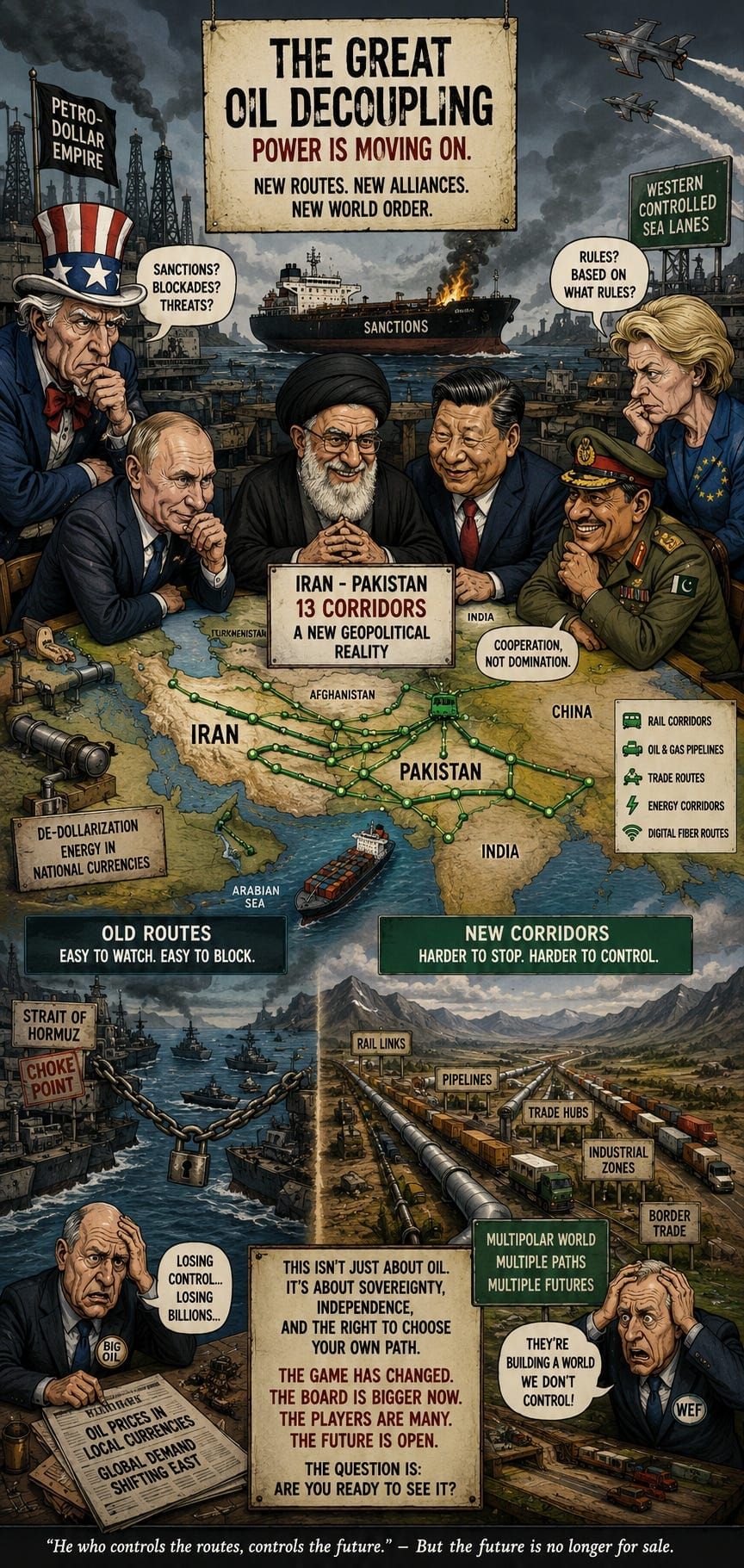
But there is an even more important shift: the new power will no longer be only oil-centric. It will be corridor-centric.
Because the barrel alone is no longer enough. If a ship cannot pass, if a port is blocked, if insurance premiums explode, if payments are sanctioned, if a maritime corridor becomes a battlefield, oil remains underground or trapped at sea. It becomes potential power, not real power.
That is why the UAE’s exit from OPEC must be read together with the crisis in Hormuz, the opening of Pakistan-Iran land corridors, China’s projection toward Gwadar, the Saudi-Emirati competition, the rise of digital payments and the global race for green energy and AI.
This is not the end of oil.
It is the beginning of the post-OPEC era.
The News That Sounds Technical, But Speaks to Our Daily Lives
Imagine owning a gold mine while knowing that the world is slowly changing currency.
What do you do?
Do you continue defending only the mine? Or do you use the gold you still have to buy banks, ports, factories, digital networks, power plants, technology and new trade routes?
The United Arab Emirates appears to have chosen the second path.
On April 28, 2026, Abu Dhabi announced its exit from OPEC and OPEC+, effective May 1, 2026. Reuters described the decision as a heavy blow to the producers’ group and to its de facto leader, Saudi Arabia, at a time when war with Iran and the energy crisis were already exposing internal fractures in the Gulf. (Reuters)
A few days later came another significant step: the UAE also left OAPEC, the Organization of Arab Petroleum Exporting Countries. Unlike OPEC, OAPEC does not set production quotas, but it carries political and symbolic weight in the Arab oil world. (Reuters)
That detail matters. If the issue were only “we want to produce more oil,” leaving OAPEC would be secondary. Instead, it suggests something broader: Abu Dhabi appears to be distancing itself from the old collective oil architectures of the twentieth century.
For many readers, this may sound like remote news. In reality, it concerns everyone.
When the way oil is produced, transported, insured, sold and paid for changes, energy prices change. Transport costs change. Supply chains change. Food prices change. The strength of the dollar changes. Military alliances change. Even the future of artificial intelligence changes.
Yes, even artificial intelligence.
Because AI does not live in a magical cloud. It lives in data centers that consume electricity, water, chips, cooling systems, physical security, cybersecurity, fiber optics, capital and geopolitical agreements.
Whoever controls energy, infrastructure, sovereign wealth funds, ports and relations with the United States, China, Asia and Africa can become much more than an oil producer.
It can become a node of power.
First, the Basics: What Is OPEC and Why Does It Matter?
OPEC is the Organization of the Petroleum Exporting Countries. In simple terms, it is a group of oil-producing states that coordinate part of global oil output in order to influence supply and, indirectly, prices.
OPEC+ is the expanded version, which also includes major non-OPEC producers such as Russia. This mechanism does not control all the oil in the world, but for decades it has functioned as a political valve for the market: if prices fall too much, production is cut; if the market needs more oil, production is increased.
When a marginal producer leaves, the damage is contained.
When a producer like the UAE leaves, the message is different. Reuters reported that the UAE was among the group’s largest producers and that its exit weakens OPEC+’s power over the market, even if it does not automatically mean the alliance will collapse. (Reuters)
So the issue is not simply: “the UAE is leaving OPEC.”
The real question is: why would a country that owes much of its wealth to oil decide to leave the very club that has governed oil for decades?
The Simple Answer: The UAE Wants to Produce More
Let us begin with the most immediate explanation.
Inside OPEC, the UAE had to respect production quotas. Outside OPEC, it can move with more freedom.
ADNOC, the Emirati national oil company, is pushing unconventional oil and gas projects after the OPEC exit. Reuters reported on May 5, 2026, that ADNOC aims to reach 5 million barrels per day of production capacity by 2027, with the possibility of reaching 6 million barrels per day if market conditions require it. (Reuters)
Put simply: if you build a more powerful machine, but the club tells you to drive with the handbrake on, sooner or later the club becomes a problem.
The UAE has invested to increase production capacity. It wants to monetize those investments. It wants to reassure partners and investors. It wants to decide for itself when to produce, how much to produce, whom to sell to and under what conditions.
Energy Minister Suhail Al Mazrouei defended the decision by arguing that the UAE owes its investors the ability to produce according to market needs, without restrictions incompatible with its national strategy. Reuters also read this position within the context of a growing rivalry between the UAE and Saudi Arabia. (Reuters)
Here is the first educational point: OPEC is not only a technical organization. It is also a political discipline. Leaving it means saying that national strategy comes before collective discipline.
But the Real Answer Is Deeper: Oil Alone Is No Longer Enough
If we stop at oil production, we miss the picture.
The UAE is not abandoning oil. It is abandoning the idea that oil alone is enough to guarantee power in the twenty-first century.
That is the fundamental difference.
The old Gulf model was relatively simple: oil, the dollar, American protection, stable monarchies, strategic ports, military bases, investments in the West.
But the world has changed.
China has become the great energy and industrial customer. India is rising as a commercial and diplomatic power. Russia remains central in energy and security, even under sanctions. Iran remains both a vulnerability and a regional deterrent. Europe is weakened by energy dependencies and industrial crisis. The United States remains extremely powerful, but it is no longer the only rational horizon.
The UAE seems to have understood something before many others: in a multipolar world, whoever depends on a single protector becomes blackmailable. Whoever builds multiple corridors becomes a negotiator.
That is the difference between being protected and being indispensable.
The Gulf Crisis: Why This Exit Matters Much More Than It Seems
The UAE’s exit from OPEC is not taking place in a normal moment. It is happening while the Gulf is inside an energy and military crisis that has transformed the Strait of Hormuz from a trade route into a geopolitical lever.
This changes everything.
Seen through a Western lens, the Hormuz crisis is often narrated like this: “we must protect freedom of navigation,” “we must guarantee global energy flows,” “we must contain Iran.”
It is a convenient narrative, because it shifts the center of the conversation to the security of routes as seen from Washington, London or Brussels.
But if we change perspective, the question becomes different: who really pays when the Gulf becomes a battlefield?
Not only Europe. Not only the United States. In fact, much less than Western rhetoric often suggests.
The Hormuz crisis primarily affects industrial Asia: China, India, Japan, South Korea. It affects the routes of the real productive world, not only Western consumption. And when Asia pays more for energy, transport, insurance and raw materials, the increase reaches everywhere: industrial goods, food, fertilizers, fuels, containers, electricity bills.
This is the first leap in critical awareness: Hormuz is not merely “a Western route to protect.” It is a global choke point on which Asian economies, food chains, poor importing countries and industrial markets depend.
And that is why the UAE move must be read this way: Abu Dhabi is leaving OPEC exactly while the old collective oil system is showing its physical limits.
OPEC can decide quotas.
It can announce increases.
It can communicate discipline.
But if ships do not pass, if ports are vulnerable, if insurance premiums explode, if payments are blocked, if traders wait and Asian refineries fear interruptions, the quota becomes a theoretical number.
This is the truth missing from much of the debate: oil is not only extraction. It is route, ship, insurance, port, payment, refining, contract and security.
If one of these links breaks, the barrel may exist underground, but it does not reach where it is needed.
From Barrel to Corridor: The Key That Changes Everything
Here we arrive at the most important part.
For decades, we have read the Gulf through an oil-centric lens: who has more oil? Who produces more? Who cuts? Who increases? Who controls the price?
But the current crisis forces us to change the question.
It is no longer enough to ask: who has oil?
We must ask: who has corridors?
Because power does not belong only to those who possess the barrel. It belongs to those who can extract it, transport it, insure it, sell it, pay for it and deliver it even when a route is militarized.
The Gulf crisis is showing a brutal truth: when the sea becomes blackmailable, land becomes strategic again.
And this is where the Pakistan-Iran dossier becomes essential.
On April 25, 2026, Islamabad issued the Transit of Goods through Territory of Pakistan Order 2026, authorizing the transit of third-country goods through Pakistani territory toward Iran. The official Pakistani document designates routes connecting Karachi, Port Qasim and Gwadar to the Iranian crossings of Gabd and Taftan. (Pakistan Ministry of Commerce)
Al Jazeera reconstructed that the six designated land routes connect Pakistan’s major ports — Karachi, Port Qasim and Gwadar — to the Iranian crossings, passing through Balochistan via Turbat, Panjgur, Khuzdar, Quetta and Dalbandin. (Al Jazeera)
This point must be handled with precision. I have not found solid confirmation of “13 corridors” formally established between Pakistan and Iran. The verified sources speak of six officially designated land routes. But the strategic intuition remains correct: the number is not the main issue. The shift in geopolitical grammar is.
Pakistan is opening a land bypass while Hormuz and Iranian ports are under pressure. The National described this opening as a potential “land bridge” between Pakistani ports and Iran, underlining that it can provide Tehran with a breathing line and reshape parts of Asian trade routes. (The National)
Caution is necessary: these corridors do not replace Hormuz. That would be an oversimplification. Crude oil, especially in the large volumes destined for China or other major Asian importers, remains extremely difficult to move overland in quantities equivalent to maritime routes.
But the political signal is enormous: if the sea is blocked, the region looks for land. If a port is sanctioned, another port is sought. If payment is controlled, other financial rails are explored.
This is the war of corridors.
And this war changes the meaning of the Emirati exit from OPEC.
Why the Pakistan-Iran Corridors Also Speak About the UAE
At first glance, the reader might ask: what do Pakistan, Iran and Balochistan have to do with the UAE leaving OPEC?
They have a great deal to do with it.
Because they show that the energy power of the future will not be located only in barrels. It will be located in the capacity to build alternatives when traditional routes are militarized.
The UAE built part of its wealth on oil and part of its influence on ports, logistics, free zones, finance and trade. Dubai and Abu Dhabi are not only places of extraction or consumption: they are platforms of intermediation.
But if Iran, Pakistan, China and other regional actors begin opening alternative land corridors, if Gwadar becomes more relevant, if Balochistan returns as a strategic hinge, if Asia seeks bypasses to vulnerable maritime routes, then the entire Gulf must rethink its function.
The UAE cannot limit itself to saying: “we have oil.”
It must be able to say: we have ports, logistics, capital, AI, digital payments, alternative energy, trade agreements and the ability to connect multiple blocs.
That is why the exit from OPEC is not only an escape from quotas. It is the symptom of a wider transformation: from barrel to corridor, from cartel to platform, from rent to network.
The old order was oil-centric, maritime, dollar-centric and militarily protected by the West.
The new order will be hybrid: maritime and terrestrial, fossil and renewable, physical and digital, dollar and alternative currencies, ports and data centers, ships and instant payments, OPEC and bilateral agreements.
In the multipolar world, the barrel remains important.
But the corridor becomes sovereign.
A Weakened OPEC: Freedom or Instability?
There is a risk of naïve interpretation: thinking that a weaker OPEC automatically means cheaper energy for everyone.
It is not that simple.
A cartel can be criticized. It can manipulate supply and prices. It can protect rents and elite interests. But it can also function as a shock absorber in moments of crisis, because it coordinates signals, cuts, increases and market expectations.
Reuters warned that a weakened OPEC could increase volatility and unpredictability in the global energy market. Its analysis argued that breaking the OPEC balance may look useful in the short term, but could reduce the market’s ability to absorb future shocks. (Reuters)
And volatility does not hit everyone in the same way.
Those who have reserves, dollars, ships, insurance, sovereign wealth funds and political access can protect themselves.
Those who import energy, food and fertilizers with weak currencies are overwhelmed.
This is the part that financial media often treat as a footnote: the energy crisis is not only the price of Brent. It is the cost of bread, diesel, fertilizer, containers, electricity bills, public transport, plane tickets and daily life.
When the market becomes more volatile, those with capital speculate.
Those living on the edge pay.
That is why the Gulf crisis must also be read as a crisis of global energy justice.
The Fracture With Saudi Arabia: Silent, But Real
Saudi Arabia remains the oil giant of the Gulf. But the UAE no longer wants to be read merely as a junior partner inside an energy order led by Riyadh.
This should not be turned into a soap opera between monarchies. But the rivalry exists.
Reuters wrote that the UAE decision exposes years of tensions with Saudi Arabia and tests Saudi oil leadership. (Reuters)
The point is this: Riyadh wants to remain the center of the old oil kingdom, even while trying to diversify. Abu Dhabi wants to become a more agile platform: less “kingdom of oil,” more a node between energy, logistics, technology, finance and multipolar trade.
Saudi Arabia has mass, territory, reserves, religious weight and political centrality.
The UAE has speed, ports, sovereign wealth funds, free zones, finance, logistics, trade diplomacy and a more aggressive model of global hub-building.
This is not only economic competition. It is a different idea of the future.
Saudi Arabia wants to lead the old order while building the new one.
The UAE seems to want to exit the symbolic cage of the old order first, in order to become a node of the new.
The Green Transition Is Not Climate Idealism
We must be very clear here.
When we say that the UAE is investing in green energy, we should not imagine a romantic conversion to environmentalism.
This is not a climate fairy tale.
It is industrial geopolitics.
The UAE’s official energy strategy aims to triple the contribution of renewables and invest between 150 and 200 billion dirhams by 2030 to meet the country’s energy demand and sustain economic growth. (UAE Government Portal)
Masdar, the UAE’s renewable energy company, reached 65 GW of global clean energy capacity in January 2026 and aims for 100 GW by 2030. Reuters also noted that Masdar is controlled by Mubadala and ADNOC, two pillars of the Emirati economic and oil apparatus. (Reuters)
This is what many fail to see: in the UAE, the green transition is not born against oil. It is born using oil capital.
ADNOC is not simply the past resisting Masdar. ADNOC is also one of the vaults that allows Masdar to buy the future.
This is a harsh lesson for Europe: while we often discuss the transition as if it were only a moral, climate or bureaucratic issue, others read it for what it also is — and perhaps above all is — a war for infrastructure, technology, energy and industrial control.
Green Energy to Feed the New Digital Power
What are renewables really for in this design?
Not only to replace oil and gas. They are there to feed the new digital power.
Artificial intelligence is not immaterial. Every question asked to an AI system passes through servers, data centers, cooling systems, electrical grids, chips, cables, water, physical and cyber security.
The digital future has a material body. And that body consumes energy.
If a country wants to become an AI hub, it is not enough to attract programmers. It must guarantee energy, capital, infrastructure, political stability, data centers, cloud, security, chip agreements and market access.
The UAE is trying to put all these pieces together.
In January 2026, the UAE joined Pax Silica, a US-led initiative to strengthen AI and semiconductor supply chains. Reuters reported that the program also includes countries such as Australia, the United Kingdom, Israel, Japan, Qatar, Singapore and South Korea. (Reuters)
An earlier Reuters report cited US Under Secretary Jacob Helberg on the logic of the initiative: logistical arteries, industrial capacity, capital and energy. The entry of Qatar and the UAE into the project reflects Washington’s desire to bring Gulf monarchies into a strategic technological infrastructure. (Reuters)
This is almost a geopolitical confession.
The UAE is not useful only as a military ally or oil supplier. It is useful as a complete platform: energy, territory, funds, ports, industry, data, infrastructure.
The old bargain was: oil in exchange for protection.
The new bargain seems to be: energy, capital and computational territory in exchange for chips, AI and technological legitimacy.
China Is Not a Detail: It Is the Second Pillar
If we read this move only as an American victory, we are wrong.
The UAE is not leaving OPEC simply to hand itself over to the United States. It is doing something more sophisticated: it remains compatible with Washington, while building corridors with Beijing.
In April 2026, during the visit to China by Abu Dhabi Crown Prince Sheikh Khaled bin Mohamed bin Zayed, the UAE and China signed 24 agreements to strengthen economic, trade and investment relations. The National reported that the agreements were signed during a UAE-China economic conference on the sidelines of the official visit. (The National)
A few days later, The National also reported a preliminary agreement to strengthen investment flows and mobilize capital between the two countries, building on the 24 agreements already signed. (The National)
Reuters also reported that Chinese Premier Li Qiang called for deeper energy cooperation with the UAE, citing energy storage, hydrogen and new energy vehicles. (Reuters)
This tells us that Beijing does not look at the UAE only as an oil producer. It looks at it as an energy-industrial partner in the new cycle: storage, hydrogen, electric mobility, infrastructure, trade.
The public must understand this passage: the UAE does not want to choose between the US and China. It wants to become useful to both.
With Washington, it seeks chips, security and access to the Western technological architecture.
With Beijing, it seeks market, infrastructure, industry, digital payments and access to Asian demand.
This is not naïve neutrality. It is hedging. It is calculated balance. It is diplomacy as a strategic node.
Industrial Asia: South Korea and Japan Enter the Mosaic
The UAE is not speaking only with Washington and Beijing. It is building a broader Asian network.
The CEPA between the UAE and South Korea entered into force on May 1, 2026, the same day as the Emirati exit from OPEC. According to the reported statements, the agreement strengthens trade, investment and cooperation in priority sectors such as advanced technology, manufacturing and logistics. (Qazinform)
With Japan, the Japanese Ministry of Foreign Affairs confirmed the conclusion of negotiations for a Japan-UAE economic partnership agreement in March 2026. (Japan Ministry of Foreign Affairs)
These are not secondary trade details.
South Korea and Japan mean advanced industry, semiconductors, batteries, components, manufacturing, energy, clean technologies, infrastructure.
The UAE is building bridges with those who produce the material pieces of the new world.
Because the digital world, let us repeat it, is not abstract. It is made of chips, batteries, cables, power plants, ports, servers, factories and customs agreements.
Whoever wants to matter in the future cannot limit itself to selling oil. It must enter the value chain.
FinTech: Whoever Controls Payment Controls Trade
At this point comes the most underestimated piece: digital finance.
It is not enough to produce oil.
It is not enough to transport it.
It is not enough to transform it into electricity or use it to finance data centers.
One must also decide how it is paid for.
In November 2025, the UAE Ministry of Finance and Dubai Finance announced the first UAE government transaction using the Digital Dirham, in collaboration with the Central Bank. The official statement presented it as a step toward broader adoption of the national digital currency in the public and private sectors. (UAE Ministry of Finance)
The Central Bank of the UAE also participates in mBridge, a platform using central bank digital currencies for international transfers based on distributed ledger technology, with the stated goal of reducing costs, opacity, inefficiencies and operational complexity in cross-border payments. (Central Bank of the UAE)
Here precision is necessary: this does not mean the dollar disappears tomorrow morning. That would be propaganda, not analysis.
It means, however, that parallel rails are being born.
And in finance, having alternative rails means having political margin.
If you can pay, settle, clear and transfer value through multiple systems, you are less blackmailable. You are not absolutely free, but you have more options.
And in the multipolar world, options are power.
The Overall Design: Energy, Data, Ports, Corridors, Payments
Now we can put the pieces together.
The UAE is not making an isolated move. It is building a system.
Oil and gas provide cash, contractual power and immediate relevance.
Renewables feed the industrial and digital future.
AI requires data centers, chips, energy, security and capital.
Ports and logistics allow control over the physical routes of goods.
Land corridors become essential when maritime routes are vulnerable.
Digital finance allows the construction of alternative payment rails.
Trade agreements with the US, China, South Korea, Japan, Europe, Africa and Latin America allow the UAE not to depend on a single bloc.
This is the formula:
energy → corridors → data → logistics → payments → power.
Oil does not disappear. It is downgraded from sole identity to transition capital.
The UAE no longer wants to be only “the oil country.”
It wants to become the place through which energy, goods, data, capital and technology pass.
The Old Western Protectorate Is No Longer Enough
Now we reach the political point.
For decades, the Gulf has been read through an almost automatic formula: oil in exchange for American protection.
But today this formula is too narrow.
The UAE maintains strong relations with the United States. It enters Western technological programs. It seeks access to chips, AI, defense and global finance. But at the same time, it signs agreements with China, builds bridges with industrial Asia, keeps channels with Eurasia, invests in Africa, uses sovereign funds and pushes digital infrastructures.
Abu Dhabi does not want to be protected by a single empire.
It wants to be useful to all empires.
This sentence may sound cynical, but it is the key to the multipolar world. The states that survive best are not always the most “loyal.” They are the most indispensable.
And the UAE is trying to become indispensable in at least six fields: energy, logistics, corridors, capital, technology and payments.
The Lesson for Europe
Here the dossier also becomes a mirror for us.
Europe talks a great deal about the green transition. But it often treats it as if it were only a regulatory, climate or moral issue.
The UAE is treating it as a question of power.
Green energy does not only mean solar panels. It means industrial capacity.
AI does not only mean software. It means energy, chips and data centers.
FinTech does not only mean an app to pay for coffee. It means monetary sovereignty, traceability, alternative circuits and the ability to regulate flows.
Ports do not only mean trade. They mean control of routes.
Land corridors do not only mean trucks and customs. They mean geopolitical bypasses.
Trade agreements do not only mean tariffs. They mean strategic positioning.
While Europe often separates everything into compartments — climate, industry, finance, digital, security — the UAE appears to be integrating them into the same project.
And this is the real provocation: whoever reads the transition as bureaucracy will remain a consumer; whoever reads it as an architecture of power will become a strategic node.
The Question We Should Ask
The question is not: “Are the UAE good or bad?”
That is a childish question.
The real question is: what are they building?
And the answer, looking at the pattern, seems to be this:
the UAE is trying to build the first prototype of a multipolar post-oil state in the Gulf.
A state that continues extracting oil, but does not want to be defined by oil.
A state that maintains its relationship with Washington, but does not want to be only an energy protectorate.
A state that signs agreements with China, South Korea, Japan, Europe, Africa and the digital world.
A state that wants to control not only the barrel, but the path of the barrel, the payment for the barrel, the data generated by the trade in the barrel and the energy that will feed the world after that barrel.
This is the real historical shift.
The UAE Is Not Leaving Oil — It Is Leaving the Illusion That Oil Is Enough
May 1, 2026 is not only a date in the energy calendar.
It is a signal.
The old order said: oil, dollar, OPEC, American protection, Saudi discipline, guaranteed maritime routes.
The new order Abu Dhabi appears to be pursuing says: oil as long as it is useful, renewables to feed the future, AI to produce power, ports to control routes, land corridors to bypass blockades, FinTech to regulate payments, multipolar agreements to avoid dependence on a single master.
The UAE is not abandoning oil.
It is abandoning the illusion that oil is enough.
And this is the most uncomfortable part: perhaps Abu Dhabi understood before many Western governments that the energy transition will not be a climate gala dinner. It will be a struggle for infrastructure, data, minerals, payments, chips, routes, corridors and industrial capacity.
Those who face it with green slogans will remain consumers.
Those who face it with strategy will become nodes of power.
The UAE has chosen the second path.
Oil is not dying.
But it is changing hands.
And perhaps, above all, it is changing grammar: from barrel to corridor.
If this dossier helped you read beyond the surface of the news, share it.
Because the point is not to cheer for the UAE, OPEC, Washington, Beijing or Tehran. The point is to understand how global power is being redesigned while many media outlets continue to tell it as a simple question of oil prices.
Energy, wars, finance, technology, routes and propaganda are not separate dossiers.
They are the same architecture of power seen from different angles.
Follow AntonellaNEWS to keep reading the world with critical tools, cross-checked sources and a gaze free from prefabricated narratives.