Trump in Beijing: the Empire Knocks on the Rival’s Door

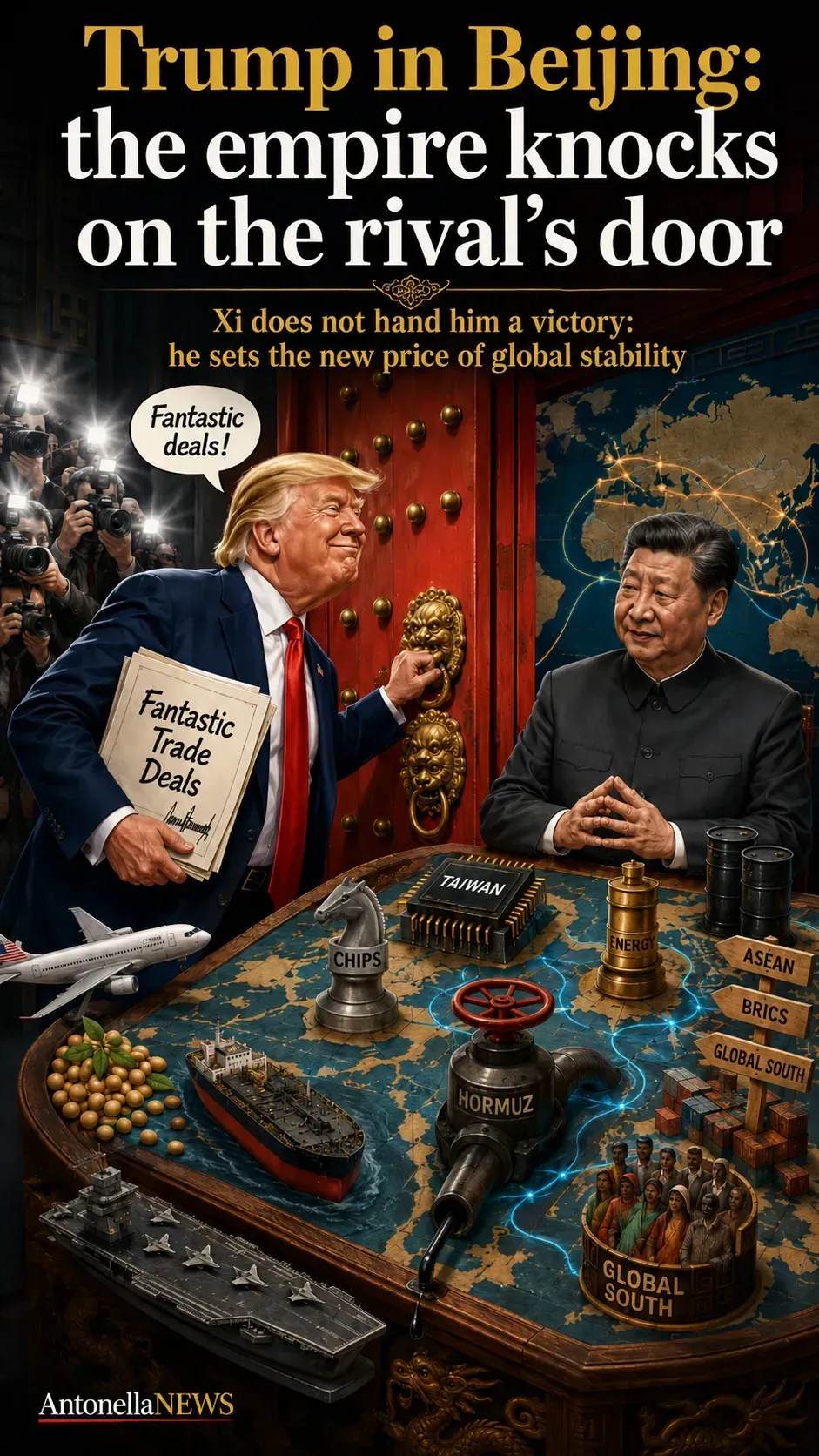
Xi does not hand him a victory. He sets the new price of global stability: Taiwan, Hormuz, chips, rare earths, energy, and the Global South
May 16,2026
onald Trump arrived in China looking for a photograph he could sell as success: “fantastic trade deals,” personal friendship with Xi Jinping, commercial agreements, Boeing, agriculture, energy, Iran. But behind the diplomatic choreography, the 14–15 May 2026 summit tells a very different story: the United States can no longer manage alone the crises it helps create.
Xi did not receive Trump as a winner. He received him as the head of a power that remains militarily dominant, but increasingly dependent on what it no longer fully controls: energy routes, Asian supply chains, Taiwanese semiconductors, Chinese rare earths, Iranian oil, agricultural markets, global logistics, and the diplomacy of the Global South.
The point is not whether Trump obtained a contract. The point is far more uncomfortable: if America is still the centre of the world order, why does its president have to go to Beijing to ask that the world keep functioning?
This was not ordinary diplomacy. It was a photograph of the new power map
Trump’s visit to China took place inside a systemic crisis: war with Iran, the partial closure of the Strait of Hormuz, pressure on energy markets, tension over Taiwan, technological warfare, rare earth diplomacy, the reorganisation of global trade, and the growing centrality of BRICS, ASEAN, Africa, and Latin America in China’s strategy.
Xi Jinping, in the official Chinese framing, placed the summit inside a historical question: can China and the United States overcome the so-called “Thucydides Trap” and build a new paradigm between great powers? Can they face global challenges together and provide stability to the world?
This is not ceremonial rhetoric. It is strategic language. Xi is not simply saying, “Let us avoid conflict.” He is telling Washington that the problem is not only China’s rise; the problem is America’s fear of losing the monopoly of global command.
Trump, instead, used his usual register. In the transcript of his 15 May remarks, he speaks of an “incredible visit,” “fantastic trade deals,” personal friendship with Xi, respect, reciprocity, and the promise of a future Chinese visit to the United States. It is diplomacy transformed into personal performance. But the structure of the summit says something deeper: Xi speaks of systems; Trump speaks of marketable success.
Trump wanted a scene. Xi imposed a framework.
Trump wanted contracts. Xi placed the architecture of the new order on the table.
Xi neutralises MAGA: American greatness can no longer mean containing China
One of the most sophisticated passages of the summit was Xi’s formula linking the “great rejuvenation of the Chinese nation” to Trump’s project of “Make America Great Again.” The message sounds conciliatory, but it is politically sharp: America can pursue its own greatness without trying to prevent China from becoming great.
This is an elegant rhetorical trap. Xi takes Trump’s identity slogan and absorbs it into a multipolar vision. In substance, he says: if Washington interprets every non-Western rise as a threat, then conflict does not originate in Beijing, but in America’s inability to accept a world that is no longer unipolar.
Here, the “Thucydides Trap” is not a cultured reference. It is a diplomatic blade. Xi reminds Trump that wars between great powers often do not begin with a single incident, but with the structural fear of the dominant power when confronted by an emerging power.
Hormuz: the energy valve forcing Trump to ask Beijing for help
The ghost of the summit is the Strait of Hormuz. It is not a geographical detail. It is a valve of the world economy.
According to the International Energy Agency, around 20 million barrels per day of crude oil and petroleum products normally pass through Hormuz, equal to roughly a quarter of global seaborne oil trade. The Strait is also decisive for gas: LNG from Qatar and the United Arab Emirates passing through Hormuz accounts for almost 20% of global LNG trade. Much of the oil moving through Hormuz goes to Asia, especially China, India, and Japan.
The picture becomes even more serious when the current crisis is considered. Energy flows through Hormuz reportedly collapsed from around 20 million barrels per day before the war to just over 2 million barrels per day by March 2026, while more than 110 billion cubic metres of LNG had passed through the Strait in 2025.
This means that Hormuz is not just oil. It is inflation, fertilisers, industry, transport, marine insurance, household bills, electoral consensus, and Asian and European stability.
That is why Trump went to Beijing. Not because China had suddenly become a “friend.” But because the energy crisis made China indispensable.
When Hormuz is blocked, Washington can threaten.
Beijing can negotiate.
And in the new world, negotiating access can be worth more than displaying an aircraft carrier.
The sentence that cracks the entire American narrative
In the 15 May transcript, Trump says the most important line:
“We want the straits open. We’re closing it now. They closed it, and we closed it on top of them.”
It sounds improvised, but politically it is devastating.
Trump says he wants the Strait open, yet admits that the United States is also closing it “on top” of Iran’s closure. Washington therefore no longer appears only as the guarantor of freedom of navigation. It becomes an active part of the compression of global maritime traffic.
This is the central contradiction: Trump asks China to help stabilise a crisis that the US-Israeli military and sanctions strategy helped aggravate.
This is no longer only “freedom of navigation.” It is a double chokehold: Iran on one side, the United States on the other, global trade caught in the middle.
China obtains passages where the United States produces escalation
The strongest data point is the one concerning Chinese vessels.
Iran reportedly began allowing some Chinese vessels to transit the Strait of Hormuz after an agreement on Iranian protocols for managing the waterway. A Chinese supertanker carrying 2 million barrels of Iraqi crude was able to pass after being stuck in the Gulf for more than two months.
This changes the meaning of the summit.
While Trump says, “we want the Strait open,” Beijing obtains selective access. Not through bombing. Not through an ultimatum. Not through a naval blockade. But through diplomatic relations, commercial weight, channels with Tehran, and the ability to speak with actors that Washington often treats almost exclusively as enemies.
The difference is brutal:
Washington militarises the problem.
Beijing negotiates the corridor.
This does not mean idealising China. It means recognising the material fact: in 2026, power is not only the ability to strike. It is also the ability to obtain passage, maintain supply, speak with those controlling the choke point, and transform a crisis into diplomatic leverage.
Iran as the mirror of the new asymmetry
Trump says: “We feel very similar in Iran.” He wants Xi to appear as co-signatory of the American line: Iran must not have nuclear weapons, the war must end, Hormuz must reopen.
But the convergence is partial. China is not joining the American strategy. It is defending its own interests: energy, trade, access to Iranian oil, stability of flows, reputation in the Global South, and its role as a mediating power.
According to US officials, China considers it essential that Hormuz remain open without tolls, restrictions, or military control. But Beijing maintains an autonomous position: it wants the sea lanes reopened, but it does not want to become the diplomatic arm of US pressure on Tehran.
The difference is decisive. Washington wants China to help close a crisis that the US-Israeli axis helped open. Beijing wants the crisis to end because it damages energy, trade, and global stability.
Those interests can intersect. They are not the same strategy.
Taiwan: the hidden geopolitical price behind Hormuz
If Hormuz is the energy choke point, Taiwan is the technological choke point.
Xi warned Trump that Taiwan is the most important issue in China-US relations and that mishandling it could lead to “clashes and even conflicts.” International coverage confirmed that Taiwan was a central red line at the summit, while Washington continued to insist that its official position had not changed.
But Taiwan is not only sovereignty, national identity, or territorial dispute. It is the vault of the digital economy.
According to the US Department of Commerce, Taiwan accounts for more than 60% of global semiconductor foundry revenue and more than 90% of global leading-edge chip production. In 2024, Taiwan’s semiconductor industry generated more than $165 billion, equal to around 20.7% of the island’s GDP.
This means Taiwan is to technology what Hormuz is to energy.
Hormuz determines the price of energy.
Taiwan determines the speed of artificial intelligence.
AI, cloud, data centres, drones, missiles, telecommunications, cars, military systems, algorithmic finance: all of them depend, in a decisive part, on Taiwan’s stability.
That is why Xi does not separate the dossiers. Iran, Hormuz, Taiwan, chips, and trade are not separate chapters. They are the same game: who controls the material nodes of the twenty-first century?
Arms to Taiwan: Trump suspended between the US security state and negotiation with Beijing
The Taiwan issue did not remain theoretical. Trump, before leaving China, said he had not yet decided whether to proceed with a major arms package for Taiwan. Xi warned Trump of the risk of “clashes and conflicts” if the package was not handled correctly.
This suspension reveals the American dilemma.
Trump cannot abandon Taiwan without appearing weak before Congress, Asian allies, the military-industrial complex, and the US security apparatus. But he also cannot push too hard on Taiwan while asking Xi for cooperation on Iran, Hormuz, energy, agriculture, Boeing, and supply chains.
Xi knows this. And he places Taiwan at the centre of the geopolitical price.
The implicit message is clear: if Washington wants stability on Hormuz, it cannot expect permanent escalation over Taiwan without paying a cost.
US-China trade: a smaller deficit does not mean less dependence
Trump needs to describe the summit as a commercial victory. But the numbers tell a more ambiguous story.
According to the Office of the United States Trade Representative, in 2025 US-China goods trade totalled $414.7 billion. The United States exported $106.3 billion to China and imported $308.4 billion, producing a US goods deficit of $202.1 billion. The deficit fell by 31.6% compared with 2024, but it remains enormous and structural.
This reduction does not mean Washington has freed itself from China. It means tariffs, trade diversion, and supply-chain reorganisation have shifted part of the flows towards Vietnam, Mexico, India, Thailand, Taiwan, and other hubs. But many of those flows remain connected to Chinese components, capital, logistics, or manufacturing.
The journalistic point is this: Trump can reduce the direct deficit with China, but he cannot erase China from global supply chains. He can change the route of goods. Not necessarily their deeper industrial origin.
China is no longer waiting for Washington: it has already shifted the centre of gravity
While Trump speaks of “reciprocal trade,” Beijing has already redrawn the map.
In the first two months of 2026, China’s foreign trade grew by 18.3% year on year, reaching 7.73 trillion yuan, approximately $1.12 trillion. Exports rose by 19.2%, imports by 17.1%, and exports of high-tech and high-value electromechanical products grew by 24.3%.
The most geopolitically important fact is the geographical composition. ASEAN remained China’s largest trading partner, with more than 1.24 trillion yuan in trade in the first two months of 2026, up 20.3%. Trade with the European Union grew by 19.9%. Trade with Latin America and Africa rose by 19.7% and 34.2%, respectively. Trade with the United States, by contrast, fell by 16.9%. China’s trade with Belt and Road countries reached 4.02 trillion yuan, up 20%.
This is the data point that dismantles the Western lens: China is not simply resisting the United States. It is reducing America’s centrality inside its own commercial architecture.
Washington looks at China as a bilateral rival.
Beijing moves as the central node of a global network.
China’s surplus: the geoeconomic bomb under the table
In 2025, China recorded a record trade surplus of $1.189 trillion. This is essential because it shows that Trump’s tariffs did not break China’s export capacity. They pushed it to scale new markets, strengthen alternative routes, and consolidate its position in advanced industrial sectors.
The surplus is not only an accounting number. It is geopolitical power.
It means reserves.
It means investment capacity.
It means commercial influence.
It means currency leverage.
It means room for manoeuvre in crises.
It means the ability to finance infrastructure, energy deals, logistics corridors, and market penetration across emerging economies.
When Xi receives Trump, he is not receiving him as the leader of a vulnerable economy begging for access to the United States. He receives him as the leader of a power that has already shown it can absorb part of the American tariff shock and shift weight towards Asia, the Global South, and alternative networks.
BRICS, ASEAN, BRI: China is not only selling goods, it is building infrastructural dependence
UNCTAD has found that intra-BRICS trade has grown more than 13-fold since 2003, reaching $1.17 trillion in intra-BRICS exports in 2024. China remains the central engine of these flows, together with Brazil, India, Indonesia, Russia, and the United Arab Emirates.
This must be read together with the Belt and Road Initiative. The first two months of 2026 show that China’s trade with BRI countries grew by 20%, reaching 4.02 trillion yuan.
Here we see the strategic leap. China is not merely exporting goods. It is building interdependence: ports, railways, energy, logistics, finance, telecommunications, industrial zones, land corridors, and maritime routes.
Trump thinks in terms of deals. Xi thinks in terms of networks.
And whoever controls networks does not need to win every battle. They need to become indispensable.
Boeing: the contract that makes headlines but does not change the structure
Trump announced that China would buy 200 Boeing jets, with a possible expansion up to 750. The announcement generated headlines, but details on models, delivery times, financing, and final structure remained unclear.
The market reaction was revealing. Boeing shares fell by more than 4% after the announcement, because investors had expected an order closer to 500 aircraft, not 200.
Boeing thus becomes the perfect symbol of the summit: large enough to produce headlines, too uncertain to change the balance of power.
Trump gets a narrative.
Xi keeps the leverage.
China can buy Boeing, buy Airbus, or accelerate COMAC. It can use aircraft orders as a diplomatic signal, a temporary reward, or a pressure tool. The United States, by contrast, needs those numbers to become domestic political capital.
Agriculture, soybeans, energy: domestic politics disguised as geopolitics
Another pillar of Trump’s narrative concerns agriculture and energy. The United States expects Chinese agricultural purchases worth “tens of billions” of dollars after the Trump-Xi summit.
This speaks directly to Trump’s electoral heartland: farmers, rural states, exporters, the energy industry, gas and oil lobbies.
But agriculture and energy are not enough to rebalance the structure. China can buy American soybeans, but it is diversifying suppliers. It can buy US LNG or crude, but it continues to look to Iran, Russia, the Middle East, Central Asia, and alternative routes. It can buy Boeing, but it does not abandon the development of its own industrial base.
This is the difference between a transaction and a strategy.
Trump wants to sell products.
Xi wants to preserve options.
US-China energy: interdependence, not American victory
The possibility of reviving American energy exports to China must be read within a more complex dynamic.
After years of tariffs and tensions, a Trump-Xi deal could reopen space for US energy exports to Beijing. But politically the meaning is not simple. Trump can present energy exports as an American victory. China reads them as diversification.
Beijing buys if it is convenient.
It signs if it is useful.
It delays if delay creates pressure.
It shifts volumes if the strategic context changes.
For Washington, exporting energy to China helps reduce the deficit, support industry, and produce political consensus. For Beijing, buying energy from the United States is only one of many options.
And whoever has more options has more negotiating power.
Rare earths: the drip-feed economic war
While Trump speaks of great deals, Beijing preserves a silent lever: rare earths.
Chinese rare-earth exports to the United States may have improved, but Beijing still sometimes slows approvals. The licensing system remains irregular, and the United States must intervene diplomatically when companies encounter delays.
This is a much more powerful lever than the general public realises. Rare earths such as yttrium, dysprosium, and terbium are essential for semiconductors, aerospace, defence, magnets, advanced electronics, electric motors, electric vehicles, and industrial systems.
China does not need to block everything. It only needs to slow the flow.
Enough supply to avoid looking like a total aggressor.
Enough scarcity to remind Washington, Berlin, Tokyo, and Seoul who controls the tap.
This is the drip-feed economic war. It does not have the theatricality of an aircraft carrier, but it can stop a factory, slow an assembly line, inflate prices, and put entire industrial sectors under pressure.
Chips and AI: the loud silence of the summit
Semiconductors are the great absent-present of the summit. Everyone knows they are central. No one truly resolves them.
The United States wants to restrict China’s access to the most advanced chips, because advanced chips mean AI, supercomputing, surveillance, military systems, drones, missiles, cyberwarfare, data centres, and industrial advantage. China wants to overcome this dependence by accelerating technological self-sufficiency.
Taiwan remains the key. And as long as Taiwan produces more than 90% of the world’s leading-edge chips, every crisis in the Taiwan Strait is not merely a regional crisis: it is a potential earthquake for the global digital economy.
That is why the summit does not close the technological war. It suspends it rhetorically, while the apparatuses continue preparing for the next phase.
Markets did not fully buy the narrative
If the summit had truly been perceived as a stable breakthrough, markets would have reacted with enthusiasm. Instead, the reaction was cautious.
Asian stocks remained weak as the summit closed: Hong Kong fell, Shanghai and Shenzhen slipped, the Nikkei declined, and the Kospi was hit by weakness in chip stocks. The reason is clear: many positive statements, few concrete details, and an Iran-Hormuz crisis still capable of pushing oil, inflation, and industrial fears higher.
Markets, unlike propaganda, demand verifiable contracts, timelines, volumes, execution, logistics, margins, and political risk.
Trump sells optimism. Investors measure uncertainty.
The Gulf is changing strategy: if Hormuz is vulnerable, bypasses must be built
The crisis has already produced geopolitical effects in the Gulf.
The United Arab Emirates wants to accelerate a pipeline project to bypass Hormuz and double export capacity through Fujairah by 2027. The existing Habshan-Fujairah pipeline carries around 1.8 million barrels per day, but the crisis has exposed the vulnerability of Gulf producers when Hormuz becomes politically fragile.
This matters because the crisis is not limited to the US-Iran-China confrontation. It is already reshaping infrastructure, investment, energy priorities, and the strategic autonomy of Gulf states.
When a route becomes a weapon, those who can build alternatives do so.
When no alternative exists, whoever controls the route controls the pressure.
International law: the silent guest at the table
Then there is the legal question. It should not turn the article into a legal dossier, but it must remain central to the analysis.
The United Nations Charter limits the use of force. Article 51 recognises the right of individual or collective self-defence only in the event of an armed attack, until the Security Council takes the necessary measures.
If Trump admits that the United States is “closing” on top of Iran’s closure, then the American narrative of simple “freedom of navigation” becomes insufficient. The public question becomes different: with what legitimacy does Washington present itself as guarantor of international order if it helps generate or aggravate the crisis it then asks China to stabilise?
This does not mean absolving Iran. It means refusing propagandistic simplification.
Iran uses Hormuz as leverage.
The United States uses sanctions, blockades, and military pressure as leverage.
China uses access, energy, and diplomacy as leverage.
The difference is not between those who do geopolitics and those who do not. The difference lies in instruments, costs, and consequences.
The 24 September reciprocal visit: not friendship, but risk management
In the 15 May transcript, Trump says Xi should come to the United States around 24 September, and that the visit will be “reciprocal,” like reciprocal trade.
The phrase sounds light, almost theatrical. In reality, it reveals a serious point: the US-China relationship is no longer a chain of command. It is risk management.
Trump and Xi closed the summit claiming progress in stabilising relations, but profound differences remain open on Taiwan, Iran, and nuclear control.
So the future visit is not proof that tensions are over. It is proof that they have become too costly to be left without a control room.
The real result: not peace, but managed mutual dependence
In the end, the summit does not produce structural peace. It does not resolve Taiwan. It does not close the technological war. It does not eliminate the Iranian crisis. It does not fully reopen Hormuz. It does not produce a grand commercial agreement whose details are fully verifiable.
It produces something else: a temporary management of mutual dependence.
The United States needs China to stabilise routes, markets, supply chains, energy, and the Iranian crisis.
China needs the United States to avoid too rapid a fracture in global trade, maintain access to markets, and gain time in the technological race.
But the symmetry is only apparent.
The United States arrives with the urgency of crisis.
China arrives with the patience of infrastructure.
The United States arrives with aircraft carriers, sanctions, and tariffs.
China arrives with ASEAN, BRICS, BRI, rare earths, energy access, and manufacturing capacity.
The United States asks for Hormuz to be open.
China obtains selective passage.
The United States speaks of freedom of navigation.
China speaks with those controlling the gate.
Trump wanted a victory. Xi showed him the new price of the world
Trump went to China to sell a scene of strength. But the visit tells a story of dependence.
He wanted “fantastic trade deals,” but markets asked for details.
He wanted Boeing, but the initial order disappointed expectations.
He wanted cooperation on Iran, but China maintained autonomy.
He wanted Hormuz open, but admitted that the United States is also contributing to the closure.
He wanted a winner’s photograph, but Xi placed Taiwan, chips, energy, rare earths, and the Global South on the table.
The real trap is not Thucydides.
The real trap is imperial arrogance: the belief that one can produce instability and then ask others to repair it.
Power in 2026 is not only who bombs.
It is who can open or close a corridor.
Who controls semiconductors, ports, routes, rare earths, insurance, gas, oil, fertilisers, data centres, agricultural markets, and logistics infrastructure.
Who can speak with Tehran while Washington threatens.
Who can trade with ASEAN, Africa, Latin America, and BRICS while the West continues to look at the world as if it were still its backyard.
Trump knocked on Beijing’s door to display strength.
But the message that remains is different:
the empire still speaks like a master, but it is beginning to negotiate like someone who knows it can no longer command alone.
If this article helped you read the Trump-Xi summit beyond the propaganda of “fantastic trade deals,” share it.
Because this is not only a story about Trump and Xi. It is a story about the world changing before our eyes: wars becoming energy crises, maritime routes becoming political weapons, Taiwan becoming the vault of artificial intelligence, rare earths becoming silent leverage, and the Global South becoming a new field of power.
On AntonellaNEWS, we will continue to follow these dossiers with investigative method, cross-checked sources, and a multipolar lens.
Share, comment, subscribe, and support independent journalism.
Propaganda simplifies. Investigation connects the dots.
Sources
Chinese Ministry of Foreign Affairs — official statements on the Trump-Xi summit, Taiwan, strategic stability, and the reference to the “Thucydides Trap.”
Reuters — reporting on Trump’s remarks about Iran, Hormuz, Chinese companies buying Iranian oil, sanctions, Boeing, agriculture, energy, rare earths, and the limits of the announced trade deals.
International Energy Agency — data on the Strait of Hormuz, oil flows, LNG transit, energy disruption, and global market exposure.
USTR / BEA — 2025 data on US-China goods trade, exports, imports, and the US trade deficit with China.
Trade.gov / US Department of Commerce — data on Taiwan’s semiconductor industry, global foundry revenue, and leading-edge chip production.
UNCTAD — data on intra-BRICS trade and the shifting geoeconomic weight toward multipolar trade networks.
Associated Press / The Guardian — international coverage of the summit, Taiwan tensions, Iran, AI, and the broader political reading of the Trump-Xi meeting.
Reuters / Energy sector reporting — rare earth restrictions, Boeing orders, UAE plans to bypass Hormuz, and supply-chain vulnerabilities.
United Nations Charter — Article 51 and the legal framework on the use of force and self-defence.
Trump transcript, 15 May 2026 — NCB/NBC News transcript provided by the author and cross-checked against Reuters/AP coverage on the main claims.