Venezuela, Narcotrafficking, and Regime Change
Venezuela, Narcotrafficking, and Regime Change The Official U.S. Narrative (2020–2026): from “dictatorship” to “criminal state”

Jan 09,2026
The Official U.S. Narrative (2020–2026): from “dictatorship” to “criminal state”
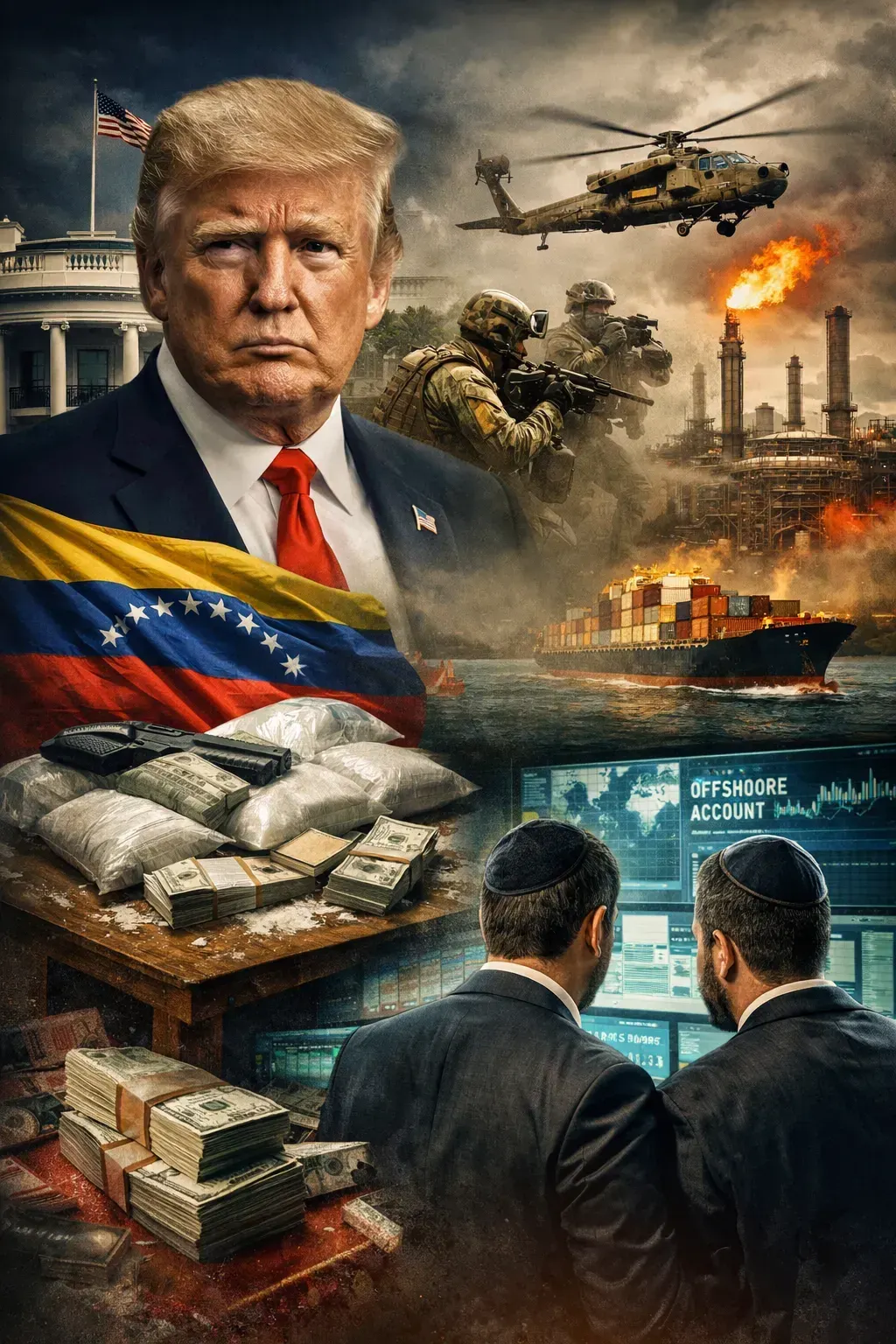
Since 2020—and with escalation through 2026—the United States has increasingly framed Venezuela as a narco-state, rather than merely an authoritarian regime. This shift is operationally significant because it alters the type of engagement deemed legitimate.
A dictatorship remains, in principle, a political interlocutor.
A “criminal state” is reclassified as a security and law-enforcement problem.
The narrative structure is consistent and replicable:
- Nicolás Maduro is indicted on narcotrafficking-related charges (U.S. indictment, 2020).
- On that basis, he is treated less as a negotiable political actor and more as a prosecutable criminal subject.
- This reframing expands the policy space for measures that would otherwise be contested under standard diplomatic practice.
It supports:
- extraterritorial sanctions administered by Office of Foreign Assets Control (OFAC);
- asset freezes and seizures;
- sustained financial and economic pressure presented as risk containment rather than geopolitical coercion.
Analytical observation: the prominence attributed to Venezuela within this narrative does not correspond to Venezuela’s position in the empirical data on global cocaine production.
Opposition leadership and the legitimacy gap: regime change without infrastructure
Regime change is frequently framed as a substitution of leadership. Historical and comparative evidence suggests that successful political transitions depend instead on institutional infrastructure.
Minimum operational requirements include:
- territorial control (even if partial);
- administrative continuity;
- domestic legitimacy and social anchoring;
- security and chain-of-command continuity.
The case of María Corina Machado illustrates a recurrent limitation: international recognition and external support can coexist with the absence of:
- effective territorial governance;
- a functioning administrative apparatus;
- broad internal consensus.
Historical pattern: where internal replacement structures are weak, regime-change efforts more often produce institutional vacuum, fragmentation, or re-centralised coercive control than democratic transition.
Global cocaine production: what UNODC data indicate
According to the United Nations Office on Drugs and Crime (UNODC), global cocaine production remains structurally concentrated in three countries:
- Colombia
- Peru
- Bolivia
Across multiple reporting cycles, over 90% of global production is associated with this triad.
Within UNODC reporting, Venezuela:
- does not appear as a major cultivation zone;
- is not identified as a primary processing hub;
- does not determine production geography.
It appears primarily as a transit environment, with intensity fluctuating in response to enforcement pressure elsewhere.
Inference supported by data: the primary economic value of cocaine does not originate in Venezuela.
Transit versus control: where value concentrates in the chain
UNODC analytical models and European investigative frameworks (including those used by Europol) consistently locate value concentration in three stages:
- access to final markets;
- intercontinental logistics;
- financial laundering and capital absorption.
Production contributes materially but represents a minority share of retail value—commonly estimated at 10–15%.
Implication: enforcement focused on transit environments does not materially affect demand, financial absorption, or long-term capital flows. Routes adapt rather than collapse.
This constitutes a structural inconsistency in the prevailing narrative: if Venezuela functions primarily as a corridor, its depiction as the system’s centre lacks empirical alignment.
Why Venezuela became “traversable” after 2015: measurable conditions
From 2015 onward, Venezuela’s utility as a transit environment increased due to the convergence of identifiable shocks.
Economic indicators
- real GDP contraction of approximately −75% (2013–2021);
- hyperinflation peaking in 2018 (frequently cited above 1,000,000%);
- collapse of legal imports.
Financial indicators
- restricted access to international banking;
- blocked multilateral credit;
- freezing of state assets abroad.
Institutional indicators
- reduced territorial control capacity;
- endemic corruption;
- hyper-centralised security structures.
Assessment: these conditions do not demonstrate the existence of a coherent “narco-state” governance model. They describe a permeable state—vulnerable to instrumental exploitation by external criminal networks.
External pressure and the siege frame as a governing mechanism
Venezuela’s crisis is preceded and accompanied by events that consolidate an internal perception of external siege:
- the 2002 coup attempt;
- progressive rupture with Washington;
- growing diplomatic isolation.
Over time, this perception is institutionalised:
- repression is framed as defence;
- elite cohesion is reinforced;
- opposition actors are portrayed as externally aligned.
This is not merely rhetorical. It functions as a mechanism of governance, converting external pressure into internal stabilisation.
Sanctions (OFAC): redesigning flows rather than stopping them
Sanctions intensify from 2015 onwards.
Documented economic effects
- oil production decline from ~2.5 million bpd (2013) to below ~700,000 (2020);
- loss of hard-currency revenues;
- contraction of public services.
Documented political effects
- strengthened security apparatus;
- executive power concentration;
- reduced political competition.
Systemic effect: sanctions do not eliminate capital. They displace it.
Where formal channels close, capital migrates to:
- informal intermediaries;
- transnational brokers;
- grey jurisdictions;
- alternative settlement mechanisms.
This increases opacity and amplifies the structural power of financial intermediaries.
A historical pattern: Operation Condor as functional precedent
Operation Condor is reconstructable through declassified archives held by the Central Intelligence Agency and the National Security Archive.
Associated outcomes are historically documented:
- military dictatorships;
- systematic repression;
- mass human-rights violations.
The analytical relevance lies in the pattern: external interference can consolidate authoritarian stability when “security” is prioritised over democratic legality. The terminology has shifted—from anti-communism to narco-terrorism—but the underlying logic persists.
Venezuela today: internal responsibility and external conditions
Maduro remains directly responsible for repression, institutional dismantling, and human-rights violations.
However, the authoritarian trajectory is not adequately explained by:
- narcotrafficking as a primary cause;
- a single external actor;
- drug production (which is not Venezuelan).
It develops within a context of economic collapse, financial isolation, geopolitical pressure, and a permanent siege narrative. In this context, narcotrafficking functions primarily as opportunistic adaptation.
The false equation of the “war on drugs”
Venezuela:
- does not control global markets;
- does not set prices;
- does not govern global laundering.
It is an expendable and replaceable node. Targeting it:
- does not reduce global supply;
- does not affect financial absorption;
- does not disrupt final markets.
Conclusion: a war on drugs focused on Venezuela can reallocate corridors, but it cannot dismantle the system.
Europe: market stability, logistics, and capital absorption
If Venezuela is a corridor, demand is the engine.
European drug markets exhibit stable demand and shock-absorption capacity. As Europol assessments repeatedly note, increased seizures do not automatically translate into reduced availability.
High-volume ports—Rotterdam, Antwerp-Bruges, and key Mediterranean hubs—illustrate the scale. With physical inspection rates typically discussed at ~0.5–1%, trafficking exploits logistical complexity rather than controlling infrastructure.
European organised crime groups, particularly the ’ndrangheta, function as economic guarantors by:
- advancing capital;
- guaranteeing purchase;
- controlling post-landing distribution.
This is an economic, not moral, description.
The United States: the financial absorption function
The U.S. role is structurally distinct. It is not only a market but a high-capacity environment for capital absorption.
Convergent public estimates place the U.S. cocaine market above $100bn annually. The strategic issue lies in the mass of liquidity requiring laundering and stabilisation.
Enforcement assessments frequently note interception rates below 2–3%. Key channels include:
- real estate;
- LLCs and shell companies;
- trusts;
- digital finance layers.
Inference: targeting routes without addressing absorption systems affects transport, not the business model.
Sanctions and broker demand
Sanctions generate demand for brokers capable of navigating opacity. As formal channels close:
- intermediaries proliferate;
- traceability declines;
- hybrid criminal-financial ecosystems strengthen.
This dynamic explains why sanctions may inadvertently entrench, rather than disrupt, illicit financial structures.
Dual-use crime within the U.S. system
High-impact criminality in the United States often operates within regulated sectors:
- pharmaceutical distribution (opioids);
- selectively legalised cannabis markets;
- systemic healthcare and insurance fraud.
These are framed as regulatory failures rather than security threats. The contrast highlights a structural double standard: external corridors are securitised; internal absorption systems are normalised.
Brokers, dual-use systems, and the recurrent reference to Israel
This analysis does not assert Israeli state orchestration of Venezuelan narcotrafficking. What is observable in public records is a recurrence of Israeli actors, technologies, and environments in broker-relevant segments: security, surveillance, financial intermediation.
The broker is the function; dual-use infrastructure is the mechanism.
This explains why Israel appears in investigative flows and political accusations without constituting evidence of central control.
Hezbollah in Venezuela: claims, evidence, amplification
Independent analyses by the RAND Corporation and the Wilson Center converge on the following:
Documented:
- fundraising networks in Latin America;
- non-violent criminal activities (smuggling, fraud).
Not documented:
- control of cocaine routes;
- large-scale physical trafficking;
- operational bases in Venezuela.
Venezuela appears as a permissive environment, not a command centre. The Venezuela–Hezbollah link is politically amplified because it aligns with a pre-existing security frame.
If the logic were applied consistently
If “narco-state” designation followed financial centrality, laundering capacity, and demand stability, attention would shift toward core economies and their internal systems.
That does not occur because it would require confronting domestic interests, destabilising legal markets, and exposing structural financial vulnerabilities.
It is politically easier to criminalise corridors than to interrogate centres of value.
Reader responsibility
If the war on drugs follows convenience rather than data, the critical question is not what corridors do, but why centres remain unnamed.
That decision ultimately rests with the reader.
Sources
1. Global trafficking & Venezuela’s role
- UNODC – World Drug Report (2019–2024)
- DEA – National Drug Threat Assessment (2020–2025)
- Europol – SOCTA (2021, 2024)
- CRS – Reports on Venezuela & narcotrafficking
2. European mafias & cocaine routes
- DIA (Italy) – Annual reports (2018–2024)
- Europol – Drugs Market Analysis: Cocaine
- Transcrime (Università Cattolica) – studies
- EU Parliament/Commission – ’ndrangheta & transnational crime
3. U.S.: market, laundering, dual-use crime
- U.S. Treasury – National Money Laundering Risk Assessment
- FinCEN – illicit finance reporting
- FBI – Organized Crime Strategy + sectoral dossiers
- Academic journals on crime economics and legal-sector capture
4. Brokers & non-territorial criminal structures
- Europol – intermediation structures
- UNODC – Global Study on Transnational Organized Crime
- RAND – hybrid networks
- Journal of International Affairs – diaspora crime & finance
5. Hezbollah networks in Latin America
- RAND – Hezbollah’s networks in Latin America (2025)
- Wilson Center – Tri-Border analyses
- U.S. congressional hearings
- WINEP – grey-zone actors
- UN/OHCHR – reports not confirming operational cells in Venezuela
6. Foreign influence claims: data vs propaganda
- Reuters; Brookings; IISS; SIPRI; UNCTAD
7. Sanctions, OFAC & flow displacement
- OFAC – Venezuela Sanctions Program
- World Bank; UNCTAD – investment/FDI data
- FATF – laundering and sanctions dynamics
8. Operation Condor precedent
- CIA Reading Room; National Security Archive; U.S. National Archives
- HRW; Amnesty historical reporting; Journal of Latin American Studies
9. Human rights in Venezuela
- Amnesty; HRW; UN Fact-Finding Mission
10. Costs for U.S. taxpayers
- CBO; DoD cost reporting; Brown University Watson – Costs of War
- CRS – anti-drug policy outcomes
11. International law: non-interference
- UNGA resolution on non-interference (1974)
- UN HRC resolutions
- International Crisis Group